What “Managing and Tracking Multiple Accounts” Actually Means in 2026
Back when this guide first went up, “managing multiple accounts” mostly meant switching between two Instagram logins without getting logged out. That problem hasn’t gone away, but it’s a much smaller slice of the picture now. Freelancers juggle five client Gmail accounts. Agencies run twenty Facebook ad accounts from one seat. Sellers operate a dozen Amazon or eBay storefronts. Social media managers post across thirty client profiles a week. And every one of those people has the same two questions: how do I keep these accounts from bleeding into each other, and how do I actually keep track of which login belongs to which client, project, or brand?
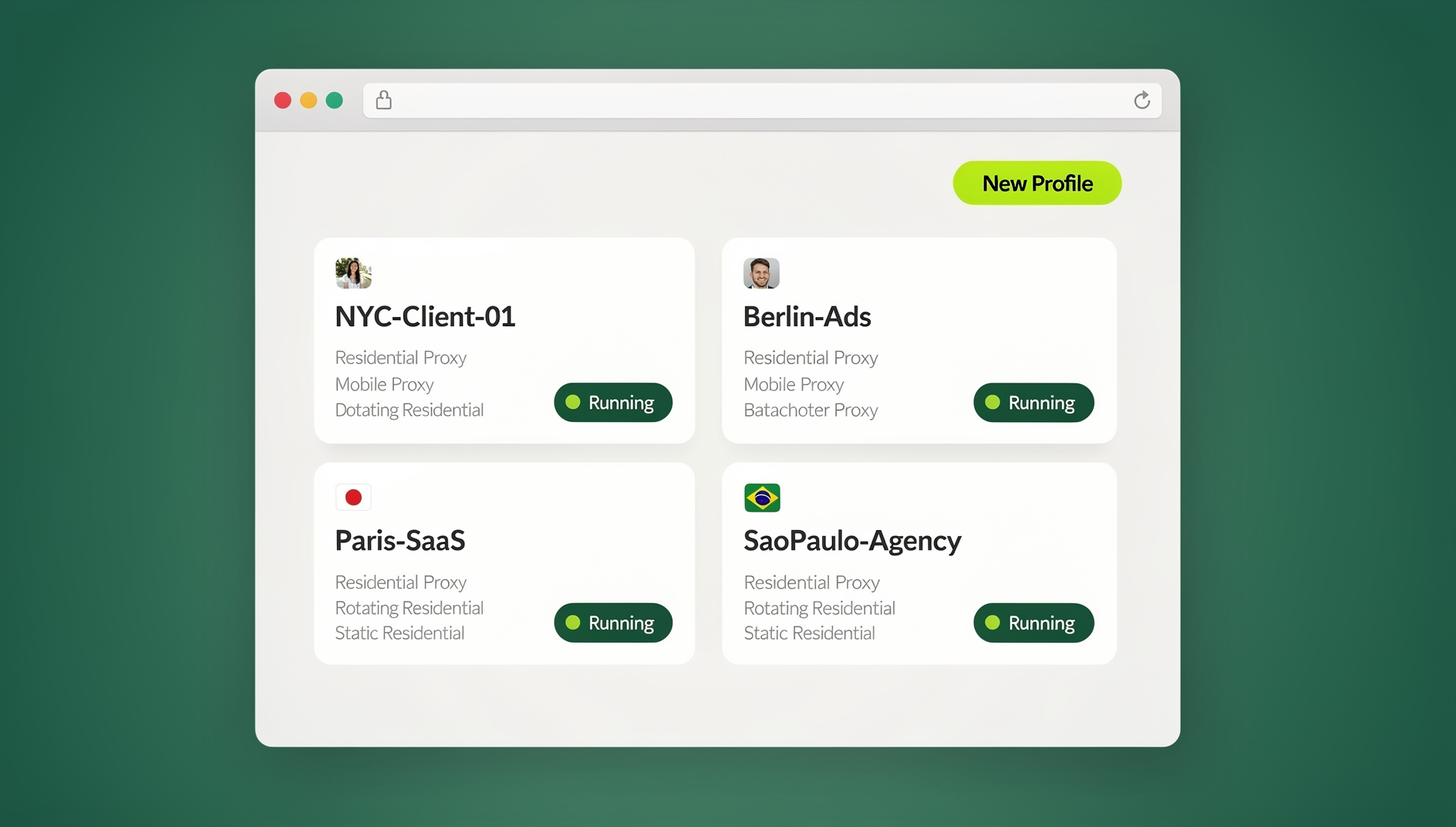
Those are two different problems that get lumped together as one. Managing multiple accounts is about isolation — making sure Account A’s cookies, cache, and browser fingerprint never touch Account B’s, so platforms don’t flag you for suspicious multi-accounting. Tracking is about organization — naming, labeling, grouping, and finding the right login in seconds instead of digging through a spreadsheet or a password manager with 40 identical-looking entries. A proper system solves both at once, and that’s what this guide walks through in full, including the tools that have replaced the old “just keep everything logged in and hope for the best” approach.
Why Native Browser Multi-Accounting Falls Apart at Scale
Most people start with what’s already free: Chrome’s built-in profile switcher, or the platform’s own “switch account” button. Both work fine for two accounts. Neither survives contact with five or more.
The Cookie and Cache Contamination Problem
Standard browser profiles still share a surprising amount under the hood — extensions, some cached resources, and occasionally sync data if you’re not careful with your Google account settings. Incognito windows are cleaner but wipe everything on close, meaning you re-authenticate every single session. Neither option gives you a persistent, fully separated environment per account.
The Fingerprint Trap
Platforms like Meta, Amazon, and TikTok don’t just look at your login credentials — they look at your browser fingerprint (canvas rendering, WebGL output, fonts, screen resolution, timezone, and dozens of smaller signals) plus your IP address. If five “different” accounts all share the same fingerprint and the same home IP, that’s a pattern automated fraud systems are specifically built to catch. This is exactly why simple incognito tabs or separate Chrome profiles aren’t a real fix — the underlying machine still looks identical to the platform.
The Manual Login Treadmill
Even if isolation weren’t an issue, the sheer time cost of typing in credentials, solving 2FA prompts, and re-entering saved payment details for account after account adds up to real hours lost every week. Multiply that by a team of five people each juggling ten accounts and you’re looking at a genuine productivity leak, not just an annoyance.
The Modern Solution: Isolated Browser Profiles
The fix that’s replaced “just use incognito” is the browser profile — a fully separated environment with its own cookies, cache, local storage, and (critically) its own browser fingerprint and IP address, bundled into one saved, nameable unit you can open with a click. This is the core idea behind tools built specifically for managing multiple accounts at scale, and it’s a meaningfully different architecture from “just another browser tab.”
Saved Sessions vs. Unsaved Sessions
Send.win still gives you both options, and knowing when to use each matters:
- Saved sessions store your login state, cookies, and fingerprint configuration permanently. Open the profile and you’re already logged in — no credentials to re-enter, ever. Use these for accounts you touch daily: your main client accounts, your primary ad accounts, your core social profiles.
- Unsaved (temporary) sessions spin up a clean, isolated environment that disappears when you close it — nothing is stored. Use these for one-off logins, testing a link a client sent you, or checking how a page renders without touching your saved profile data.
The distinction is small but it’s the difference between a system that scales to 50 accounts and one that collapses into chaos at account number eight.
How to Manage and Track Multiple Accounts With Send.win: Step-by-Step
Step 1: Pick Your Access Method — Desktop App or Cloud Browser Sessions
Send.win gives you two genuinely different ways to work: the native Sendwin Browser desktop app for Windows, macOS, and Linux, which runs each profile as its own dedicated, isolated browser window with local-first storage and encrypted cloud sync, and cloud browser sessions, which run the entire browsing session remotely with zero local install, metered by cloud browsing time the same way a proxy meters bandwidth. The desktop app is the better pick once you’re past a handful of accounts — it keeps every profile in its own process, makes it trivial to have ten windows open side by side on different monitors, and doesn’t compete with your everyday browsing tabs for memory or attention. Cloud browser sessions are the faster on-ramp if you need an isolated profile fast without installing anything, or you’re working from a machine you’d rather not put software on.
Step 2: Create and Properly Name Each Profile
This is where “tracking” actually happens. Don’t name profiles “Account 1,” “Account 2.” Use a convention you’ll still understand in six months: ClientName – Platform – Purpose (e.g., “Acme Co — Instagram — Main,” “Acme Co — Instagram — Backup”). Every profile in Send.win gets its own name, icon color, and notes field, so a glance at your dashboard tells you exactly what you’re opening before you click.
Step 3: Attach a Dedicated Proxy to Each Profile
A unique fingerprint means little if every profile still connects from the same IP address. Send.win includes built-in proxy support so each profile can route through its own residential, datacenter, or mobile IP — matched to a plausible location and timezone — without you sourcing and configuring proxies separately. This is the piece that most “just use Chrome profiles” advice completely skips, and it’s the single biggest factor in whether platforms treat your accounts as genuinely separate.
Step 4: Organize With Folders, Tags, and Groups
Once you’re past ten profiles, a flat list stops being useful. Group profiles by client, by platform, or by campaign, and use tags for cross-cutting labels like “active,” “needs proxy renewal,” or “review by Friday.” This is the tracking half of the equation solved properly — the same idea the original version of this post gestured at with “naming and grouping accounts,” just with real folder and tag infrastructure behind it instead of a flat, unsorted list.
Step 5: Share Access Without Sharing Passwords
If you run a team, this step matters more than any other. Instead of pasting credentials into Slack or a shared doc, Send.win lets you share a specific profile with a teammate directly — they get working access to the session, you keep the underlying password private, and you can revoke access instantly if someone leaves the project. It’s a cleaner, more auditable way to handle the exact problem a multi-login browser is supposed to solve for teams.
Step 6: Organize the Repetitive Parts With Profile Groups
Once you’re managing dozens of accounts, some tasks stop being worth doing by hand — daily engagement checks, scheduled posting, routine data pulls, or QA sweeps across every profile. Send.win’s isolated profiles, each with its own cookies, storage, sessions, fingerprint settings and proxy, keep each account separate, so you can organize these tasks by profile instead of building fragile custom workflows from scratch. This is a genuinely new capability compared to the manual, click-through-everything workflow of a few years ago, and it’s the feature that turns “managing multiple accounts” from a daily chore into something you set up once and let run.
Desktop App vs. Cloud Browser Sessions: Which One Fits Your Workflow
| Factor | Cloud Browser Sessions | Desktop App |
|---|---|---|
| Best for | Occasional use, quick sessions, no install | 10+ accounts, daily heavy use |
| Isolation | Isolated session run entirely in the cloud | Fully separate native window per profile |
| Multitasking | Limited by concurrent cloud session allowance | True side-by-side windows across monitors |
| Setup | No install — open a cloud session in any browser, sign in | Download native client (Windows/macOS/Linux), sign in |
| Resource use | Runs remotely, metered by cloud browsing time | Dedicated process per profile |
| Automation API access | Not applicable | Not available |
Best Practices for Tracking Multiple Accounts Without Getting Flagged
- One proxy per account, matched by geography. Never route two active profiles through the same IP if the accounts are meant to look independent.
- Keep behavior human-paced. Automation is a huge time-saver, but scripted actions that fire every account within the same second are exactly the pattern detection systems look for — stagger timing even when using automation tools.
- Name and tag consistently from day one. Retrofitting a naming convention onto 40 untitled profiles is far more painful than starting with one.
- Review dormant profiles regularly. Old sessions that haven’t been touched in months are the ones most likely to have expired proxies or stale fingerprints — check on a schedule, not just when something breaks.
- Don’t sync personal and work accounts into the same environment. Keep a clean separation between your own accounts and client or team accounts, even within the same tool.
- Log out of “shared” habits. If you used to keep five tabs logged into five accounts in one regular browser window, break that habit entirely — it’s the single most common way accounts get cross-contaminated by mistake.
Send.win Pricing for Multi-Account Management (2026)
Send.win has no free trial, but the first card purchase is covered by a 7-day money-back guarantee, and you can preview the cloud browser free at https://send.win/demo-browser/ before committing to anything.
| Plan | Price | Profiles | Best For |
|---|---|---|---|
| Pro | $19/mo ($6.99/mo billed annually — 63% off) | 150 profiles, 5GB proxy bandwidth | Freelancers, solo sellers, individual social media managers |
| Team | $49/mo ($251.88/yr) | 500 profiles, 20GB bandwidth, 16 seats | Agencies, e-commerce teams, anyone needing shared access |
Additional bandwidth is billed at $6/GB and extra profiles at $0.05 each if you outgrow your plan’s included allowance. The Team plan is the one to pick if multi-seat sharing from Step 5 above is part of your workflow — it’s not available on Pro.
Common Multi-Account Management Mistakes to Avoid
Even with the right tool, a few habits undermine the whole system. The most common one is treating profile creation as a one-time setup task rather than an ongoing discipline — profiles get created in a rush, left unnamed, and six months later nobody remembers which login belongs to which client. The second is skipping proxies “just this once” because a login is urgent, which is exactly the kind of shortcut that produces the fingerprint-plus-IP overlap platforms are built to catch. The third is assuming a browser for multiple accounts is a “set and forget” purchase — proxies expire, team members change, and profiles need periodic review the same way any piece of business infrastructure does. Building five minutes of weekly review into your routine solves most of this before it becomes a real problem, and it pairs well with picking the best browser for multiple accounts for your specific use case rather than defaulting to whatever’s free.
It’s also worth understanding what’s actually happening under the hood when a profile stays isolated session to session — the mechanics of session isolation explain why a properly separated profile survives scrutiny that a simple incognito tab won’t.
🏆 Send.win Verdict
Managing and tracking multiple accounts stopped being a “just use incognito” problem years ago. Send.win handles both halves properly: isolated profiles with dedicated fingerprints and proxies solve the management side, while named, tagged, and grouped profiles solve the tracking side — and the native desktop app means the system scales from 5 accounts to 500 without changing tools. Whether you’re a solo freelancer with a handful of client logins or an agency running dozens of ad accounts, this is the setup that replaces spreadsheets, sticky notes, and shared passwords with one organized dashboard.
Get started with Send.win — get your first profiles organized in minutes, with a 7-day money-back guarantee on your first card purchase.
Frequently Asked Questions
What’s the difference between managing and tracking multiple accounts?
Managing refers to keeping accounts technically isolated from each other — separate cookies, cache, and browser fingerprint — so platforms don’t detect suspicious multi-accounting patterns. Tracking refers to the organizational side: naming, labeling, and grouping accounts so you can find and identify the right login quickly. A complete solution needs both; isolation without organization just leaves you with dozens of unlabeled profiles.
Is it safe to log into multiple accounts on the same platform from one device?
It’s safe when each account runs in a genuinely isolated environment with its own browser fingerprint and, ideally, its own IP address via a proxy. It becomes risky when accounts share a fingerprint and IP, since that overlap is precisely what automated fraud and duplicate-account detection systems are designed to flag.
Do I need the Send.win desktop app, or are cloud browser sessions enough?
Cloud browser sessions are enough if you’re switching between a small number of accounts and don’t want to install anything — they run entirely in the cloud with no local footprint, though usage is metered by cloud browsing time. Once you’re regularly running ten or more profiles, or want to have several windows open side by side across monitors, the native Sendwin Browser desktop app for Windows, macOS, or Linux is the better fit — each profile runs as its own dedicated, local-first process rather than a metered cloud session.
Does Send.win offer an automation interface?
Send.win has no automation interface: no API, SDK, headless mode or Selenium/Puppeteer/Playwright support on any plan. Teams that need to script repetitive tasks — scheduled checks, routine data pulls, bulk actions — across many accounts will need to do it by hand or use another tool. Solo users managing a handful of accounts typically don’t need it; agencies and teams running dozens of profiles usually do.
How many accounts can I realistically manage with Send.win?
The Pro plan includes 150 profiles, and the Team plan includes 500, with additional profiles available at $0.05 each beyond your plan’s allowance. In practice, the limiting factor for most users isn’t the profile cap — it’s proxy bandwidth and organizational discipline (naming, tagging, and reviewing profiles regularly).
Can I share an account with a teammate without giving them the password?
Yes. Send.win lets you share a specific profile directly with a teammate so they get working access to the logged-in session without ever seeing the underlying password. Access can be revoked instantly if a teammate leaves the project, which is far more auditable than pasting credentials into a shared document.
Does Send.win require installing software, or does it work entirely in the cloud?
Send.win offers both: the native Sendwin Browser desktop app for Windows, macOS, and Linux for full local functionality, and cloud browser sessions that run entirely in the cloud with zero local install, metered by cloud browsing time. Getting the complete feature set — dedicated isolated windows and deeper proxy control — does involve installing the desktop client, but if you just need an isolated session fast, cloud browsing requires no download at all.
What happens to my saved sessions if I stop paying for Send.win?
Saved session data is tied to your account, so downgrading or pausing a subscription affects your active profile count and bandwidth allowance according to your plan, but the first card purchase is covered by a 7-day money-back guarantee, so you can test the full workflow before deciding on Pro or Team.
Is this different from just using Chrome’s built-in profiles?
Yes, in a meaningful way. Chrome’s native profile switcher separates some browsing data but doesn’t change your browser fingerprint or IP address — every profile still looks identical to detection systems on those two fronts. Purpose-built multi-login tools generate distinct fingerprints per profile and pair each one with its own proxy, which is the part native browser profiles were never designed to do.