How to Spoof Your Browser Timezone and Stay Undetected
A timezone spoofing browser masks your real local timezone so websites see a location-consistent time offset instead of your actual one. This matters because timezone is a fingerprinting signal—sites compare your reported UTC offset against your IP’s geolocation, and a mismatch instantly flags the session as suspicious. Below you’ll learn exactly how browsers leak timezone data, five methods to spoof it (with trade-offs for each), how to keep your spoofed timezone consistent with other fingerprint signals, and how to verify everything works before going live.
Why Timezone Matters for Browser Fingerprinting
Most people obsess over IP addresses and user agents when trying to stay anonymous online. Timezone is the sleeper signal they ignore—and the one that gets them caught.
Every browser exposes your system timezone through multiple JavaScript APIs. Tracking scripts harvest this passively, never asking permission. The timezone alone narrows your location to a vertical strip of the globe. Combined with your IP geolocation, language headers, and screen resolution, it becomes a powerful identifier. If you’re running accounts from New York but your browser reports Asia/Tokyo, the game is over before it starts.
Anti-fraud systems at major platforms—Google, Meta, Amazon, PayPal—cross-reference timezone against IP geolocation as a first-pass integrity check. A mismatch doesn’t just look suspicious; it triggers escalated fingerprinting, CAPTCHA walls, and sometimes instant account flags. Understanding how timezone detection works is the first step to spoofing it correctly.
How Websites Detect Your Browser Timezone
Sites don’t rely on a single API call. They triangulate timezone data from multiple sources to catch inconsistencies. Here are the three primary detection vectors:
1. Intl.DateTimeFormat().resolvedOptions().timeZone
This is the most direct method. It returns the IANA timezone string (e.g., America/New_York, Europe/London) rather than just a numeric offset. It’s precise—it distinguishes between timezones that share the same UTC offset but have different daylight saving rules.
const tz = Intl.DateTimeFormat().resolvedOptions().timeZone;
console.log(tz); // "America/New_York"
Anti-fraud scripts love this because it gives them a canonical timezone name, not just a number. Spoofing the numeric offset but forgetting this API is a common mistake that triggers detection.
2. Date.getTimezoneOffset()
This returns the difference in minutes between UTC and local time. For America/New_York during EST, it returns 300 (UTC is 5 hours ahead). During EDT, it returns 240.
const offset = new Date().getTimezoneOffset();
console.log(offset); // 300 (EST) or 240 (EDT)
The catch: this value must be consistent with the IANA timezone above, including daylight saving transitions. A static offset that never changes across seasons is a dead giveaway. Sophisticated detection scripts test multiple date values across DST boundaries to verify consistency.
3. performance.timeOrigin and Date Artifacts
The performance.timeOrigin timestamp and Date.now() both return milliseconds since the Unix epoch in UTC. By comparing these with locally formatted date strings, scripts can infer your real timezone independently of the APIs above. Some fingerprinting libraries also check Date.toString(), which includes the timezone abbreviation (e.g., “Eastern Standard Time”).
This three-way cross-check means you can’t just override one API and call it done. Effective timezone spoofing must be comprehensive.
Five Methods to Spoof Browser Timezone
Each method has different trade-offs in terms of reliability, detection resistance, and ease of use. Here’s an honest breakdown:
Method 1: Browser Flags and Environment Variables
Chromium-based browsers respect the TZ environment variable on Linux/macOS. You can launch Chrome with a spoofed timezone:
TZ='Asia/Tokyo' google-chrome --user-data-dir=/tmp/tokyo-profileOn Windows, you’d change the system timezone—which affects everything, not just the browser.
Pros: Simple, no extensions needed, affects all JavaScript APIs consistently.
Cons: One timezone per browser instance. Changing system timezone on Windows is disruptive. Doesn’t help if you need multiple timezones simultaneously.
Method 2: Browser Extensions
Extensions like “Change Timezone” inject scripts to override Date and Intl objects. They work through content scripts that run before page JavaScript.
Pros: Easy to install and toggle.
Cons: Detectable. Content script injection leaves traces in the DOM. Advanced fingerprinters check for prototype tampering on Date objects. Extensions also can’t override performance.timeOrigin reliably. Many anti-bot systems flag browsers with known spoofing extensions installed.
Method 3: JavaScript Injection via Page Scripts
You can inject JavaScript that redefines timezone-related functions before any page script runs. This typically involves overriding Date.prototype.getTimezoneOffset, wrapping Intl.DateTimeFormat, and modifying Date.prototype.toString.
// Override getTimezoneOffset for JST (UTC+9)
Date.prototype.getTimezoneOffset = function() { return -540; };

// Override Intl.DateTimeFormat
const origDTF = Intl.DateTimeFormat;
Intl.DateTimeFormat = function(locale, options) {
  options = options || {};
  options.timeZone = 'Asia/Tokyo';
  return new origDTF(locale, options);
};
Pros: Fine-grained control, no extension footprint.
Cons: Prototype tampering is detectable via Function.prototype.toString checks. You must intercept execution before any tracking script runs, which is tricky in a live page environment. Mishandling DST edge cases creates inconsistencies.
Method 4: Chrome DevTools Protocol (CDP) Overrides
CDP lets you override the timezone at the browser engine level via Emulation.setTimezoneOverride. This is the method Puppeteer and Playwright use internally:
// Playwright example
const context = await browser.newContext({
  timezoneId: 'America/Los_Angeles'
});

// Puppeteer example
await page.emulateTimezone('America/Los_Angeles');
This is the cleanest programmatic method because it operates below the JavaScript layer—there’s no prototype tampering to detect. The override is consistent across all APIs including Intl.DateTimeFormat, getTimezoneOffset, and Date.toString.
Pros: Engine-level override, no JS tampering footprint, consistent across all APIs.
Cons: Requires automation framework. CDP connections themselves can be detected (the Runtime.enable domain and webdriver flag). Best used within anti-bot bypass frameworks that handle those signals too.
Method 5: Antidetect Browsers with Per-Profile Timezone
Dedicated antidetect browsers handle timezone spoofing as part of a complete fingerprint profile. You set the timezone per profile, and the browser ensures consistency with every other fingerprint parameter—IP geolocation, language, locale, date formatting—automatically.
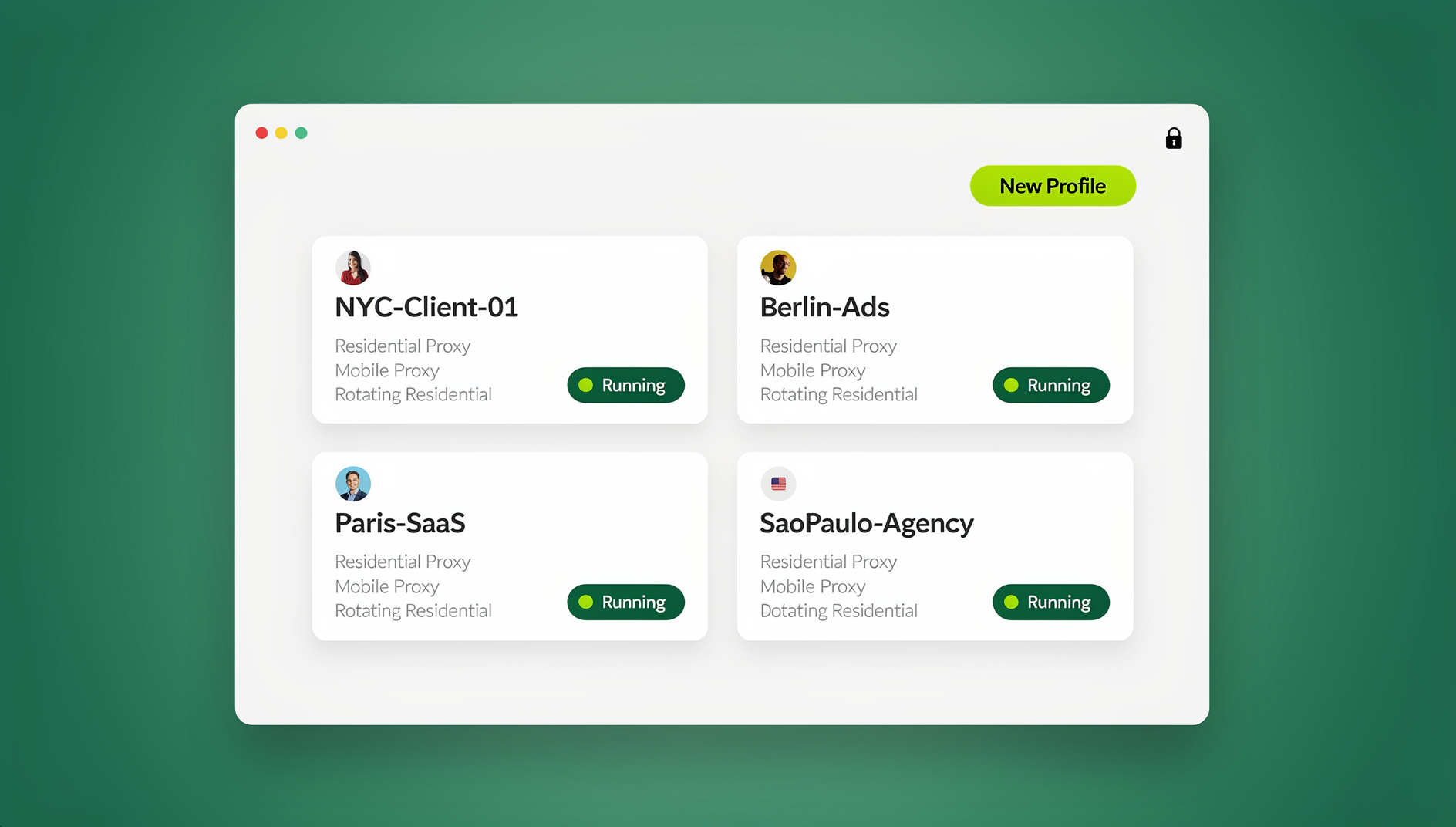
This is the only method that solves the consistency problem by design rather than by manual effort. When you create a profile in Send.win’s Sendwin Browser desktop app, you assign a timezone, proxy, language, and other parameters. The browser engine enforces all of them simultaneously, and you can run dozens of profiles with different timezones from a single machine.
Pros: Holistic fingerprint management, consistency handled automatically, scales to hundreds of profiles.
Cons: Requires a dedicated tool (not just a browser flag). But this is precisely why it works—half-measures invite detection.
The Consistency Challenge: Matching Timezone to IP Geolocation
Spoofing your timezone without matching your IP location is worse than not spoofing at all. Here’s why:
When a site sees your IP resolving to Frankfurt, Germany (UTC+1) but your browser reports America/Chicago (UTC-6), the mismatch is a high-confidence fraud signal. Anti-fraud systems weight timezone-IP consistency heavily because legitimate users almost never have mismatches.
To maintain consistency, you need to coordinate:
- Proxy IP location — use a residential proxy in the target region
- IANA timezone — match the proxy’s city/region (not just the UTC offset)
- Browser language and locale —
navigator.languageshould match the region - Date formatting — locale-specific date/number formats should align
- WebRTC local IP — if not disabled, should be in the same subnet range
This is where browser fingerprinting gets complex. Each signal must reinforce the others. One inconsistency in a dozen parameters and sophisticated detection systems flag the session. Browser profile managers like Send.win handle this by letting you configure all these parameters per profile and validating consistency before launch.
How to Test Your Timezone Spoofing
Never assume your spoofing works—verify it. Here are the key checks:
JavaScript Console Tests
Open DevTools and run these commands:
// Check IANA timezone
console.log(Intl.DateTimeFormat().resolvedOptions().timeZone);

// Check numeric offset
console.log(new Date().getTimezoneOffset());

// Check date string representation
console.log(new Date().toString());

// DST consistency check — compare winter and summer
console.log(new Date('2026-01-15').getTimezoneOffset());
console.log(new Date('2026-07-15').getTimezoneOffset());
All four outputs should be consistent with your target timezone, including correct DST transitions.
Online Fingerprint Testing Tools
Use tools like BrowserLeaks, CreepJS, or Pixelscan to see what tracking scripts actually detect. These tools run the same checks that anti-fraud systems use.
Pay special attention to:
- Whether the IANA timezone matches your proxy’s geolocation
- Whether DST offsets are correct for both summer and winter dates
- Whether
Date.toString()shows the expected timezone abbreviation - Whether
performance.timeOriginis consistent with local time calculations
Cross-Check with IP Geolocation
Visit an IP geolocation service and confirm your proxy IP maps to the same region as your spoofed timezone. The timezone database used by detection systems is MaxMind’s GeoIP2—match against that specifically, not just generic “country” lookups.
Send.win’s Per-Profile Timezone Approach
Send.win’s Sendwin Browser desktop app treats timezone as a first-class profile parameter. When you create or edit a browser profile, you select the target timezone from the full IANA database. The browser then enforces this timezone at the engine level—affecting Intl.DateTimeFormat, getTimezoneOffset, Date.toString, and all other time-related APIs consistently.
What makes this approach different from manual methods:
- Automatic IP-timezone matching — when you assign a proxy to a profile, Send.win can align the timezone to the proxy’s geolocation
- No JavaScript tampering — the override happens at the browser engine level, leaving no detectable prototype modifications
- Persistent per profile — each of your 150+ profiles (on Pro) can have a different timezone, all running simultaneously
- Consistent with other fingerprint parameters — language, locale, geolocation API, and WebRTC are all coordinated per profile
For teams managing accounts across multiple regions, session isolation ensures each profile’s timezone, cookies, and storage stay completely separate.
Cloud browser sessions are another option—you run profiles on Send.win’s cloud infrastructure without installing the desktop app, and timezone settings travel with the profile regardless of where it executes.
Common Timezone Spoofing Mistakes
Even experienced operators make these errors. Avoid them:
- Static offset without DST handling — hardcoding
getTimezoneOffsetto return-540year-round when Japan doesn’t observe DST is fine. But doing the same forAmerica/New_York(which switches between -300 and -240) is a red flag. - Spoofing timezone but not locale — your browser says
Asia/Tokyobutnavigator.languagereturnsen-USand dates format as MM/DD/YYYY. Inconsistent. - Forgetting
Date.toString()— many spoofing methods override the numeric APIs but leave the string representation showing your real timezone abbreviation. - Using VPN without timezone correction — VPNs change your IP but don’t touch browser timezone. This is the most common source of timezone-IP mismatches.
- Ignoring proxy browser isolation — running multiple accounts through the same browser instance with different proxies but the same timezone. Each account needs its own isolated profile with matching timezone.
🏆 Send.win Verdict
Timezone spoofing is essential for multi-account management, but it only works when every fingerprint signal is consistent. Send.win’s Sendwin Browser handles timezone at the engine level per profile—no JavaScript hacks, no extension footprints, no manual coordination. With 150 profiles on Pro ($19/mo, or $83.88/yr) and Team ($49/mo, or $251.88/yr), it’s the simplest way to run location-consistent browser sessions at scale.
Try Send.win today — paid plans start at $19/mo, with a 7-day money-back guarantee on your first card purchase.
Frequently Asked Questions
Can websites detect timezone spoofing?
Yes, if the spoofing is inconsistent. Sites cross-reference Intl.DateTimeFormat, getTimezoneOffset, Date.toString(), and IP geolocation. If any of these disagree, the spoofing is detected. Engine-level overrides (like CDP or antidetect browsers) are much harder to detect than JavaScript injection or extensions.
Does a VPN change my browser timezone?
No. A VPN changes your IP address but has zero effect on browser timezone APIs. Your browser still reports your operating system’s timezone. This is the most common reason VPN users get flagged—their IP says London but their browser says Los Angeles.
What’s the difference between UTC offset and IANA timezone?
A UTC offset (like +05:30) only tells you the current time difference from UTC. An IANA timezone (like Asia/Kolkata) includes historical and daylight saving rules. Two timezones can share the same offset right now but differ during DST transitions. Detection scripts check the IANA string, not just the offset.
How do I match timezone to my proxy location?
Look up your proxy IP’s geolocation using MaxMind’s GeoIP2 database (the industry standard). Find the IANA timezone for that city/region and set your browser to match. Browser profile managers like Send.win let you configure each profile’s timezone alongside its proxy, so the two can be kept consistent.
Is timezone spoofing legal?
Timezone spoofing itself is not illegal in most jurisdictions. However, using it to violate a platform’s Terms of Service (like running multiple accounts where prohibited) may result in account suspension. The legality depends on your use case and local laws—managing legitimate business accounts across regions is generally acceptable.
Can I spoof timezone in headless browser mode?
Yes. Both Puppeteer and Playwright support timezone emulation in headless mode via CDP. However, headless mode itself is detectable through other signals (missing plugins, WebGL anomalies). For production use, headful mode with an antidetect browser is more reliable for avoiding detection.
How many different timezones can I run simultaneously?
With system-level spoofing (TZ environment variable), you need one browser instance per timezone. With browser profile managers like Send.win, you can run as many different timezones as you have profiles—up to 150 on Pro or 500 on Team—all from a single machine.
Does timezone affect browser fingerprint uniqueness?
Timezone is one of roughly 50+ signals in a browser fingerprint. Alone, it narrows you to a geographic band. Combined with screen resolution, installed fonts, WebGL renderer, and canvas hash, it contributes to a highly unique fingerprint. Spoofing timezone without managing other fingerprint parameters provides minimal anonymity benefit.
How Send.win Helps With Browser Timezone Settings
Send.win is a browser profile manager built for exactly this kind of work — every profile is a clean, isolated identity:
- Isolated profiles – unique fingerprint, separate cookies and storage per profile
- Fingerprint settings – canvas, WebGL, fonts, and audio settings kept consistent per profile
- Desktop app + cloud sessions – native app for Windows, macOS, and Linux, or run profiles in the cloud with no install
- Built-in residential proxies – with automatic timezone, locale, and WebRTC matching
- Team features – share logged-in profiles with teammates without sharing passwords
Try the instant cloud browser demo — no install, no signup — or download the desktop app. There is no free trial; paid plans start at $19/month, and the first card purchase is covered by a 7-day money-back guarantee (see pricing).