Yes, you can manage multiple Google Ads accounts without triggering suspensions by routing each account through a dedicated, isolated browser session with distinct hardware fingerprints and unique residential proxies, rather than relying on standard browser profiles or sharing payment methods. While Google officially permits linking client accounts via a Manager Account (MCC), keeping accounts structurally separated at the device level is essential to prevent cascade bans if one account encounters a policy violation.
The Hidden Risks of Managing Multiple Ads Accounts
For search engine marketers, pay-per-click (PPC) specialists, and digital agencies, operating multiple Google Ads accounts is standard practice. Agencies must separate client funds, budgets, and campaigns, while e-commerce businesses frequently run isolated campaigns for diverse brands to ensure financial clarity. However, operating multiple advertising profiles carries massive risks. Google employs highly advanced anti-fraud and tracking mechanisms to detect coordinated account operations.
If Google detects a policy violation on a single account—such as a billing discrepancy, an inadvertent trademark violation, or a rejected landing page—it does not simply pause that specific campaign. Using sophisticated machine learning algorithms, Google correlates your physical machine fingerprint, IP address range, and payment patterns. This triggers a “cascade suspension,” disabling all associated Google Ads accounts under the guise of “circumventing systems” or “suspicious payment activity.” Understanding how to isolate these elements is critical to preserving your digital marketing operations.
Google Ads Manager Account (MCC): Purpose and Limitations
Google provides an official tool for multi-account management: the Google Ads Manager Account, historically known as My Client Center (MCC). While the MCC is an indispensable tool for agency-level reporting and consolidated billing, it is not a cure-all, and it introduces its own set of structural vulnerabilities.
The MCC acts as an umbrella. It links separate Google Ads accounts under a single master dashboard. This makes it easy for administrators to allocate budgets, review cross-campaign performance metrics, and grant team access. However, because all these sub-accounts are explicitly linked in Google’s database, an MCC creates a clear connection between them. If one sub-account is banned for a serious policy violation, the entire MCC dashboard, along with all other linked sub-accounts, faces heightened scrutiny and potential suspension. Furthermore, for businesses that require absolute privacy or want to keep their brands completely disconnected in Google’s eyes, the MCC is entirely unsuitable because it leaves an undeniable paper trail of ownership.
How Google Tracks and Links Advertising Accounts
To successfully run multiple ad accounts without triggering automatic links, you must understand the specific data points Google’s tracking scripts collect from your system. Google does not simply look at your login email; it analyzes a complex web of signals to build a digital fingerprint of your identity.
1. IP Addresses and Network Geolocation
Every time you log into Google Ads, Google records your IP address. If you access ten different ad accounts from the exact same residential or commercial IP address within a short time frame, Google flags these accounts as connected. If one account is suspended, the IP address itself is flagged, putting all other accounts operating on that same network at risk. Furthermore, accessing local regional ad accounts (e.g., in Germany) from an IP address located in a different country (e.g., the US) triggers automatic fraud checks.
2. Hardware and Browser Fingerprints
Modern web browsers share an immense amount of system data with web servers via JavaScript APIs. Google’s tracking libraries compile these data points to build a unique “browser fingerprint.” This fingerprint includes:
- Canvas and WebGL rendering outputs
- Audio context configurations
- Installed system fonts and emoji sets
- Screen resolution, color depth, and device pixel ratio
- CPU cores, hardware concurrency, and system memory limits
- HTTP header structures and User-Agent strings
Even if you clear your cookies, log out of your accounts, and use a separate Google Chrome profile, your browser fingerprint remains identical because the underlying hardware of your computer has not changed. Google recognizes that the same device is accessing multiple accounts, undoing any separation you hoped to achieve.
3. Billing Footprints and Credit Card Data
Payment methods are the strongest linking signal available to Google. Using the same credit card, banking account, or PayPal profile across different ad accounts instantly links them together. If credit card “A” is associated with a suspended account, any other account that attempts to use credit card “A”—or even a card with the same cardholder name and billing address—will be immediately suspended.
Standard Browser Profiles vs. Session Isolation
A common misconception among search marketers is that Google Chrome’s built-in “profiles” are sufficient to keep advertising accounts separate. While Chrome profiles do isolate cookies, local storage, and history, they do not mask or modify the hardware characteristics of your computer. The canvas fingerprint, WebGL signature, and screen parameters remain identical across all Chrome profiles on your machine.
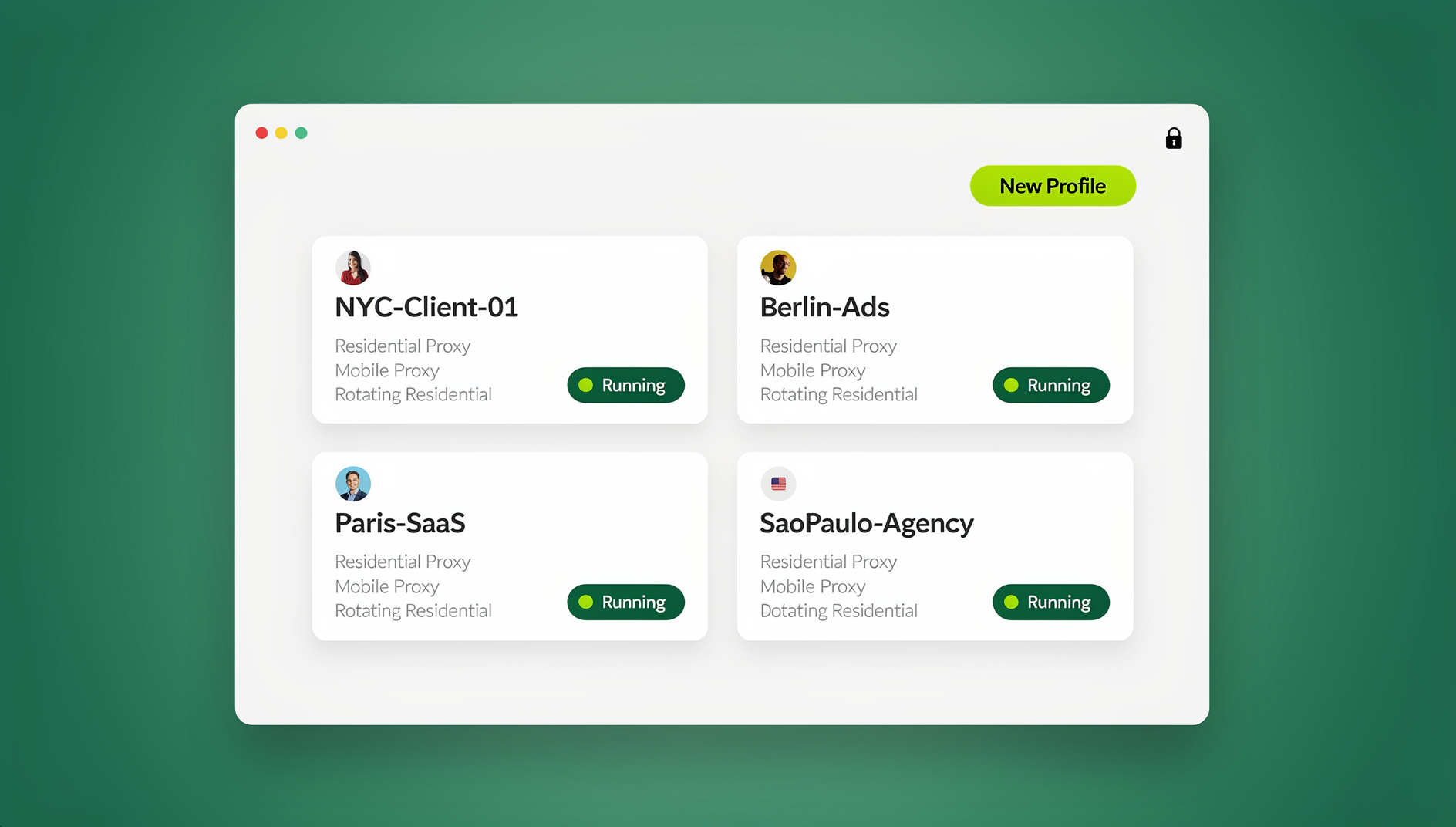
To achieve true separation, marketers must use specialized session isolation. Using a secure isolated environment allows you to manage multiple ad accounts safely by avoiding device fingerprint correlation. With advanced virtual browser profiles, you can easily run ads in parallel across completely separate profiles without data leakage. Selecting the correct browser for ads management is key to maintaining clean hardware fingerprints. A professional multi-login browser will guarantee that each profile maintains distinct IP addresses and tracking cookies.
The native Sendwin Browser desktop client runs sandboxed containers locally, giving each profile its own consistent browser fingerprint, including canvas rendering, WebGL context, and screen coordinates. If you prefer a lightweight solution without local software installs, Send.win also offers cloud browser sessions. In this mode, the browser runs on a remote cloud server in the EU, streaming the visual display to your machine. This means the browser environment belongs to the cloud server, keeping your physical device separate from the advertising dashboard.
Managing Multiple Campaigns Without Automation
For teams executing high-frequency campaigns or optimizing bids, the manual management of multiple browser windows becomes a bottleneck. Send.win does not offer an automation interface: there is no API, SDK, headless mode or Selenium/Puppeteer/Playwright support on any plan. Instead, each browser profile is opened on demand, works with its own distinct proxy channel, and can be closed cleanly once tasks are complete, keeping cross-profile activity separate.
Conversion Tracking & Attribution Guardrails
Another major linking signal that is often overlooked is conversion tracking scripts. When configuring multiple client accounts, developers sometimes reuse the same Google Tag Manager (GTM) container or apply identical Google Analytics tags across different domains. Google’s web spiders are highly optimized to crawl websites, register matching tracking keys, and trace ownership. Reusing GTM containers across websites that target different niches or represent different businesses acts as a clear signal that the sites are under coordinated control. To protect your operations, always generate unique conversion tags, avoid cross-domain analytics unless explicitly necessary, and set up independent tag instances for each advertising profile.
Step-by-Step Blueprint for Safe Multi-Account Google Ads Configuration
To establish a secure advertising workflow that protects your campaigns from cascade suspensions, follow this systematic configuration blueprint.
Step 1: Map Your Account Structure
Clearly define which accounts must remain completely isolated from one another. For example, group client accounts by business vertical and determine if they require separate credit card structures and proxy networks.
Step 2: Procure High-Quality Proxies
Never use public VPNs or datacenter proxies for Google Ads management. Google maintains databases of commercial datacenter IP ranges and automatically flags accounts accessing the platform via these networks. Instead, buy dedicated static residential (ISP) proxies. These IPs are registered under consumer internet providers (like Comcast or AT&T) and appear to Google’s systems as standard residential households, minimizing security alerts.
Step 3: Create Isolated Profiles in Sendwin
For each Google Ads account group, configure a dedicated profile inside the Sendwin Browser. Assign the corresponding residential proxy to this profile, and enable fingerprint noise generation to ensure Canvas and WebGL APIs return unique values. Save the profile settings.
Step 4: Establish Decoupled Billing
For accounts that must remain independent, use separate payment methods. Utilize virtual credit card (VCC) services to generate unique cards for each account, ensuring that each card has a distinct billing address and card number. Never reuse a payment method that has been associated with a previously flagged account.
Step 5: Isolate Landing Pages and Assets
Do not direct traffic from different accounts to the same website URL, domain, or landing page layout. Ensure that each ad account targets unique domains hosted on separate IP addresses or CDN networks. Avoid copying identical ad copy, headlines, and graphics across separate accounts, as Google’s automated review systems scan and match asset metadata.
Comparison of Multi-Account Management Approaches
| Management Method | Fingerprint Isolation | IP Isolation | Cascade Ban Protection | Best Suited For |
|---|---|---|---|---|
| Google Ads MCC | None (Same Device) | None (Same Network) | Low (Accounts are explicitly linked) | Standard agencies managing client campaigns transparently. |
| Chrome Browser Profiles | None (Shares hardware parameters) | None (Shares network IP) | Low (Fingerprints match across profiles) | Managing multiple personal accounts with low risk profiles. |
| Sendwin Browser (Local App) | High (Each profile keeps its own consistent browser fingerprint) | High (Assigns unique proxy per profile) | High (No data crossover between containers) | Professional marketers running parallel ad campaigns locally. |
| Sendwin Cloud Sessions | Maximum (Runs on cloud hardware, zero local trace) | High (Dedicated cloud network and proxies) | Maximum (Hardware and network are completely remote) | Agencies requiring absolute isolation and multi-device access. |
Troubleshooting Common Google Ads Account Bans
If you encounter an account suspension, handling it correctly is vital. Taking the wrong action can permanently lock your business out of Google Ads.
Symptom: Suspended for “Suspicious Payment Activity”
This occurs when the billing information does not match the account owner’s details, or if the credit card has been flagged elsewhere. To resolve this, ensure the billing address matches the card’s registered details exactly. Avoid using credit cards registered in countries different from the ad account’s billing country. Submit an appeal with card statements proving ownership.
Symptom: Suspended for “Circumventing Systems”
This is a critical suspension indicating that Google believes you are trying to bypass their policies (e.g., creating new accounts after a ban, or using cloaking scripts). If this was a false positive, submit a detailed appeal outlining your business registration, domains, and advertising intent. Do not immediately create a new account from the same computer or network, as this new account will be auto-flagged and banned within hours, compounding the problem.
🏆 Send.win Verdict
Managing multiple Google Ads accounts successfully requires separating your network IPs, hardware fingerprints, and payment footprints. Send.win provides the sandbox container architecture and cloud browser sessions needed to protect your campaigns from cascade suspensions, ensuring your marketing assets remain secure and independent.
Try Send.win free today — run isolated Google Ads environments with unique browser fingerprints and residential proxies.
Frequently Asked Questions
Does Google Ads allow one business to have two separate accounts?
Generally, Google’s policy states that a single business entity should have only one Google Ads account to prevent monopolizing search results for the same keywords. However, exceptions are allowed if you have distinct business lines, separate registered brands, or operate in entirely different geographic regions with separate billing.
What is the difference between datacenter and residential proxies?
Datacenter proxies originate from commercial servers and cloud hosting companies. They are cheap but easily detected and flagged by Google. Residential proxies are assigned by consumer internet service providers to real homes, making them appear completely legitimate and safe for logging into ad accounts.
Can I use a VPN to manage multiple Google Ads accounts?
VPNs are generally not recommended for managing multiple ad accounts. Most VPNs share a pool of IP addresses among thousands of users, meaning you might end up using an IP that was recently flagged by another user for spam, triggering immediate security checkpoints on your account.
Is Send.win a session manager or standalone software?
Send.win is not a browser extension. It has two main operational modes: the Sendwin Browser (a native desktop application for Windows, macOS, and Linux that runs sandboxed profiles locally) and cloud browser sessions, which run entirely on remote servers and require no local installation.
How does the free cloud demo work?
The free cloud demo at https://send.win/demo-browser/ gives you a 3-minute preview without signup, or 10 minutes a day with a free account, so you can see Send.win’s session isolation features. You can create multiple profiles, configure proxies, and test the platform’s ability to maintain separate account states.
What are the pricing plans for Send.win?
Send.win offers two paid plans: the Pro plan at $19/mo (or $83.88/yr), and the Team plan at $49/mo (or $251.88/yr), which supports up to 16 seats and team profile sharing. The first card purchase is covered by a 7-day money-back guarantee.
Can Google detect canvas fingerprinting?
Yes, Google’s tracking scripts use the HTML5 Canvas API to draw hidden shapes and text in the background. Because different graphics cards and drivers render these shapes slightly differently, Google can construct a unique device signature. Send.win counteracts this by adding subtle, mathematically consistent noise to the canvas output.