How to Manage Multiple Social Accounts Without Getting Flagged or Overwhelmed
The fastest way to manage multiple social accounts safely is to pair a content-scheduling tool with browser-level session isolation so every profile runs in its own fingerprint, IP address, and cookie silo. Scheduling platforms like Buffer or Hootsuite handle queuing posts, but they cannot protect you during direct interactions — DMs, story replies, manual engagement — where platforms actually detect multi-account behavior. Send.win closes that gap by giving each account its own cloud browser session with a unique digital identity, letting agencies and solo marketers run dozens of profiles from one dashboard without triggering bans or shadowbans.
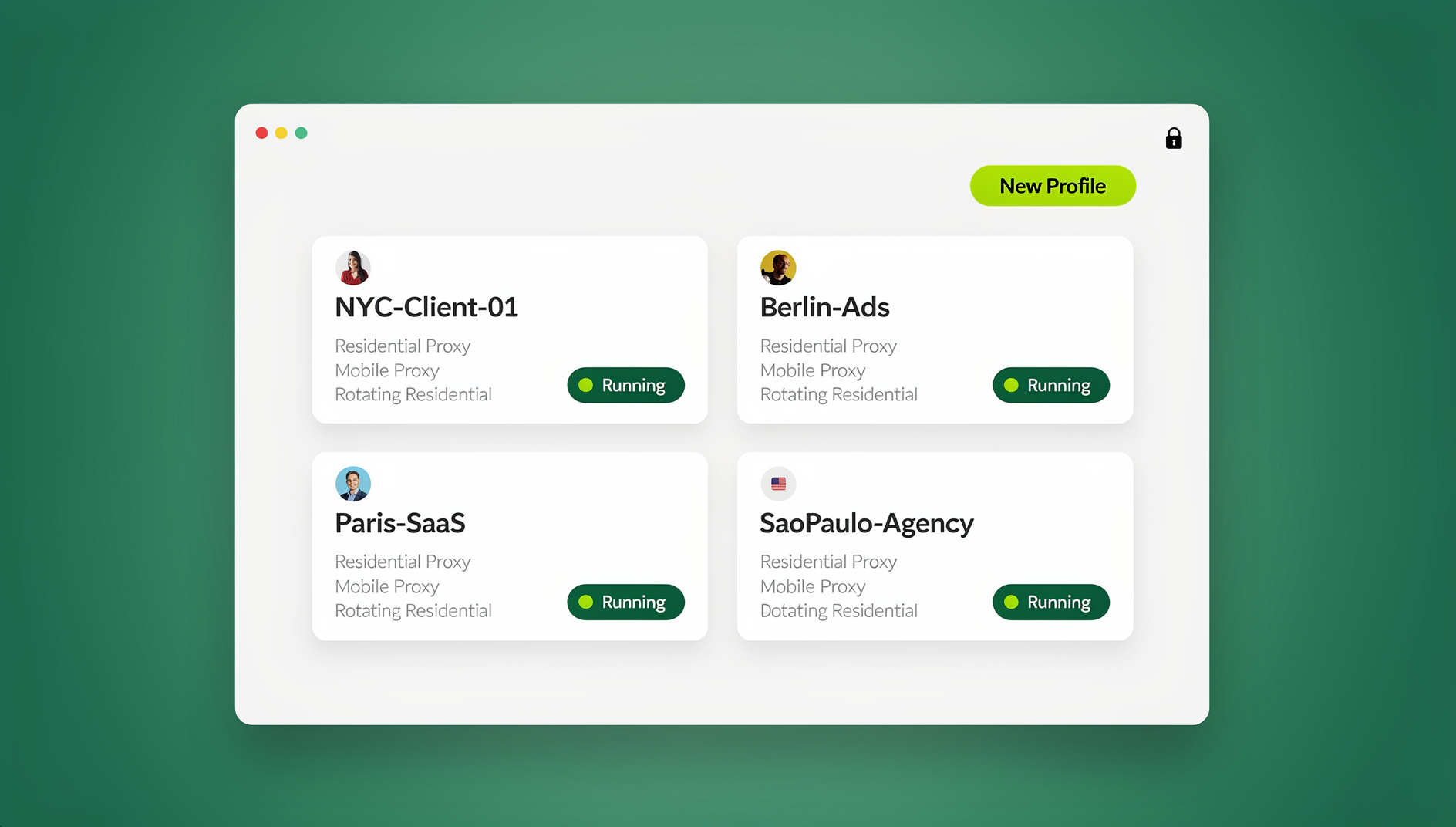
Why Multi-Account Management Keeps Getting Harder
Platform Detection Has Evolved Beyond IP Checks
Social networks no longer rely on IP addresses alone to spot multiple accounts. Instagram, Facebook, X (formerly Twitter), TikTok, and LinkedIn now combine browser fingerprinting, device-level identifiers, behavioral biometrics, and machine-learning models that compare login cadence, typing rhythm, and engagement velocity across accounts. Incognito mode — the go-to hack of 2022 — does nothing against canvas, WebGL, or AudioContext fingerprinting. If two accounts share the same fingerprint, the platform treats them as one user regardless of which email or phone number is attached.
Penalties Have Escalated to Cluster-Wide Bans
The consequences of detection are no longer a slap on the wrist. Instagram now shadowbans entire account clusters, meaning every profile linked by a shared fingerprint or device ID loses reach simultaneously. X suspends accounts for “coordinated inauthentic behavior,” and TikTok issues device-level bans that make recovery nearly impossible without a completely new hardware identity. For agencies, a single detection event can wipe out months of client growth overnight.
Client Complexity Scales Non-Linearly
Managing 30 client accounts is not simply three times harder than managing 10. Every additional account introduces exponential risk: more passwords to store, more content calendars to maintain, more engagement routines to execute without cross-posting a tweet to the wrong brand. Agencies that rely on manual switching between browser tabs or native app account toggles are setting themselves up for a reputation-ending mistake.
The Three Pillars Every Multi-Account Operation Needs
Pillar 1 — Technical Isolation
Each social account must exist inside its own technical silo. That means a unique browser fingerprint (canvas hash, WebGL renderer, installed fonts, screen resolution), a separate IP address, independent cookies, and an isolated local-storage partition. Without this foundation, scheduling tools, SOPs, and team training are all built on sand. Send.win delivers this isolation through cloud browser sessions: every profile you create gets its own sandboxed environment with a residential proxy baked in, so platforms see each account as a distinct user on a distinct device in a distinct location.
Pillar 2 — Operational Organization
Technology prevents detection; process prevents human error. You need clear naming conventions (ClientName_Platform_AccountHandle), documented workflows for content approval, and color-coded browser profiles so a team member never accidentally opens the wrong account. Content calendars should live in a shared tool — Notion, Airtable, or a dedicated social calendar — and every post should pass through at least one approval gate before it goes live. Teams that skip this step discover the hard way what it feels like to post a client’s competitor analysis to that client’s own Instagram feed.
Pillar 3 — Security Hardening
Multi-account operations create a large attack surface. Every profile needs a strong, unique password stored in a credential manager — never shared via Slack, email, or a spreadsheet. Two-factor authentication should be enabled on every account, with backup codes stored securely. Cloud browser profiles add an extra layer here: team members access accounts through shared profiles that maintain persistent sessions, so credentials never leave the vault in the first place. If a team member leaves, you revoke their profile access rather than rotating a dozen passwords.
Choosing the Right Tools to Manage Multiple Social Accounts
Scheduling and Publishing Platforms
| Tool | Platforms Supported | Best For | Key Limitation |
|---|---|---|---|
| Buffer | All major networks | Small teams, simple queuing | Limited analytics depth |
| Hootsuite | All major networks | Enterprise dashboards, team collaboration | Expensive at scale |
| Later | Instagram, TikTok, Pinterest | Visual content planning and link-in-bio | Narrow platform coverage |
| Sprout Social | All major networks | Advanced analytics and reporting | Premium pricing tiers |
| SocialBee | All major networks | Evergreen content recycling | Steeper learning curve |
Important distinction: these tools handle what gets published and when. They do not solve how you interact with platforms in real time. Story replies, DMs, community management, ad-account adjustments, and manual engagement still happen inside the platform — and that is where detection risk lives. You need a complementary isolation layer, which is where social media management tools meet browser-level protection.
Browser Session Isolation with Send.win
Send.win provides two ways to run isolated sessions. The Sendwin Browser is a native desktop application you install on Windows or Mac, giving you full local performance with built-in fingerprint management. Alternatively, cloud browser sessions let you launch profiles directly from any device with no install required — ideal for remote teams, freelancers, or situations where you need quick access from a laptop you don’t own. Both modes give each profile:
- Unique canvas, WebGL, and AudioContext fingerprints
- Built-in residential proxy for IP isolation
- Persistent sessions — accounts stay logged in across restarts
- Team sharing with role-based permissions (viewer, editor, admin)
- No automation interface on any plan — no API, SDK, headless mode or Selenium/Puppeteer/Playwright support
Pricing starts with Pro at $19/month ($83.88/year) and Team at $49/month ($251.88/year). The first card purchase is covered by a 7-day money-back guarantee, and there is no free trial — the only free option is the cloud demo at https://send.win/demo-browser/. Send.win has no automation interface, so repetitive tasks cannot be scripted.
Platform-by-Platform Playbook
Instagram’s detection engine is among the most aggressive in the industry. The native app allows toggling between up to five accounts, but once you exceed that threshold, you need isolated browser profiles accessing Instagram’s web interface. Stagger posting times across accounts — identical scheduling patterns trigger flags — and vary engagement cadence so the algorithm doesn’t see uniform like/comment velocity. Use unique hashtag strategies per account, and never follow or interact between your own profiles. Agencies managing multiple social profiles on Instagram should treat each client’s account as if it lived on a completely separate phone.
Facebook and Meta Platforms
Meta ties accounts together through device IDs, browser fingerprints, and even behavioral biometrics like scroll speed and cursor movement. Run each Facebook account in a fully isolated profile, never accept friend requests between your own accounts, and use separate Business Manager instances for each client’s ad accounts. If you manage Facebook Pages for multiple brands, Business Manager provides legitimate multi-page access — but the underlying browser session still needs isolation to prevent Meta from correlating page-admin activity.
X (Formerly Twitter)
X flags “coordinated inauthentic behavior” — multiple accounts amplifying the same content through retweets, quote tweets, or identical phrasing. Never post identical copy across accounts. Maintain distinct follower-following graphs, unique bios, and separate profile aesthetics. Each account should feel like a different person. For agencies that need to run social media campaigns across multiple X handles, isolated sessions are non-negotiable.
TikTok
TikTok relies heavily on device fingerprinting, including screen resolution, GPU renderer, and installed codecs. Use isolated browser profiles to access TikTok Studio (the web creator dashboard), and ensure each profile has a unique screen resolution and canvas fingerprint. Content style matters too — TikTok’s algorithm can detect similar editing patterns, audio choices, and caption structures across accounts, so vary creative direction per profile.
LinkedIn prohibits multiple personal profiles per individual but allows management of multiple Company Pages. For teams handling several LinkedIn Company Pages or managing client personal profiles, use isolated browser sessions to prevent session conflicts and avoid LinkedIn’s account-linking detection. LinkedIn’s enforcement tends to focus on automated connection requests and InMail spam, so keep engagement human-paced and genuine.
Building an Agency Workflow That Scales
Client Onboarding Checklist
- Create dedicated browser profiles — one per client, per platform if needed.
- Request platform access — Instagram login credentials, Facebook Business Manager invite, X account credentials, etc.
- Set up accounts inside isolated profiles — log in once, let the session persist.
- Store credentials in a vault — 1Password, Bitwarden, or equivalent. Never Slack or email passwords.
- Assign team members — use Send.win’s role-based sharing to grant profile access without exposing raw credentials.
- Document the workflow — which profiles belong to which client, who is responsible, what the posting cadence looks like.
Daily Engagement Routine
Structure engagement in time blocks. Open Client A’s Instagram profile, spend 15-20 minutes responding to comments, replying to DMs, and engaging with relevant hashtags. Close the profile. Open Client B’s profile. This sequential approach, powered by isolated sessions, eliminates the risk of accidentally engaging as the wrong brand. Color-coded profile labels in Send.win make visual confirmation instant — you always know which client world you’re inside.
Content Approval and Scheduling
Use your scheduling tool to queue posts across all client accounts, but funnel every piece of content through an approval workflow first. The ideal pipeline looks like: Draft → Internal Review → Client Approval → Scheduled → Published → Performance Report. Tag each piece with the client name, platform, and campaign so reporting is painless at month-end.
Avoiding the Five Most Common Multi-Account Disasters
1. Posting to the Wrong Account
The number-one agency nightmare. Prevent it by using color-coded browser profiles for visual distinction, implementing multi-step approval workflows, and requiring a manual account-name check before every post. Scheduling tools that force explicit account selection add another safety net.
2. Cascading Bans from Linked Accounts
If a platform detects that multiple accounts share a fingerprint or IP, it may ban all of them in one sweep. Prevent cascading bans by ensuring every account lives in a fully isolated browser profile with a unique fingerprint and dedicated residential proxy — exactly what Send.win provides out of the box.
3. Credential Leaks
Sharing passwords through email, Slack, or spreadsheets is a breach waiting to happen. Cloud browser profiles that maintain persistent sessions let team members access accounts without ever seeing the password. When someone leaves the team, revoke their profile access — no password rotation required.
4. Session Conflicts and Forced Logouts
When two people log into the same social account from different browsers, the platform may flag the activity or force a logout. Isolated cloud sessions avoid this entirely: the session is tied to the profile, not to the person’s local machine. Multiple team members can access the same profile sequentially without triggering security alerts.
5. Cross-Account Data Leakage
Cookies, cached data, and autofill from one account can bleed into another when you rely on basic browser tabs. Isolated profiles sandbox everything — cookies, local storage, cache, autofill — so nothing leaks between accounts.
Scaling Past 50 Accounts
Standard Operating Procedures
Document every process: client onboarding, content approval, crisis response, reporting cadence, and team handoffs. SOPs ensure consistency as you add team members and clients. Review and update them quarterly — what worked at 20 accounts may bottleneck at 80. Teams that invest early in managing social profiles securely across newer platforms like Threads and Bluesky will have a structural advantage as those networks grow.
Hierarchical Team Structure
Assign account managers to client clusters of five to ten clients each. Specialists handle cross-client tasks — graphic design, analytics, ad management — while account managers own the day-to-day engagement and client communication. This prevents any single person from being a bottleneck or a single point of failure.
Monitoring and Early-Warning Systems
Set up alerts for unusual account activity: sudden follower drops, engagement crashes, login alerts from unfamiliar locations, or rate-limit warnings. Early detection of platform flags gives you time to address issues — adjusting engagement velocity, rotating proxies, or pausing automation — before accounts get permanently banned.
No Automation Interface for Repetitive Tasks
Send.win has no automation interface: no API, SDK, headless mode or Selenium/Puppeteer/Playwright support on any plan, so profile creation, session launches and cookie imports cannot be scripted. High-volume agencies set up client profiles manually — each with its own cookies, storage, fingerprint settings and proxy — and reserve human attention for creative strategy and client relationships.
🏆 Send.win Verdict
Managing multiple social accounts in 2026 requires more than a posting scheduler — it demands browser-level isolation that gives every profile its own cookies, storage, fingerprint settings and session. Send.win delivers exactly that through Sendwin Browser (native desktop app) or cloud browser sessions (no install), with team sharing, persistent sessions, and plans starting at $19/month. Pair it with your favorite scheduling tool and you have a complete multi-account stack.
Try the Send.win cloud demo — a 3-minute preview without signup, and run every social account in its own isolated session.
Frequently Asked Questions
What is the safest way to manage multiple social accounts?
The safest approach combines a content-scheduling tool for automated publishing with browser-level session isolation for direct interactions. Scheduling tools handle queuing and analytics; isolated browser profiles (like those from Send.win) ensure each account has a unique fingerprint, IP address, and cookie silo so platforms never link them together.
How many social media accounts can one person realistically manage?
With proper technical isolation, there is no hard limit imposed by the tools. The real constraint is human bandwidth — how many accounts your team can create quality content for, engage with authentically, and monitor for issues. Most solo marketers cap out around 10-15 active accounts; agencies with dedicated teams handle 50 or more.
Do I need separate phones or devices for each social account?
No. Cloud browser profiles replace the need for device farms entirely. Each profile provides equivalent isolation to a separate phone — unique fingerprint, dedicated IP, independent session — accessible from any device with a web browser. This eliminates the cost and logistical headache of maintaining physical hardware.
Will using a scheduling tool alone protect me from bans?
No. Scheduling tools publish content through official APIs, which is generally safe. But direct platform interactions — logging in, replying to DMs, managing settings, running engagement sessions — still happen in a browser. If multiple accounts share the same browser fingerprint during these interactions, the platform can detect and link them. You need session isolation alongside your scheduler.
What is browser fingerprinting and why does it matter for multi-account management?
Browser fingerprinting is a technique platforms use to identify your device by collecting data points like canvas rendering, WebGL capabilities, installed fonts, screen resolution, and timezone. Even without cookies, this fingerprint can uniquely identify a browser. When two accounts share the same fingerprint, platforms flag them as operated by the same person. Isolated browser profiles generate unique fingerprints per session, defeating this detection method.
How does Send.win differ from regular Chrome profiles or incognito mode?
Regular Chrome profiles share underlying browser characteristics — the same canvas hash, WebGL renderer, and hardware identifiers. Incognito mode only clears cookies; it does not change your fingerprint. Send.win creates fully isolated sessions where every detectable parameter (fingerprint, IP, cookies, local storage) is unique per profile. This is the difference between wearing a different hat and actually being a different person to the platform’s detection systems.
Can I share account access with team members without sharing passwords?
Yes. Send.win’s cloud browser profiles maintain persistent sessions. You share the profile — not the credentials — with team members through role-based permissions. They open the profile, find the account already logged in, and work within it. When someone leaves the team, you revoke their profile access. The account password never leaves your credential vault.
What does Send.win cost and is there a free trial?
Send.win has no free trial. The Pro plan is $19/month ($83.88/year) and the Team plan is $49/month ($251.88/year), and the first card purchase is covered by a 7-day money-back guarantee. The only free option is the cloud demo at https://send.win/demo-browser/. Send.win has no automation interface, so repetitive profile-management tasks cannot be scripted.