Why Managing Multiple Facebook Ads Accounts Requires Environment Isolation
To manage multiple facebook ads accounts safely, media buyers and marketing agencies must replace shared browser profiles with true environment isolation. Meta’s automated anti-fraud systems track browser fingerprints, canvas hardware signals, IP subnets, and cookies. Standard browsers or native Meta Business Suite sharing fail to isolate these hardware signals, causing chain bans across connected client profiles. Multi-account management platforms like Send.win isolate profiles completely to eliminate cross-account contamination.
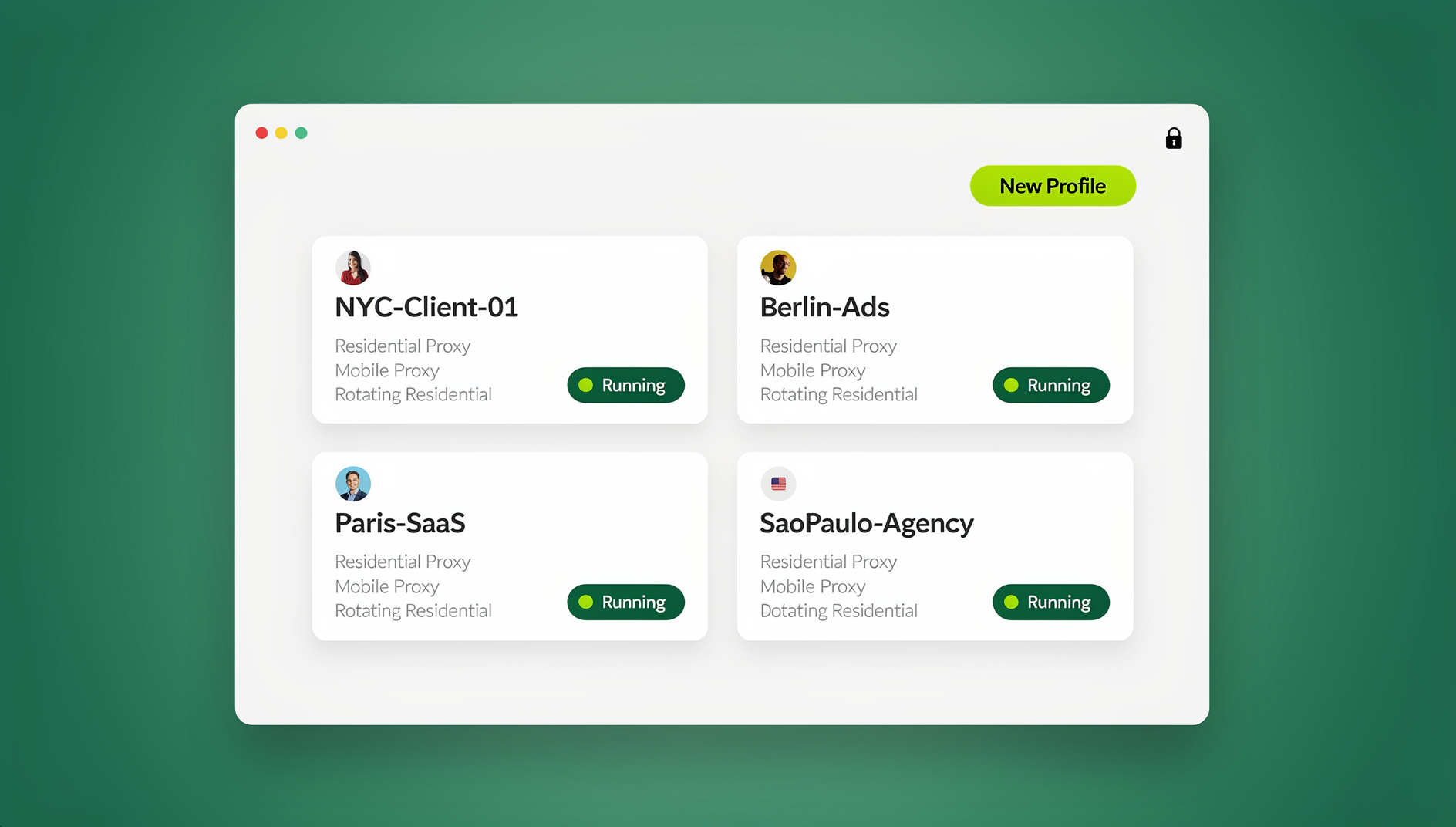
For digital marketing agencies, performance media buyers, and e-commerce growth teams, managing high-budget Meta advertising campaigns is a high-stakes operation. Scaling multi-account strategies across e-commerce verticals, affiliate campaigns, or client agency portfolios requires handling dozens—sometimes hundreds—of Facebook Ads Manager and Meta Business Suite accounts simultaneously. However, media buyers routinely face sudden account suspensions, restricted Business Managers, and catastrophic chain bans where a single policy flag on one client account instantly disables every ad account connected to the media buyer’s machine.
The root cause of these cascading bans lies in Meta’s sophisticated security telemetry. Meta does not merely inspect account login credentials; it continuously gathers deep hardware, network, and behavioral browser metrics. When an agency attempts to manage multiple client accounts from a single browser installation or standard browser profile switcher, Meta’s tracking algorithms link those accounts together under a single entity signature. Understanding how Meta identifies linked profiles—and how true browser session isolation neutralizes this risk—is essential for any media buyer scaling ad spend.
The Technical Architecture of Meta’s Multi-Account Tracking
Meta employs one of the most advanced fraud-detection engines in the advertising industry. Designed to block ad fraud, farm networks, and malicious behavior, Meta’s security system monitors telemetry across multiple architectural layers:
1. Browser Fingerprinting and Hardware Telemetry
Modern web browsers expose hundreds of hardware and rendering parameters to websites through JavaScript APIs. When you access Facebook Ads Manager, Meta scripts generate a unique “browser fingerprint” by querying your computer’s underlying hardware. Key data points captured include:
- Canvas and WebGL Rendering: HTML5 Canvas and WebGL APIs render subtle 2D and 3D graphical artifacts determined by your specific Graphics Processing Unit (GPU), graphics driver, and OS rasterization engine. Two accounts logged into different Chrome user profiles on the same PC will generate identical Canvas and WebGL hashes.
- AudioContext Fingerprinting: Audio APIs analyze how your computer’s sound card processes audio signals, generating a distinct hardware hash.
- System Font and Screen Metrics: The list of system fonts installed on your machine, alongside screen resolution, color depth, device pixel ratio, and multi-monitor configurations.
- Navigator Object and TLS Fingerprints: Details including CPU core count, system memory (RAM), device memory API readings, exact user-agent strings, system language, and JA3/JA4 TLS handshake signatures.
If Meta observes 20 distinct Facebook ad accounts operating from browser profiles that return identical Canvas hashes, WebGL renderer signatures, and CPU core counts, those accounts are flagged as operating from a single physical workstation.
2. Network and IP Subnet Profiling
Network identity is equally critical. If an agency logs into multiple client ad accounts located in different cities or countries using a single office Wi-Fi connection, Meta detects an unnatural geographical mismatch. Furthermore, commercial VPNs and datacenter IP addresses are heavily flagged in Meta’s risk engine because they originate from known server farms rather than legitimate residential Internet Service Providers (ISPs).
3. Cookie and Local Storage Cross-Contamination
Standard browser profile switches often leak persistent storage artifacts. Shared local storage, IndexedDB databases, service workers, and third-party tracking pixels can persist across session restarts. When Meta detects leftover authentication tokens or shared session cookies, it establishes a definitive linkage between separate advertising accounts.
4. Payment Method and Identity Correlation
Connecting the same credit card, PayPal account, or billing address across multiple Business Managers triggers immediate identity links. Even if accounts are visually separated in client dashboards, shared payment profile BINs (Bank Identification Numbers) or administrative user profiles expose the connection.
The Hidden Limitations of Meta Business Suite Client Sharing
Many marketing agencies rely on Meta Business Suite (formerly Facebook Business Manager) partner access to browser for ads management accounts. Under this official model, clients grant your agency’s Business Manager partner permissions to run ads on their behalf.
While Meta Business Suite is designed for legitimate agency workflows, it presents severe operational vulnerabilities when managing diverse or sensitive ad portfolios:
- Cascading Agency-Level Bans (Chain Bans): If your agency Business Manager is assigned administrative access to 30 client ad accounts, and a single client account violates Meta’s advertising policies (e.g., restricted product categories, trademark disputes, or automated ad disapproval flags), Meta’s AI may restrict your central agency Business Manager. Consequently, your media buyers lose access to all 30 client accounts simultaneously.
- Client Trust and Operational Exposure: When an agency Business Manager incurs a restriction, Meta often sends automated security notices to linked client accounts. This degrades client trust and disrupts ongoing campaigns across your entire client base.
- Unsuitable for Asset Warmup or E-Commerce Scaling: Media buyers managing direct-to-consumer (D2C) brand portfolios, affiliate campaigns, or backup ad accounts cannot rely on client-granted partner access. Scaling requires independent, isolated ad account environments that operate completely detached from a centralized agency node.
Why Standard Browser Profiles and Incognito Mode Fail Media Buyers
A common misconception among beginner media buyers is that Google Chrome user profiles, Firefox containers, or browser Incognito mode provide sufficient separation to managing multiple accounts safely. In reality, these native browser tools offer zero protection against hardware-level fingerprinting:
| Isolation Level | Cookie Isolation | IP Address Segregation | Canvas / WebGL Spoofing | Hardware Fingerprint Protection | Chain Ban Prevention |
|---|---|---|---|---|---|
| Chrome Profiles | Basic | ❌ None (Shared local IP) | ❌ Identical GPU Hash | ❌ Identical Telemetry | ❌ Vulnerable to Chain Bans |
| Incognito Mode | Temporary | ❌ None (Shared local IP) | ❌ Identical GPU Hash | ❌ Identical Telemetry | ❌ Vulnerable to Chain Bans |
| VPN + Standard Browser | Basic | ⚠️ Datacenter IP (High Risk) | ❌ Identical GPU Hash | ❌ Identical Telemetry | ❌ Vulnerable to Chain Bans |
| Send.win Profile Isolation | ✅ Complete Sandboxing | ✅ Assigned Residential Proxy | ✅ Synthetic Noise Injection | ✅ Fully Isolated Hardware Profile | ✅ 100% Isolated Environment |
Standard Chrome user profiles only isolate basic cookies and browsing history. They share your machine’s underlying graphics card, sound card, RAM configuration, font list, network stack, and TLS signature. When Meta queries the WebGL renderer API across 10 Chrome profiles on your laptop, every single profile returns the exact same GPU string. To Meta’s automated security algorithms, those 10 profiles are unmistakably operating from one single device.
How Send.win Delivers True Session Isolation for Media Buyers
To safely run and scale dozens of Meta advertising accounts, media buyers require comprehensive browser sandboxing. Send.win provides true session isolation by creating completely independent browser environments for every account you manage.
Here is how Send.win protects media buyers and marketing agencies from cross-account correlation and ban propagation:
1. Hardware-Level Fingerprint Randomization
Send.win operates by spoofing every critical browser telemetry vector at the engine level. When you launch a new Facebook Ads profile in Send.win, the platform constructs a unique digital identity:
- Canvas and WebGL Noise Injection: Send.win adds cryptographic micro-noise to Canvas and WebGL rendering operations. To Meta’s detection scripts, each Send.win profile appears to be running on an entirely different physical computer with a distinct graphics card and driver configuration.
- AudioContext and WebRTC Protection: Audio hashes are subtly randomized, and WebRTC leak protection ensures your local IP address is never revealed behind your assigned proxy.
- Font, Memory, and Screen Resolution Customization: Each profile is initialized with distinct screen resolution parameters, CPU core counts, device memory allocations, and operating system attributes.
2. Dedicated Proxy Binding per Profile
Operating multiple ad accounts requires matching geographic and network signatures. With Send.win, media buyers can assign dedicated residential or mobile proxies to individual profiles. Send.win locks each profile to its specific IP address, subnet, and geo-location, ensuring that Profile A always connects from a California residential IP while Profile B connects from a London residential IP. Using dedicated proxy browsers eliminates IP-based correlation and geographical location flags.
3. Dual Execution Modes: Desktop App and Cloud Browser Sessions
Send.win gives agencies flexible options for running ad management environments:
- Sendwin Browser (Native Desktop App): Install the native client on Windows, macOS, or Linux for maximum local rendering speed, low latency, and hardware acceleration when managing client ad accounts locally.
- Cloud Browser Sessions: Need to access client ad accounts while traveling or from a mobile device without installing software? Send.win allows you to run browser profiles directly inside cloud-hosted browser sessions. Cloud sessions run in secure server environments without requiring any local app installation, allowing team members to monitor campaign performance securely from any browser.
4. Automated Session Warmup with the Automation API
New Facebook accounts require careful session warming before launching ad campaigns. Send.win includes a built-in Automation API (available on both Pro and Team plans) supporting Selenium, Puppeteer, and Playwright. Agencies can automate background web browsing, cookie accumulation, and page interactions across new profiles to establish trusted browsing histories before deploying advertising budgets.
Step-by-Step Guide: Managing 50+ Facebook Ad Accounts Safely with Send.win
Below is an agency-proven workflow for setting up and managing 50+ Facebook Ads accounts using Send.win with zero risk of chain bans.
Step 1: Set Up Isolated Profiles in Send.win
Launch the Sendwin Browser desktop app or access your Send.win web dashboard. Create a new profile for each client or ad account batch:
- Profile Naming Convention: Name profiles clearly according to client, vertical, or ad account ID (e.g.,
Client_Alpha_FB_AdsorAgency_D2C_Account_04). - Operating System Matching: Select the target OS profile (Windows, macOS, or Linux) that matches the historical usage pattern of the account.
- Fingerprint Generation: Click to generate a fresh, randomized hardware fingerprint. Send.win automatically configures Canvas, WebGL, Audio, and Client Hints attributes.
Step 2: Assign High-Quality Residential Proxies
Never connect Facebook Ads profiles to commercial datacenter IPs or free VPN services. Assign a high-quality sticky residential or mobile proxy to each Send.win profile:
- Configure HTTP/HTTPS or SOCKS5 proxy credentials directly within the profile settings.
- Ensure the proxy location matches the client’s home city or billing address region.
- Set the proxy session type to sticky (maintaining the same IP address for at least 12–24 hours) to prevent frequent IP changes during active Ads Manager sessions.
Step 3: Import Existing Session Cookies or Warm Up the Profile
If you are taking over an existing Facebook account or purchasing a pre-warmed Business Manager, import authentication cookies (such as c_user, xs, datr, and sb) directly into Send.win’s profile storage. This allows you to log into Facebook Ads Manager instantly without triggering security 2FA prompts or unusual device verification alerts.
For fresh accounts, use Send.win’s Automation API to run automated warmup scripts over 3 to 5 days. Program Playwright or Puppeteer to visit popular news websites, click organic content, interact with e-commerce stores running Meta pixels, and gradually build a natural cookie history before attempting to log into Meta Ads Manager.
Step 4: Isolate Payment Profiles and Billing Data
To guarantee complete separation across 50+ accounts, adhere to strict billing hygiene:
- Use virtual credit cards (VCCs) with distinct card numbers, expiration dates, and billing ZIP codes for each ad account.
- Never reuse a payment card that was previously associated with a restricted or banned Facebook account.
- Match the billing name and address on the virtual card to the geographic location of the assigned residential proxy.
Step 5: Collaborate Securely with Team Members
With Send.win’s Team Plan ($49/mo standard or $20.99/mo billed annually), agencies can invite up to 16 team members and manage up to 500 isolated profiles. Agency managers can delegate profile access to media buyers, virtual assistants, or external copywriters without sharing raw Facebook passwords or 2FA seed codes. Team members launch the assigned Send.win profile, work inside the pre-authenticated session, and close the profile—leaving the session state perfectly preserved in the cloud.
Agency Best Practices for Scaling Facebook Ad Budgets
Maintaining long-term account health across a large ad portfolio requires disciplined operational processes. Implement these agency best practices alongside Send.win profile isolation:
1. Gradual Campaign Budget Scaling
When launching campaigns on new or newly acquired Facebook Ads accounts, avoid aggressive daily spend spikes. Scaling from $20/day to $2,000/day overnight triggers automated financial risk reviews within Meta’s billing system. Increase daily ad budgets incrementally by 15% to 20% every 48 hours to establish a consistent billing pattern.
2. Content and Landing Page Compliance Auditing
Many ad account suspensions stem from landing page policy breaches rather than technical account issues. Ensure that ad creative copy, images, video assets, and destination landing pages strictly adhere to Meta’s Advertising Policies. Avoid prohibited health claims, aggressive financial promises, or deceptive landing page redirect scripts.
3. Maintaining Independent Verification Channels
Every Facebook personal profile used for managing Business Managers should have its own dedicated, independent email address (e.g., custom domain email or dedicated Google Workspace inbox) and isolated phone number for SMS two-factor authentication. Never link multiple Facebook accounts to a single recovery phone number or backup email inbox.
Comparing Multi-Account Solutions for Media Buyers
Media buyers evaluating infrastructure for scaling Meta ad campaigns should consider total cost of ownership, profile capacity, team seats, and automation capabilities:
| Feature / Capability | Legacy Anti-Detect Browsers | Virtual Machines (VPS/RDP) | Send.win (Pro Plan) | Send.win (Team Plan) |
|---|---|---|---|---|
| Starting Monthly Price | $99 – $299 / month | $15 – $30 per profile / mo | $9.99 / mo ($6.99 annual) | $29.99 / mo ($20.99 annual) |
| Profile Capacity | 50 – 150 profiles | 1 profile per VM | 150 profiles | 500 profiles |
| Included Storage / Proxy Bandwidth | Varies (often extra) | N/A | 5 GB storage | 20 GB storage |
| Automation API (Playwright/Puppeteer) | Expensive Add-on | Complex custom setup | ✅ Included | ✅ Included |
| Cloud Browser Sessions (No Install) | ❌ Desktop Only | ❌ Slow RDP Stream | ✅ Included | ✅ Included |
| Team Seats Included | 0 – 2 seats | 1 user per RDP | 1 seat | 16 team seats |
While traditional legacy antidetect browsers charge upwards of $100 to $300 per month for basic multi-account functionality, Send.win delivers enterprise-grade browser profile isolation, hardware spoofing, cloud browsing capabilities, and API automation starting at just $19/month ($6.99/month when billed annually) for 150 profiles, or $49/month ($20.99/month annual — 57% savings) for 500 profiles and 16 team seats.
🏆 Send.win Verdict
Managing multiple Facebook ad accounts without environment isolation exposes media buyers and marketing agencies to devastating chain bans. Send.win provides bulletproof browser profile sandboxing, native Canvas/WebGL fingerprint spoofing, assigned residential proxy binding, and team seat delegation at an unbeatable price point starting at $19/mo (or $6.99/mo billed annually — 63% off) with a 30-day free trial requiring no credit card.
Try Send.win free today — launch 150+ isolated Facebook Ads Manager profiles and protect your agency revenue.
Frequently Asked Questions
Why does Facebook ban multiple ad accounts accessed from the same computer?
Facebook uses sophisticated anti-fraud algorithms that track browser fingerprints, Canvas/WebGL rendering hashes, audio signatures, and IP subnets. When Meta detects multiple ad accounts logged in from identical hardware configurations and network IPs, it flags them as an interconnected network. If one account incurs a policy flag, Meta triggers automated chain bans across all linked accounts.
Can I manage multiple Facebook Ads accounts using Google Chrome user profiles?
No. Google Chrome user profiles only isolate basic session cookies and browsing history. They share your physical computer’s underlying graphics card, WebGL rendering engine, CPU parameters, font lists, and network stack. Meta scripts quickly identify that all Chrome profiles belong to a single physical device, exposing your ad accounts to cross-account restrictions.
What is a chain ban on Facebook Meta Business Suite?
A chain ban occurs when Meta’s security automated enforcement flags a central administrative entity—such as an agency Business Manager, shared IP address, or common browser fingerprint—and automatically restricts every connected ad account, page, and payment profile associated with that entity.
How do residential proxies help in managing Facebook ad accounts?
Residential proxies route your internet traffic through real home IP addresses provided by consumer Internet Service Providers (ISPs). Assigning a unique sticky residential proxy to each Facebook Ads profile ensures that Meta sees a consistent, natural geographic location matching the client’s home region, eliminating IP correlation flags.
Does Meta Business Suite eliminate the need for session isolation?
No. Meta Business Suite partner access allows agencies to manage client assets under official permission structures, but it links all client assets to your central agency Business Manager. If your central Business Manager receives a policy restriction, all client accounts connected to it can be disabled simultaneously. Session isolation via Send.win ensures each client account operates in a completely independent environment.
Can Send.win automate Facebook ad account warming?
Yes. Send.win includes a built-in Automation API compatible with Selenium, Puppeteer, and Playwright on both Pro and Team plans. Agencies can script automated warm-up routines to browse websites, accept cookies, and build organic browsing history across fresh profiles prior to launching Facebook ad campaigns.
What execution modes does Send.win offer for media buyers?
Send.win offers two execution modes: Sendwin Browser (a native desktop application for Windows, macOS, and Linux designed for local high-performance rendering) and Cloud Browser Sessions (which allow team members to run and manage profiles directly in cloud environments without installing local software).
How does Send.win pricing compare to traditional antidetect tools?
Traditional antidetect tools cost between $99 and $300 per month for basic tier plans. Send.win offers comprehensive profile isolation, hardware spoofing, automation support, and proxy binding starting at $19/mo ($6.99/mo annual — 63% off) for 150 profiles on the Pro plan, and $49/mo ($20.99/mo annual — 57% off) for 500 profiles and 16 team seats on the Team plan, supported by a 30-day free trial with no credit card required.
How Send.win Helps With Manage Multiple Facebook Ads Accounts
Send.win is an antidetect browser built for exactly this kind of work — every profile is a clean, isolated identity:
- Isolated profiles – unique fingerprint, separate cookies and storage per profile
- Stealth engine – canvas, WebGL, fonts, and audio spoofed at the engine level
- Desktop app + cloud sessions – native app for Windows, macOS, and Linux, or run profiles in the cloud with no install
- Built-in residential proxies – with automatic timezone, locale, and WebRTC matching
- Team features – share logged-in profiles with teammates without sharing passwords
Try the instant cloud browser demo — no install, no signup — or download the desktop app. The 30-day free trial needs no credit card, and paid plans start at $6.99/month billed annually (see pricing).