Can You Really Use Multiple GitHub Accounts on One Machine?
Yes — managing multiple GitHub accounts on a single computer is entirely possible and surprisingly straightforward once you configure SSH keys, Git identities, and browser sessions correctly. Most developers need at least two accounts: a corporate one tied to their employer’s GitHub organization and a personal account for open-source work and side projects. The trick is setting up your machine so each account’s credentials, commit identity, and web sessions stay completely isolated from each other. This guide walks through every layer of that setup, from terminal to browser.
Why Developers Need Multiple GitHub Accounts
The days of one developer, one GitHub account are long gone. Here are the most common scenarios that push developers toward multi-account setups:
- Work vs. Personal: Your employer’s GitHub Enterprise org requires a corporate email and SSO login. Meanwhile, your personal account holds years of open-source contributions, stars, and your public portfolio. Mixing them risks leaking proprietary code to personal repos or tagging personal commits with a corporate email.
- Freelance and Contract Work: Different clients may require you to join their GitHub organizations under specific accounts. A freelancer working with three clients might juggle four GitHub accounts simultaneously.
- Open-Source Bot Accounts: Maintainers often run separate bot accounts for CI/CD automation, dependency updates (like Dependabot forks), or release publishing — keeping automated commits distinct from human contributions.
- Teaching and Training: Instructors create demo student accounts or lab environments with restricted permissions, separate from their own teaching account.
- Security Research: Penetration testers and security researchers use isolated accounts for vulnerability disclosure and testing organizational access controls without risking their primary account’s reputation.
Regardless of the scenario, the underlying challenge is the same: keeping identities, credentials, and sessions separate. A comprehensive approach to managing multiple accounts requires configuring every layer — Git, SSH, browser, and CLI.
SSH Key Configuration for Multiple Accounts
SSH keys are the foundation of multi-account Git operations. Since GitHub uses SSH keys to identify which account is pushing code, each account needs its own unique key pair.
Generate Separate SSH Keys
Create a dedicated key for each GitHub account. Use descriptive filenames so you can tell them apart at a glance:
ssh-keygen -t ed25519 -C "[email protected]" -f ~/.ssh/id_ed25519_personal
ssh-keygen -t ed25519 -C "[email protected]" -f ~/.ssh/id_ed25519_work
ssh-keygen -t ed25519 -C "[email protected]" -f ~/.ssh/id_ed25519_clienta
Add each public key (.pub file) to its corresponding GitHub account under Settings → SSH and GPG Keys.
Configure SSH Host Aliases
Edit ~/.ssh/config to create host aliases that route to the correct key:
Host github-personal
    HostName github.com
    User git
    IdentityFile ~/.ssh/id_ed25519_personal
    IdentitiesOnly yes

Host github-work
    HostName github.com
    User git
    IdentityFile ~/.ssh/id_ed25519_work
    IdentitiesOnly yes

Host github-clienta
    HostName github.com
    User git
    IdentityFile ~/.ssh/id_ed25519_clienta
    IdentitiesOnly yes
The IdentitiesOnly yes directive is crucial — it prevents SSH from trying every key in your agent and accidentally authenticating with the wrong account.
Clone Repos Using Host Aliases
When cloning, replace github.com with your alias:
git clone git@github-personal:yourname/side-project.git
git clone git@github-work:company/internal-tool.git
git clone git@github-clienta:client/their-app.git
For existing repos, update the remote URL:
git remote set-url origin git@github-work:company/repo.git
Git Conditional Configuration
SSH keys handle authentication, but Git also stamps every commit with your name and email. If you commit to a work repo with your personal email, that email becomes permanently embedded in the repository’s history.
Set Up Directory-Based Git Identities
Git’s includeIf directive automatically applies different configurations based on the repository’s directory path. In your global ~/.gitconfig:
[user]
    name = Your Personal Name
    email = [email protected]

[includeIf "gitdir:~/work/"]
    path = ~/.gitconfig-work

[includeIf "gitdir:~/freelance/clienta/"]
    path = ~/.gitconfig-clienta
Then create ~/.gitconfig-work:
[user]
    name = Your Work Name
    email = [email protected]
Any repository cloned into ~/work/ will automatically use your work identity. Everything else defaults to your personal identity. This single configuration prevents the most common multi-account mistake: committing with the wrong email.
Verify Your Configuration
Always verify which identity Git will use before making commits in a new repository:
cd ~/work/some-project
git config user.email   # Should show [email protected]
git config user.name    # Should show Your Work Name
GitHub CLI Multi-Account Setup
The GitHub CLI (gh) supports multiple authenticated accounts natively since version 2.40. This makes switching between accounts for pull requests, issues, and repository management seamless:
gh auth login    # Authenticate your first account
gh auth login    # Run again to add a second account
gh auth switch   # Switch between authenticated accounts
gh auth status   # Check which account is currently active
Each account’s authentication token is stored separately, so switching is instant. The CLI respects the active account for all operations — creating PRs, reviewing issues, and managing repositories.
Browser Session Management for GitHub
Terminal operations are only half the story. You also need to access GitHub’s web interface daily — reviewing pull requests, managing organization settings, browsing code, and configuring repository access. This is where most developers hit a wall.
The Single-Browser Problem
GitHub allows one authenticated session per browser. Switching accounts means logging out, logging back in, re-authenticating with 2FA, and losing all your open tabs and context. If you’re switching between two accounts ten times a day, that’s easily 30 minutes of wasted time per week.
Chrome profiles partially solve this, but they share the same underlying browser fingerprint data and require manual management. For developers needing clean session isolation between accounts, a purpose-built solution works better.
Using Send.win for Isolated GitHub Sessions
Send.win provides two ways to maintain fully isolated browser sessions for each GitHub account:
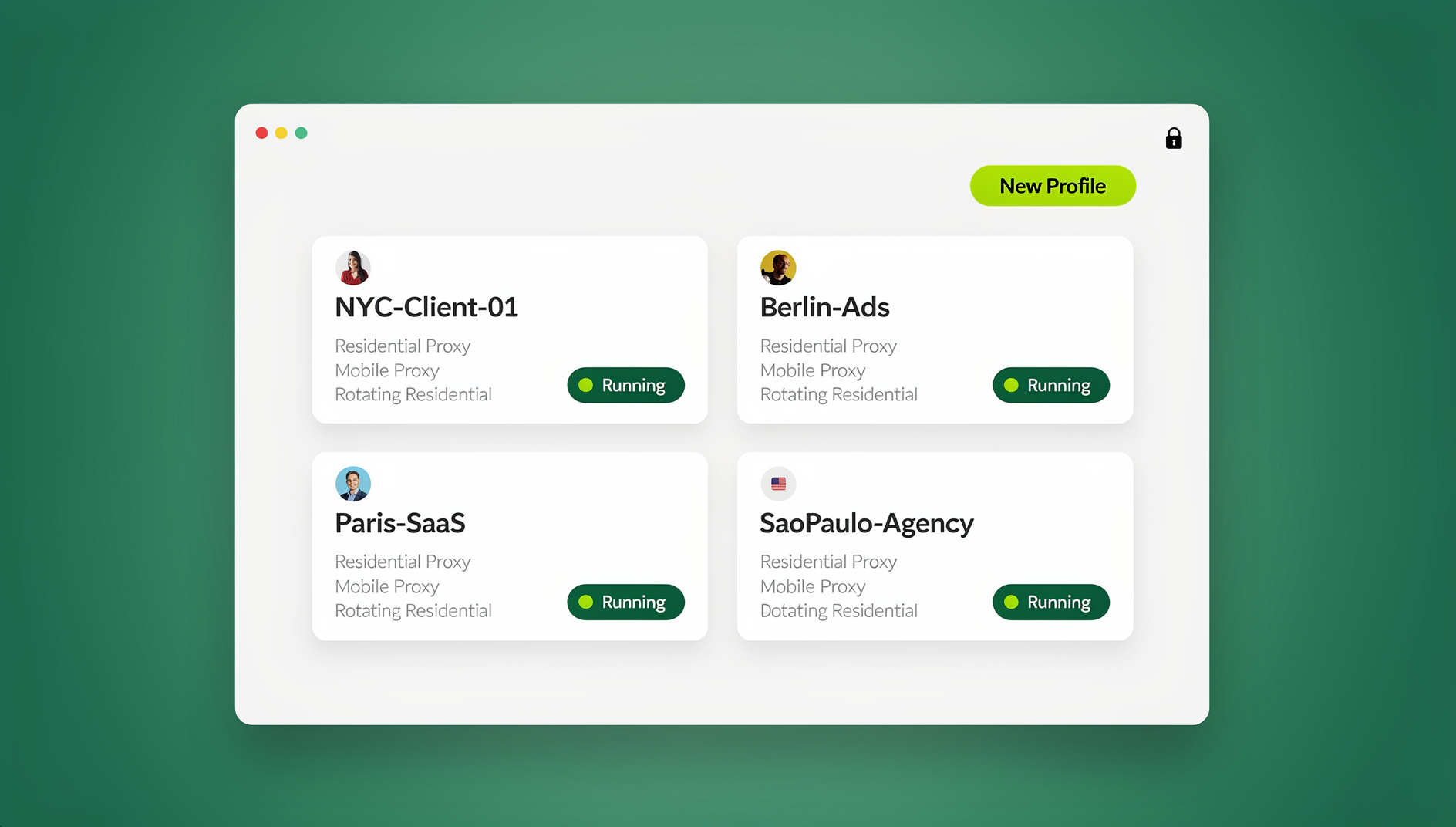
- Sendwin Browser (desktop app): Create named profiles like “GitHub-Personal”, “GitHub-Work”, and “GitHub-ClientA”. Each profile maintains its own cookies, localStorage, and session data. Log into each GitHub account once, and the session persists across restarts. Switch between profiles instantly without any logout/login cycle.
- Cloud browser sessions: Access any of your isolated profiles from any device without installing the desktop app. Your sessions live in the cloud, meaning you can review a PR from your work GitHub on your laptop and then check your personal account from a tablet — all with persistent sessions.
This approach complements your SSH and Git config setup perfectly: terminal operations use SSH keys for authentication, while browser operations use isolated profiles for each account’s web interface. A multi-login browser eliminates the constant logout-login cycle that plagues developers working across multiple GitHub organizations.
VS Code Multi-Account Configuration
VS Code’s built-in GitHub integration relies on your system Git configuration. Here is how to make it work smoothly with multiple accounts:
- Use the conditional
.gitconfigsetup described above — VS Code reads Git config per workspace, so opening a~/work/project automatically uses your work identity. - Install the GitHub Pull Requests and Issues extension, which supports account switching natively. You can sign into multiple GitHub accounts and select which one to use per workspace.
- For reviewing PRs across different organizations, open separate VS Code windows — each connected to a different workspace folder so Git applies the correct identity automatically.
- The GitLens extension overlays commit author information on every line, helping you instantly verify whether a commit used the right identity.
Personal Access Token Management
When SSH is not available — containerized CI/CD builds, GitHub Actions workflows, or API integrations — Personal Access Tokens (PATs) serve as authentication credentials. Each GitHub account needs its own set of tokens.
PAT Best Practices
- Use fine-grained PATs: GitHub’s newer fine-grained tokens let you scope permissions to specific repositories and operations, reducing the blast radius if a token leaks.
- Set expiration dates: Maximum 90 days is recommended. Shorter is better for high-privilege tokens.
- Store tokens in a secrets manager: Use 1Password, HashiCorp Vault, or your CI/CD platform’s secret storage — never commit tokens to code, environment files, or plain-text config.
- Separate tokens by purpose: Create different tokens for CI read-only access, deployment push access, and admin operations. One token per responsibility.
- Rotate proactively: Replace tokens a week before expiration to prevent sudden access loss in automated pipelines.
Commit Hygiene and Identity Verification
Even with correct configuration, mistakes happen. These safeguards catch wrong-identity commits before they reach the remote repository.
Pre-Commit Hook for Email Verification
Create a Git hook that blocks commits if the configured email does not match the expected identity for that repository:
#!/bin/bash
# .git/hooks/pre-commit
EXPECTED_EMAIL="[email protected]"
CURRENT_EMAIL=$(git config user.email)
if [ "$CURRENT_EMAIL" != "$EXPECTED_EMAIL" ]; then
    echo "ERROR: Git email is $CURRENT_EMAIL but expected $EXPECTED_EMAIL"
    echo "Fix with: git config user.email $EXPECTED_EMAIL"
    exit 1
fi
To apply this globally, configure a Git template directory that copies hooks into every new repo automatically:
git config --global init.templateDir ~/.git-templates
mkdir -p ~/.git-templates/hooks
# Copy your pre-commit hook to ~/.git-templates/hooks/
GPG Commit Signing
GPG or SSH commit signing cryptographically ties each commit to a verified identity. GitHub displays a “Verified” badge on signed commits, and many enterprise organizations require it:
git config --global commit.gpgsign true
git config --global user.signingkey YOUR_GPG_KEY_ID
Use different GPG keys for each account. Your work account’s GPG key should be registered only with your work GitHub account, and vice versa.
CI/CD and GitHub Actions Considerations
Automated workflows introduce additional multi-account complexity:
- Isolated secrets: Each organization’s GitHub Actions environment has its own secrets store. Never share secrets across organizations.
- Cross-organization access: If workflows need to access repos in another organization, use a dedicated GitHub App or machine account with scoped PATs — never your personal credentials.
- Audit logs: Regularly review Actions logs to ensure automated workflows are not accidentally leaking credentials or making cross-account API calls.
- Self-hosted runners: If you run self-hosted runners shared across multiple organizations, ensure each runner’s workspace is cleaned between jobs to prevent credential contamination.
Common Mistakes and How to Avoid Them
| Mistake | Consequence | Prevention |
|---|---|---|
| Committing with wrong email | Personal email appears in corporate repo history | Conditional Git config + pre-commit hooks |
| Using the same SSH key for multiple accounts | GitHub rejects the key on the second account | Generate one key per account, use SSH aliases |
| Sharing a browser session | Accidentally modifying wrong organization’s settings | Isolated browser profiles via Sendwin Browser or cloud browser sessions |
| Hardcoding PATs in scripts | Token leaks when code is pushed publicly | Use environment variables and secrets managers |
| Forgetting IdentitiesOnly in SSH config | SSH agent tries every key, may authenticate as wrong user | Always set IdentitiesOnly yes |
| Pushing to wrong remote | Code ends up in wrong account’s repository | Verify remote with git remote -v before pushing |
GitHub Enterprise vs. GitHub.com
If your employer uses GitHub Enterprise Server (a self-hosted instance) while you use GitHub.com for personal projects, multi-account management is simpler. The two platforms are entirely separate — different domains, different credentials, different SSH host entries. Your SSH config naturally separates them by hostname rather than alias:
Host github.com
    IdentityFile ~/.ssh/id_ed25519_personal

Host github.company.com
    IdentityFile ~/.ssh/id_ed25519_work
GitHub Enterprise Cloud (the managed SaaS version) uses github.com with enterprise SSO, so you still need the alias-based approach described earlier in this guide.
🏆 Send.win Verdict
Managing multiple GitHub accounts requires isolation at every layer — SSH keys for Git operations, conditional config for commit identity, and isolated browser profiles for web access. Send.win’s Sendwin Browser (desktop app) and cloud browser sessions handle the browser layer cleanly: create a named profile per GitHub account, log in once, and switch instantly without credential juggling. At $6.99/month (annual Pro plan) with a 30-day free trial, it costs less than the productivity you lose from constant logout-login cycles.
Try Send.win free today — isolate your GitHub accounts in 60 seconds, no credit card needed.
Frequently Asked Questions
Does GitHub allow multiple accounts per person?
GitHub’s Terms of Service specify that free accounts are intended for individual use. However, having separate personal and work accounts is universally accepted and practically necessary for most professional developers. GitHub does not penalize users for maintaining multiple accounts across different organizations.
Can I merge two GitHub accounts into one?
No. GitHub does not support account merging. You can transfer individual repositories between accounts, but contribution history, stars, followers, and issues do not transfer. Plan your account structure carefully from the start.
How do I keep work contributions visible on my personal profile?
Add your corporate email as a secondary email address on your personal GitHub account (Settings → Emails). Commits made with that email will appear on your personal contribution graph. Discuss this with your employer first, as some corporate policies prohibit linking work identities to personal accounts.
What if I accidentally commit with the wrong email?
For the most recent commit, use git commit --amend --author="Name <email>". For older commits, git rebase -i combined with git commit --amend lets you fix specific commits. For large-scale history rewrites, use git filter-repo (the modern replacement for git filter-branch). Note that rewriting history requires a force push and affects all collaborators.
Do I need a separate SSH key for each GitHub account?
Yes. GitHub does not allow the same SSH public key to be added to multiple accounts. Each account must have its own unique key pair, which is why the SSH host alias approach described in this guide is essential.
Can I use the same GPG key across multiple GitHub accounts?
Technically yes — GPG keys are not account-unique like SSH keys. However, it defeats the purpose of identity separation. Use a dedicated GPG key per account so each account’s commits are signed with the correct identity.
How does Send.win differ from Chrome profiles for GitHub?
Chrome profiles share the same underlying browser engine and can leak data through shared add-ons, synced bookmarks, or browser-level fingerprinting. Send.win’s Sendwin Browser creates genuinely isolated profiles with separate cookies, sessions, and fingerprint data. Cloud browser sessions add the benefit of accessing your isolated profiles from any device without local installation.
Is there a limit to how many GitHub accounts I can manage?
There is no hard limit. The SSH config and Git conditional includes approach scales to any number of accounts. The practical constraint is organizational: keep your directory structure, SSH aliases, and browser profiles consistently named so you can tell accounts apart at a glance.