The best software for managing multiple accounts is a dedicated multi-login browser like Send.win, which isolates browser footprints and IP addresses for each profile to prevent cross-account linking and bans. While password managers and social media schedulers help organize credentials and posts, they do not hide your digital footprint. Send.win offers a native desktop client and cloud browser sessions that keep accounts completely separate and secure.
Why You Need Dedicated Software for Managing Multiple Accounts
In the modern business landscape, managing multiple online accounts is no longer just a convenience—it is a core business necessity. E-commerce merchants run several stores on Amazon or eBay to capture different niches. Digital marketing agencies manage social profiles, ad accounts, and campaigns for dozens of clients. Solopreneurs, freelancers, and growth hackers operate multiple accounts on platforms like Reddit, Discord, and Telegram to distribute content. However, executing this strategy without the correct technical setup is incredibly risky.
Major platforms have developed highly sophisticated anti-fraud detection systems. These networks track every login, looking for patterns that suggest a single user is manipulating multiple profiles. If they detect that different accounts are being accessed from the same device, they will flag, restrict, or permanently ban the entire network of accounts. To protect your business from these disastrous shut-downs, you must move away from standard browsers and implement dedicated multi-account management solutions.
The Technical Detection Loop: How Websites Track Your Identity
When you log into an online platform, the server does not just verify your username and password. It runs background scripts to check dozens of technical parameters. These parameters form your online identity, and standard web browsers share them openly across every tab you open.
1. Browser Fingerprinting
Your browser fingerprint is a unique digital signature based on your hardware and software configuration. It includes details such as your operating system, screen resolution, list of installed system fonts, device language settings, user agent string, and media device configurations. Furthermore, websites use canvas fingerprinting and WebGL profiling to identify how your graphic card renders specific images. If you log out of one account and immediately log into another inside the same browser, the platform sees that the hardware fingerprint is identical. This correlation immediately links your accounts together.
2. Geolocation and IP Mapping
Your IP address indicates your physical location. If you access one seller account from an IP in Chicago and another from the same IP, the platform registers that they are owned by the same entity. Traditional VPNs do not solve this problem. Their IP ranges are owned by commercial datacenters and are blacklisted by major platforms. To manage multiple accounts safely, each profile must be paired with its own stable residential or mobile proxy that mimics a real home user.
3. Session Cookie Cross-Contamination
Standard browsers store cookies, local storage, and session caches in a single shared directory. If you log out of one account, some session metadata remains in the browser. When you log into the next account, that metadata is sent to the server, linking the two sessions together. This makes a dedicated cookie management tool essential to isolate storage parameters.
Comparing Categories of Multi-Account Software
There are several categories of software that promise to help you manage multiple profiles. However, they serve vastly different purposes, and only a few provide the necessary security isolation.
1. Multi-Login and Antidetect Browsers
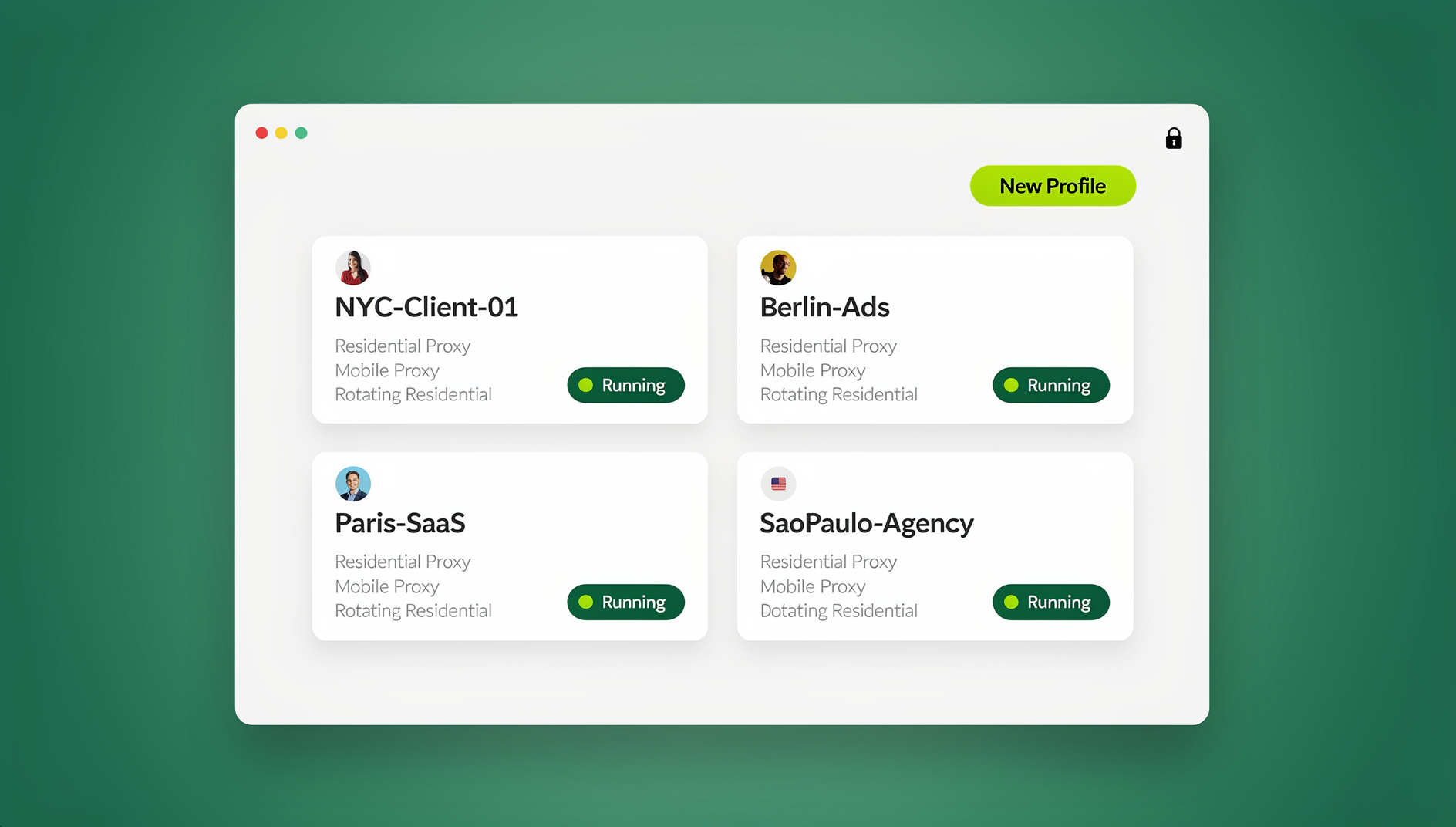
A multi-login browser is the most secure category of software. These tools create fully sandboxed browser profiles, each with its own isolated cookies, local cache, and customized browser fingerprint. Platforms see each profile as a completely separate device. Send.win provides both a local desktop client for running profiles on your machine and cloud browser sessions that run on remote servers, letting you access profiles from any device without installation.
2. Password Managers
Tools like 1Password and Bitwarden are excellent for storing credentials and managing passwords across multiple client accounts. However, they do not offer any browser fingerprint isolation or IP protection. They are a productivity add-on, not a security solution for avoiding bans.
3. Social Media Management Dashboards
Schedulers like Buffer and Hootsuite let you connect multiple social profiles to one central dashboard. They communicate with social platforms via API integrations. While this is convenient for posting, APIs are limited. If you need to respond to messages, join groups, or run ads directly on the site, you still need to log into the web interface. Doing so from a standard browser risks exposing your shared identity.
A Complete Comparison of Management Tools
Before selecting your multi-account software, compare the deployment models and security features of the top options:
| Feature | Standard Browser Profiles | Consumer Session Add-ons | Send.win Multi-Login |
|---|---|---|---|
| Cookie Isolation | Basic | Moderate | Complete Sandboxing |
| Fingerprint Masking | None (Shared hardware) | None (Shared hardware) | Unique Spoofed Fingerprints |
| Proxy Integration | Global setting only | Not supported directly | Per-profile residential proxy |
| Deployment Modes | Local install | Local install | Desktop client + Cloud sessions |
| Team Access Control | Not possible | Not supported | Role-based profile sharing |
How Send.win Protects Your Accounts from Bans
Send.win is designed from the ground up to solve the security risks associated with multi-account operations. It provides a comprehensive workspace environment that completely separates your digital identities.
1. True Browser Isolation
Every profile you create in Send.win runs in a virtualized sandbox. This means that cookies, local storage, indexedDB, and cache files are completely isolated. A website loaded in Profile A has absolutely no way to access the cookies or cache of Profile B, eliminating any risk of cookie cross-contamination.
2. Dynamic Fingerprint Customization
Instead of sharing your local hardware fingerprint, Send.win generates a randomized, natural-looking fingerprint for each profile. It customizes parameters like your canvas rendering, WebGL parameters, audio inputs, operating system user agent, screen resolution, and language settings. Websites see your profiles as distinct devices running on different hardware configurations.
3. Flexible Deployment: Native Desktop Client and Cloud Browser Sessions
Send.win fits into any workflow. The native desktop client runs on Windows, macOS, and Linux, giving you maximum performance and local control over your profiles. If you need to access your profiles on the go, or if your team is distributed, you can launch cloud browser sessions. These sessions run on remote servers, letting you manage your profiles from any device via a simple web interface, without needing to install any software locally.
Managing Multi-Account Actions with Send.win
For businesses operating dozens of accounts, performing tasks manually becomes a massive bottleneck. Send.win is a browser profile manager that gives each profile its own isolated cookies, storage, sessions, fingerprint settings and proxy, so work stays organised across accounts. Marketers, scrapers, and developers can keep each account in its own profile with its own custom user agent, screen dimensions, and residential proxy IP.
Building a Secure Multi-Account Workflow for Your Business
No matter your business model, structuring your daily workflow around secure software is critical to maintaining operational safety.
Workflow for E-Commerce Sellers
If you run multiple stores on digital marketplaces, a single ban can wipe out your revenue. Always use a dedicated profile for each storefront. For instance, when managing multiple Amazon accounts, pair each profile with a dedicated residential proxy located in the same city as the business registration. For safer scaling, implement safe multi-store operations by keeping your inventory data, billing cards, and logistics details separate for each store. This ensures that even if one store undergoes a random verification audit, your other properties remain completely unaffected.
Workflow for Marketing Agencies
Agencies must manage client channels securely. Instead of asking for client passwords, use the team sharing tools in Send.win. Create a profile for the client’s account, set it up with a region-matched proxy, and share the session with your account managers. Your team can access the profile, respond to comments, and manage campaigns without ever seeing the raw credentials. This prevents account lockouts caused by team members logging in from different locations. When choosing your software stack, make sure you evaluate the best browser for multiple accounts based on team collaboration features.
Workflow for Affiliate Marketers
Affiliate campaigns require running multiple ad accounts in parallel. Because ad networks are quick to ban accounts, separation is vital. Create a separate Send.win profile for each ad buyer. Map each buyer profile to its own residential proxy. Never use the same billing credit card across multiple profiles, and avoid using similar ad copy in different accounts simultaneously to prevent automated system-linking blocks.
Best Practices to Maintain Account Security
To get the most out of your software, follow these essential security rules:
- Never reuse proxies: Each proxy IP must remain dedicated to one profile. If you reuse proxies, platforms will immediately link the accounts.
- Separate billing details: Use virtual cards to assign a unique billing name and card number to each business entity. Shared payment methods are a primary linking trigger.
- Limit profile sharing: Only share profile sessions with team members who absolutely need access. Use read-only or operator permissions to restrict access to settings.
- Implement two-factor authentication (2FA): Secure your profiles using app-based 2FA, and store the backup recovery codes in an encrypted password manager.
🏆 Send.win Verdict
Relying on standard browsers to manage multiple accounts is an open invitation for platform bans. Send.win provides the robust security isolation you need to protect your digital assets. With unique fingerprint spoofing, proxy pairing, and the flexibility of both a desktop client and cloud browser sessions, it is the ultimate tool to manage your profiles safely.
Try the free Send.win cloud demo — a 3-minute preview without signup, or 10 minutes a day with a free account, and scale your multi-account operations with separate profiles.
Frequently Asked Questions
Is it illegal to use software for managing multiple accounts?
No, it is completely legal. Businesses use this software for legitimate purposes, such as keeping separate client properties isolated, managing independent LLC finances, and testing cross-browser experiences. However, you must always follow the terms of service of the platforms you access.
Can a standard VPN protect my accounts from being linked?
No. A VPN only hides your IP address, often replacing it with a shared datacenter IP that platforms recognize as commercial and suspicious. VPNs do not isolate your browser cookies, local cache, or hardware fingerprints, leaving your accounts linked and vulnerable.
What is the difference between the desktop client and cloud browser sessions?
The desktop client runs locally on your machine, using your device’s hardware to run isolated profiles. Cloud browser sessions run on remote servers, letting you access and manage your profiles from any device via a web browser without installing any software locally.
How much does Send.win cost?
Send.win has no free trial. Paid plans start with the Pro plan at $19/month or $83.88/year, and the Team plan is $49/month or $251.88/year. The first card purchase is covered by a 7-day money-back guarantee. The only free option is the cloud demo at https://send.win/demo-browser/.
Does Send.win have an Automation API?
Send.win has no automation interface: no API, SDK, headless mode or Selenium/Puppeteer/Playwright support on any plan. Each profile keeps its own isolated cookies, storage, sessions, fingerprint settings and proxy.
Can I share accounts with my team using Send.win?
Yes. The Team plan allows you to share profile sessions with team members. They can access and work inside the profiles without needing to see the raw passwords, keeping your account credentials secure.
Do I need to download any web browser add-ons to use Send.win?
No. Send.win is a complete standalone solution. You do not need to download or install any browser add-ons. You can manage everything through the native desktop client or run profiles directly via cloud browser sessions.