The 29 Best Online Productivity Tools for 2026
Online productivity tools are the quiet difference between a workday that feels like wading through mud and one where you actually finish your list before lunch. This guide rounds up 29 browser extensions and web apps that consistently show up in “how do you actually get things done” conversations among freelancers, marketers, agency owners, and remote teams. We’ve refreshed the original lineup for 2026 — a couple of the old picks were retired or quietly overtaken by better alternatives, and we’ve swapped those in so every tool on this list still works today.
You don’t need all 29. You need the four or five that solve your specific bottleneck — too many tabs, too many passwords, too many logins, too much context-switching. Read through the categories below, pick what matches your workflow, and install only what you’ll actually use.
Why a Modern Productivity Stack Looks Different in 2026
The productivity-extension landscape has shifted quite a bit since lists like this first went viral. A few things changed the calculus:
- Read-it-later apps consolidated. Mozilla’s Pocket shut down its standalone service, pushing a lot of “save for later” traffic toward alternatives like Raindrop.io and Instapaper.
- Multi-account work exploded. Managing five Instagram accounts, three ad accounts, and a dozen client logins used to mean juggling browser profiles or separate incognito windows. Dedicated multi-login browsers now handle this natively.
- AI got baked into everything. Writing assistants, meeting notes, and email tools all added AI layers, but the core job — helping you produce more with less friction — hasn’t changed.
- Automation moved from “nice to have” to “expected.” Teams running QA, scraping, or testing workflows now expect an API they can script against, not just a GUI.
With that context, here’s the full list.
The Complete List: 29 Productivity Tools at a Glance
| # | Tool | Category | Best For | Free Plan? |
|---|---|---|---|---|
| 1 | OneTab | Tab management | Chronic tab hoarders | Yes |
| 2 | Send.win | Multi-account/session management | Managing multiple logins on one site | No |
| 3 | Grammarly | Writing | Email, docs, and social copy | Yes |
| 4 | Raindrop.io | Bookmarking | Saving articles and links to read later | Yes |
| 5 | StayFocusd | Focus/website blocking | Limiting time on distracting sites | Yes |
| 6 | LastPass | Password management | Keeping credentials organized | Yes (limited) |
| 7 | Momentum | Dashboard/new tab | Daily focus and to-dos | Yes |
| 8 | Google Docs Offline | Offline editing | Working without internet | Yes |
| 9 | Boomerang for Gmail | Email productivity | Scheduling sends and follow-ups | Yes (limited) |
| 10 | Clockify | Time tracking | Freelancers billing by the hour | Yes |
| 11 | AdBlock Plus | Ad blocking | Distraction-free browsing | Yes |
| 12 | Power Thesaurus | Writing/vocabulary | Finding the right word fast | Yes |
| 13 | Toggl Track | Time tracking | Teams tracking project hours | Yes (limited) |
| 14 | Text Blaze | Text expansion | Repetitive replies and templates | Yes |
| 15 | Reverso | Translation/grammar | Multilingual writing | Yes |
| 16 | Notion Web Clipper | Research/note-taking | Saving pages straight into your workspace | Yes |
| 17 | Loom | Screen recording | Async video explanations | Yes (limited) |
| 18 | ColorZilla | Design utility | Grabbing colors from any page | Yes |
| 19 | Magical | Text expander & autofill | Filling repetitive forms | Yes |
| 20 | WhatFont | Design utility | Identifying fonts on any site | Yes |
| 21 | Todoist | Task management | Personal and team to-do lists | Yes (limited) |
| 22 | Session Buddy | Tab/session management | Saving and restoring browser sessions | Yes |
| 23 | Diigo | Bookmarking/annotation | Research and highlighting | Yes (limited) |
| 24 | Save to Google Drive | File storage | One-click saving to Drive | Yes |
| 25 | Planyway | Calendar/planning | Visual Trello calendar views | Yes (limited) |
| 26 | Check My Links | QA/link checking | Finding broken links fast | Yes |
| 27 | Streak | CRM in Gmail | Lightweight sales pipelines | Yes (limited) |
| 28 | Buffer | Social scheduling | Planning posts in advance | Yes (limited) |
| 29 | MultCloud | Cloud file transfer | Moving files between Drive, Dropbox, etc. | Yes (limited) |
Tab and Workspace Management
If you routinely have 40+ tabs open and your laptop fan sounds like a hair dryer, start here. OneTab converts every open tab into a single scrollable list with one click, freeing up to 90% of the RAM Chrome was eating. You can restore all tabs at once or pick them individually later — it’s the fastest fix for tab hoarding that exists. Session Buddy does something similar but leans more into named, savable sessions — useful if you work on multiple projects and want to jump between “Client A research” and “Client B research” without losing your place. Between the two, OneTab wins for pure memory recovery; Session Buddy wins if you need to organize tabs into labeled groups you’ll return to for weeks.
Writing, Email and Communication Tools
Grammarly still earns its spot on almost every productivity list because it follows you everywhere text fields exist — Gmail, Slack, LinkedIn, Google Docs — catching typos and awkward phrasing before you hit send. Pair it with Power Thesaurus when you need a synonym fast, and Reverso if you’re writing in a second language and want quick grammar and translation checks side by side.
On the email side, Boomerang for Gmail lets you schedule messages to send later, set follow-up reminders if nobody replies, and pause your inbox when you need uninterrupted focus time. Loom replaces long email threads and meetings entirely for a lot of teams — record your screen and face, share a link, and let people watch async instead of scheduling a call. Text Blaze and Magical both solve the “I type the same reply 40 times a day” problem: define a snippet once, trigger it with a shortcut, and autofill forms or canned responses in seconds.
Time Tracking and Focus Tools
Clockify and Toggl Track are the two names that come up constantly for time tracking — both let you log hours against projects and export reports for invoicing, and both have genuinely useful free tiers. Clockify tends to win for solo freelancers who want unlimited free tracking; Toggl Track tends to win for small teams that want slightly slicker reporting. StayFocusd takes the opposite approach: instead of tracking time, it caps how long you can spend on specific time-wasting sites per day, then locks you out once you hit the limit. Momentum replaces your new-tab page with a calm dashboard — a daily focus question, to-do list, and a photo — so every new tab nudges you back toward your priorities instead of toward a rabbit hole.
Password, Security and Multi-Account Management
LastPass remains one of the most widely used password managers, auto-filling logins and generating strong passwords so you’re not reusing “Password123” across 30 sites. But password management only solves half the problem for anyone who juggles multiple accounts on the same platform — multiple client Gmail inboxes, multiple Instagram or Amazon seller accounts, multiple ad accounts for different clients. That’s a different problem, and it’s where most “productivity stacks” quietly fall apart.
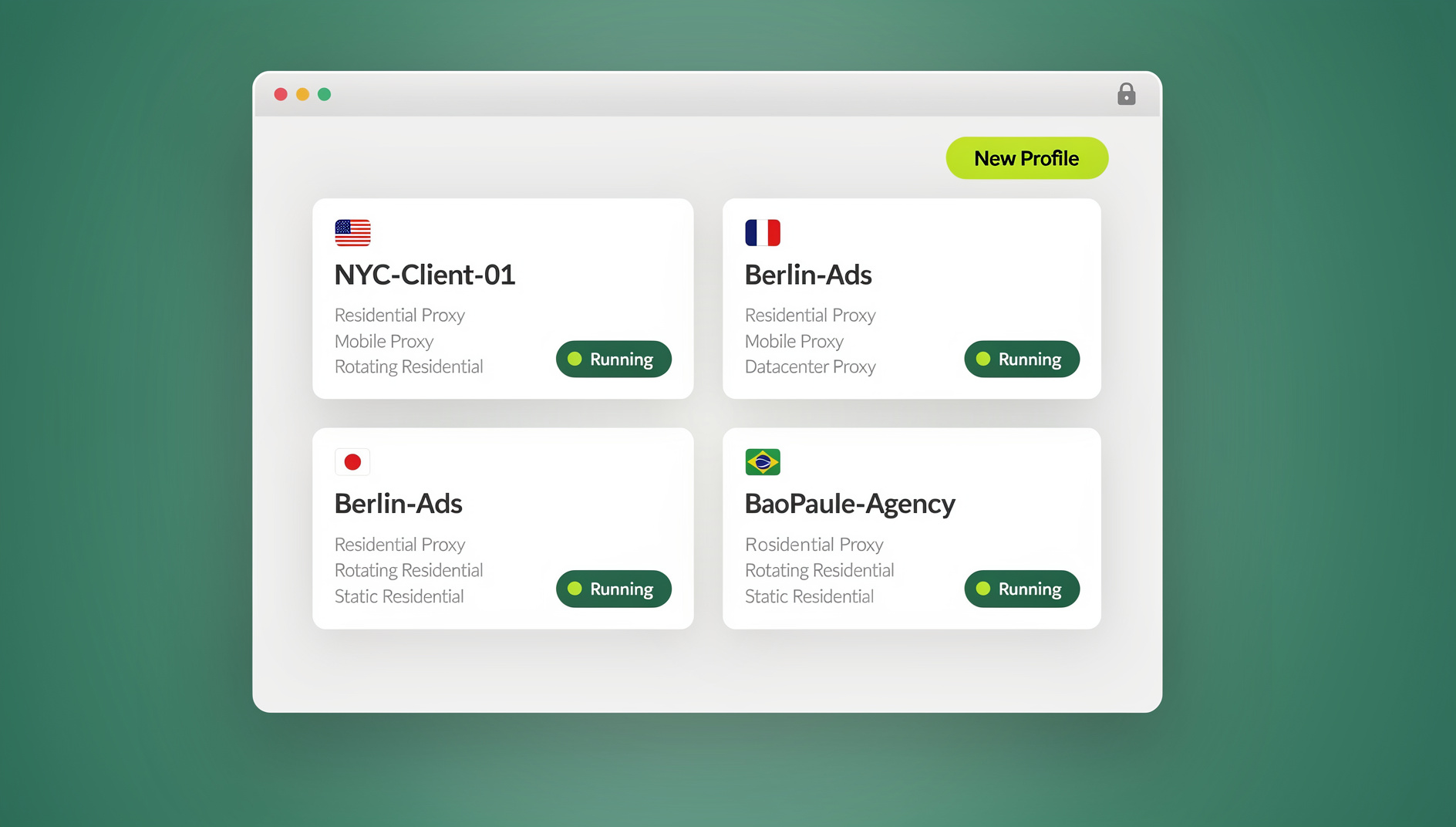
This is exactly the gap Send.win was built to close. It’s an anti-detect, multi-login browser: every profile you create gets its own isolated fingerprint, cookies, and cache, plus a built-in proxy option, so logging into ten Instagram accounts or five Amazon Seller Central accounts from the same machine doesn’t trigger the platform-side flags that come from obvious multi-accounting on one shared browser fingerprint. If you’re currently relying on incognito windows or a second browser to keep client accounts separate, a proper multi-login browser is a meaningfully cleaner setup.
A few things that make Send.win specifically relevant to a productivity-tools list rather than just a niche browser profile manager:
- Native Desktop app. Send.win ships a real installed application for Windows, macOS, and Linux — it isn’t a browser-tab-only tool, so your profiles, proxies, and sessions live in an app you open like any other piece of software on your machine.
- Team sharing without password sharing. You can share a profile with a teammate or client without ever handing over the underlying password, which matters if you manage social accounts, ad accounts, or client logins for a living.
- Built-in proxies. No separate proxy subscription or manual configuration step — proxies are managed inside the same interface as your profiles.
Getting started takes about ten minutes:
- Start with the free cloud demo at send.win/demo-browser, or choose a paid plan (Pro $19/mo or $83.88/yr, Team $49/mo or $251.88/yr) — the first card purchase is covered by a 7-day money-back guarantee.
- Download and install the Send.win Desktop app for your OS, or use it in-browser if you’d rather not install anything yet.
- Create your first profile and assign it a proxy — datacenter, residential, or mobile, depending on what the account you’re managing requires.
- Log into the account inside that isolated profile exactly as you would in a normal browser.
- Repeat for each additional account, and invite teammates to shared profiles from the dashboard when you need collaborative access.
For anyone whose day involves logging into more than two or three accounts on the same platform, this single swap tends to save more time than any other tool on this list — because it removes an entire category of manual workaround (browser profile switching, private windows, second browsers) rather than just speeding up one task.
Research, Reference and Bookmarking Tools
Pocket’s shutdown left a real gap for anyone who used to save articles for later reading, and Raindrop.io is the cleanest replacement — same “save this for later” workflow, plus tagging, folders, and highlighting. Notion Web Clipper does something adjacent but more structured: it saves the page directly into a Notion database you already use for research, which is handy if your notes and your saved links live in the same place anyway. Diigo sits a step further toward heavy research work, letting you highlight and annotate pages and share those annotations with a team — useful for anyone doing competitive research or collaborative fact-checking.
On the pure utility side, ColorZilla and WhatFont are the two extensions designers reach for constantly — grab any color or identify any font on any webpage in one click, no design software required. Check My Links scans a page and flags every broken link in seconds, which is a genuine time-saver if you’re doing an SEO audit or QA pass before publishing.
File Storage, Task Management and Marketing Tools
Google Docs Offline is a small but underrated extension — it lets you keep editing documents on a flight or during a spotty connection and syncs automatically the moment you’re back online. Save to Google Drive adds a right-click “save to Drive” option to any image or page, and MultCloud goes a step further, letting you move files directly between Drive, Dropbox, OneDrive, and other cloud storage accounts without downloading and re-uploading manually.
For task management, Todoist remains one of the cleanest to-do apps around — natural-language due dates, project organization, and a genuinely useful free tier. Planyway layers a visual calendar view on top of Trello, which is worth it if your team already lives in Trello boards but wants a timeline view for deadlines. On the outreach and marketing side, Streak turns Gmail into a lightweight CRM with pipeline stages right in your inbox, and Buffer lets you queue up social posts across platforms in advance instead of posting live every single day — a natural pairing for anyone cutting their to-do list in half by batching repetitive marketing tasks.
Free vs. Paid: What’s Actually Worth Paying For in 2026
| Category | Free tier is usually enough | Paying usually pays off |
|---|---|---|
| Tab management | OneTab, Session Buddy | Rarely necessary |
| Writing assistant | Basic Grammarly | Grammarly Premium for tone/clarity rewrites |
| Password management | LastPass Free (single device type) | LastPass Premium for cross-device sync |
| Time tracking | Clockify Free (unlimited tracking) | Toggl/Clockify paid tiers for reporting + integrations |
| Multi-account/session management | Not really — fingerprinting and proxies need real infrastructure | Send.win Pro ($19/mo) or Team ($49/mo) for reliability and scale |
| Screen recording | Loom Free (limited videos/length) | Loom paid for unlimited length and team libraries |
| Social scheduling | Buffer Free (limited channels) | Buffer paid once you manage 3+ channels or clients |
The general pattern: single-purpose utilities (tab management, color pickers, link checkers) rarely need a paid tier. Tools that scale with your account volume or team size — time tracking, scheduling, and especially multi-account/session management — are where the free plan runs out fastest, because the free tier is usually capped on the exact dimension (accounts, seats, bandwidth) that a growing workflow needs more of.
How to Build Your Own Productivity Stack in 5 Steps
- Audit your actual bottleneck first. Don’t install all 29 tools. Spend one day noticing where you lose the most time — too many tabs, too many logins, too much manual scheduling — and start there.
- Pick one tool per category, not five. Overlapping tools (two password managers, three task apps) create more friction than they remove.
- Separate “personal productivity” from “account management.” Grammarly and Todoist make you faster at the work you’re already doing. A multi-login browser or session manager solves a structurally different problem — keeping parallel identities clean — and deserves its own slot in the stack rather than being treated as optional. If you want the fuller extension roundup this list draws from, see our best Chrome extensions for productivity guide.
- Set up automation once you’re stable. Once your core stack is in place, look at what can run without you — scheduled posts in Buffer, recurring reminders in Boomerang, or other scripted workflows where the tool supports them.
- Review every quarter. Extensions get deprecated (see: Pocket), pricing changes, and better alternatives launch constantly. A 15-minute quarterly review keeps your stack from quietly rotting.
If you’re rebuilding your stack from scratch and want a broader menu beyond this list, our productivity software for solo makers roundup is a good next read, especially if you’re assembling a stack from zero rather than swapping one or two tools.
🏆 Send.win Verdict
Most of the 29 tools on this list make you faster at one task. Send.win solves a different, often bigger drain on your day: the manual workaround of switching browser profiles, opening private windows, or juggling a second browser just to keep multiple accounts on the same platform separate. With isolated cookies, storage and fingerprint settings per profile, built-in proxies, and a native Desktop app, it’s the one tool on this list built specifically for people managing more than a handful of logins — freelancers, agencies, and marketing teams alike.
Try Send.win today — start with the free cloud demo or a paid plan, and see how much time disappears once account-switching stops being manual.
Frequently Asked Questions
What are the best online productivity tools for 2026?
The best productivity tools depend on your bottleneck, but the most broadly useful picks from this list are OneTab for tab overload, Grammarly for writing, Clockify or Toggl Track for time tracking, LastPass for passwords, and Send.win for anyone managing multiple accounts or client logins on the same platform.
What happened to Pocket, and what should I use instead?
Mozilla discontinued the standalone Pocket app in 2025. Raindrop.io is the closest replacement for saving articles and links to read later, with tagging and folder organization that Pocket users will find familiar.
What’s the difference between a password manager and a multi-login browser?
A password manager like LastPass stores and autofills your login credentials. A multi-login browser like Send.win goes further, giving each account its own isolated browser fingerprint, cookies, and optional proxy — which matters when you’re running multiple accounts on the same platform, since sites can flag accounts that all share one obvious fingerprint even if the passwords are different.
Do I need the Send.win Desktop app, or does the browser version work?
Send.win offers a native Desktop app for Windows, macOS, and Linux for full functionality, alongside browser-based access. Most users managing several profiles day-to-day install the Desktop app since it keeps all profiles, proxies, and sessions in one dedicated application rather than another browser tab.
What is Send.win used for?
Send.win is a browser profile manager: each profile keeps its own cookies, storage, sessions, fingerprint settings and proxy, so you can keep multiple accounts and workstreams separate without manually switching browsers.
How much does Send.win cost?
Send.win has no free trial. Paid plans are Pro at $19/month or $83.88/year, and Team at $49/month or $251.88/year; the first card purchase is covered by a 7-day money-back guarantee. The only free option is the cloud demo at https://send.win/demo-browser/.
Which of these tools should a freelancer install first?
Start with a time tracker (Clockify or Toggl Track) for billing accuracy, Grammarly for client-facing writing, and — if you manage more than one client’s social or ad accounts — Send.win to keep those logins cleanly separated from day one rather than retrofitting your workflow later.
Can teams share tools like Send.win without sharing passwords?
Yes. Send.win supports team sharing at the profile level, so a teammate or client can get access to a specific account’s browser session without ever seeing the underlying password — a meaningful upgrade over emailing credentials around a team.