Types of digital marketing is one of those phrases every marketer types into Google at some point — usually right before building a strategy, pitching a client, or trying to figure out where a shrinking budget should actually go. The honest answer hasn’t changed much in structure since digital marketing became a real discipline, but how each channel is executed in 2026 has changed enormously: more ad accounts per business, more social platforms per brand, more affiliate partners, more automation, and a lot more risk of getting a login flagged or an account suspended for logging in from the “wrong” device or IP.
This guide breaks down the six core types of digital marketing — SEO, content marketing, social media marketing, PPC, affiliate marketing, and email marketing — what each one actually involves, how they compare on cost and speed, and how to combine them into one coherent strategy. We’ll also cover the operational side most guides skip: how marketers running dozens of client ad accounts, social profiles, or affiliate logins keep everything organized and unflagged.
What Is Digital Marketing?
Digital marketing is the practice of promoting products, services, or brands using internet-connected channels and technologies — search engines, websites, social platforms, email, and paid advertising networks — instead of (or alongside) traditional offline channels like print, TV, and radio. At its core, it’is about meeting potential customers where they already spend their time online and guiding them, step by step, from awareness to purchase.
What makes digital marketing different from traditional marketing is measurability. Every click, impression, open, and conversion can be tracked, attributed, and optimized in near real time. That measurability is also why there isn’t just one “digital marketing channel” — there are several distinct disciplines, each with its own skill set, timeline, and cost structure. Understanding all six lets you build a strategy that isn’t dependent on a single channel (a lesson a lot of businesses learned the hard way when algorithm updates or ad account suspensions wiped out their only traffic source overnight).
The 6 Types of Digital Marketing
Here is the full list before we go deep on each one:
- Search Engine Optimization (SEO)
- Content Marketing
- Social Media Marketing
- Pay-Per-Click Advertising (PPC)
- Affiliate Marketing
- Email Marketing
1. Search Engine Optimization (SEO)
SEO is the practice of improving a website so it ranks higher in organic (unpaid) search results for relevant queries. It’s built on three pillars:
- Technical SEO — site speed, mobile-friendliness, crawlability, structured data, and Core Web Vitals.
- On-page SEO — keyword targeting, title tags, headings, internal linking, and content depth.
- Off-page SEO — backlinks, brand mentions, and overall domain authority.
SEO is a compounding channel: results are slow to build (often 3-6 months before meaningful traffic) but tend to keep paying off long after the initial work is done, unlike paid ads that stop the moment you stop spending. It’s the best channel for businesses that can invest time before revenue, and the worst channel if you need leads next week.
2. Content Marketing
Content marketing is the creation and distribution of valuable, relevant material — blog posts, videos, podcasts, guides, infographics, case studies — designed to attract and retain a clearly defined audience, without directly pitching a product in every piece. It overlaps heavily with SEO (content is what actually ranks) but also fuels social media, email newsletters, and even sales enablement.
The goal isn’t just traffic. Good content marketing builds trust, answers real buyer questions before a competitor does, and gives you an asset you can repurpose across every other channel on this list — a single well-researched guide can become five social posts, an email sequence, and a lead magnet.
3. Social Media Marketing
Social media marketing covers both organic posting and paid advertising across platforms like Instagram, Facebook, LinkedIn, TikTok, X, Pinterest, and YouTube. It’s the channel most businesses use to build brand awareness, engage directly with customers, and drive traffic through a mix of content, community management, and targeted ad spend.
The catch in 2026: most brands and agencies aren’t running one social account — they’re running a client’s Instagram, Facebook, LinkedIn, and TikTok, plus their own, plus test/backup accounts, often from the same laptop. Platforms increasingly flag or restrict accounts that detect shared devices, shared IPs, or inconsistent login fingerprints, which turns a simple task (posting for five clients) into a genuine account-safety problem. This is exactly where a tool like a multi-login browser earns its keep — each client account gets its own isolated browser profile with a consistent fingerprint, so switching between accounts doesn’t look like suspicious cross-account activity to the platform.
4. Pay-Per-Click Advertising (PPC)
PPC is paid advertising where you bid on placements — search ads, display banners, social ads, shopping ads — and pay only when someone clicks. Google Ads and Meta Ads are the two biggest players, but PPC also includes LinkedIn Ads, Microsoft Advertising, Amazon Ads, and programmatic display networks.
PPC’s biggest advantage is speed: a campaign can go live and start generating clicks within hours, which makes it the go-to channel when a business needs results this week rather than this quarter. The tradeoff is cost — you’re renting attention, not owning it, and the moment the budget stops, so does the traffic.
Agencies and freelance media buyers managing multiple client ad accounts face a specific operational risk here: ad platforms actively look for signs that one person is controlling many accounts from the same browser and IP, which can trigger review holds or suspensions across a client’s entire account, even when nothing was done wrong. Running each ad account in its own isolated profile with a matched proxy — as covered in our guide on how marketers and advertisers manage multiple ad accounts safely — is the standard fix agencies use to keep client accounts in good standing while still working from one machine.
5. Affiliate Marketing
Affiliate marketing is a performance-based model where you (or partners promoting your product) earn a commission for driving a sale, lead, or signup. It works in both directions: businesses recruit affiliates to sell their product, and marketers join affiliate programs to promote other companies’ products for a cut of the revenue.
What makes affiliate marketing attractive is the risk profile — you generally only pay for results, not exposure. What makes it operationally tricky is scale: a serious affiliate marketer is often running many test campaigns, multiple ad accounts, several tracking domains, and sometimes several affiliate network logins simultaneously, all of which need to stay cleanly separated so one flagged campaign doesn’t take down the rest of the portfolio. Our breakdown on how to scale affiliate campaigns securely covers the profile-isolation and proxy setup affiliates use to run dozens of campaigns without cross-contaminating accounts.
6. Email Marketing
Email marketing remains one of the highest-ROI digital channels because it reaches an audience that already opted in — no algorithm to fight, no ad auction to win. It covers newsletters, promotional campaigns, abandoned-cart sequences, onboarding drips, and re-engagement flows, usually run through platforms like Klaviyo, Mailchimp, or HubSpot.
The strategic value of email is ownership: unlike a social following or ad account, your email list is an asset you control directly. A platform policy change or account suspension can’t take it away from you, which is exactly why most seasoned marketers treat list-building as a hedge against every other channel on this list.
How the 6 Types of Digital Marketing Compare
No single channel is universally “best” — each trades off speed, cost, and durability differently. Here’s how they stack up side by side:
| Channel | Time to Results | Relative Cost | Durability | Best For |
|---|---|---|---|---|
| SEO | 3-6+ months | Low ongoing, high upfront effort | High — compounds over time | Long-term organic traffic |
| Content Marketing | 1-3 months | Low-medium | High — reusable asset | Trust-building, fueling other channels |
| Social Media Marketing | Days-weeks | Low (organic) / Medium (paid) | Medium — algorithm-dependent | Brand awareness, engagement |
| PPC Advertising | Hours-days | High, scales with spend | Low — stops when budget stops | Fast, measurable lead generation |
| Affiliate Marketing | Weeks-months | Performance-based (pay per result) | Medium — depends on partners | Scaling reach without upfront ad spend |
| Email Marketing | Immediate (to existing list) | Very low | Very high — you own the list | Retention, repeat sales, nurturing |
How to Choose the Right Mix for Your Business
Most successful digital marketing strategies don’t pick one channel — they sequence several:
- Start with a foundation. A basic website with on-page SEO and a lead-capture form gives every other channel somewhere to send traffic.
- Add a fast channel for immediate results. PPC or paid social buys you data and revenue while slower channels like SEO and content are still ramping up.
- Layer in content marketing. Use it to fuel SEO, give social media something to post, and build the email list.
- Build your owned audience early. Every visitor from PPC, social, or organic search should have a reason to join your email list — it’s the one channel immune to algorithm and auction changes.
- Scale with affiliates once you have proof. Affiliates convert best when there’s already a track record (reviews, case studies, conversion data) to point to.
The right ratio depends on budget, timeline, and industry — an e-commerce brand might lean 40% paid social, 30% email, 20% content/SEO, 10% affiliate, while a B2B SaaS company might flip that entirely toward SEO, content, and LinkedIn.
The Multi-Account Problem Digital Marketers Don’t Talk About Enough
Here’s the part most “6 types of digital marketing” guides skip entirely: in practice, executing all six channels well means logging into a lot of accounts. A single mid-size agency might be juggling:
- 10-30 client Google Ads and Meta Ads accounts (PPC)
- Multiple client social profiles across Instagram, Facebook, LinkedIn, and TikTok (social media marketing)
- Several affiliate network dashboards and tracking-domain logins (affiliate marketing)
- Multiple email platform accounts and sender domains (email marketing)
- Client and personal Google Search Console / analytics logins (SEO)
Doing all of this from one browser, one IP, and one device is exactly the pattern ad platforms and social networks are built to flag as suspicious — because it’s the same pattern bad actors use to run fake accounts at scale. The result is real, innocent marketers getting hit with review holds, temporary restrictions, or full suspensions simply for switching between five client Meta Ads accounts in the same session.
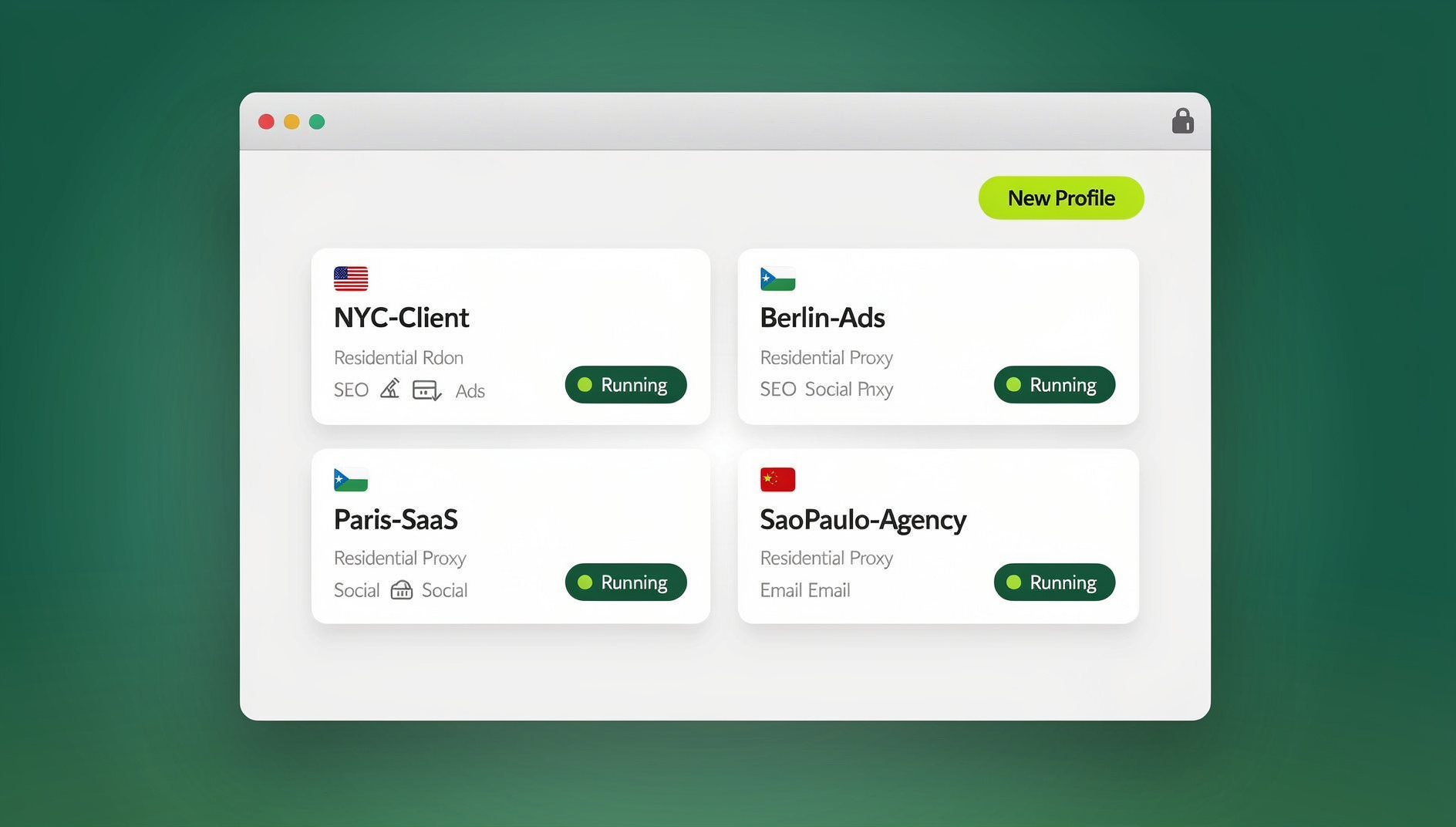
This is where a purpose-built multi-login browser like Send.win fits into a digital marketing workflow rather than a general “browser tab manager.” Send.win gives every account — client, personal, test, or affiliate — its own isolated browser profile with a unique, consistent device fingerprint, so each login looks like it’s coming from its own separate device, not one marketer’s laptop switching hats forty times a day. Add a dedicated proxy per profile (residential, datacenter, or mobile, built into Send.win) and platforms see distinct devices in distinct locations, exactly what they expect from separate legitimate users.
For agencies specifically, Send.win’s team-sharing feature lets you hand a client’s ad account or social profile to a teammate or contractor without ever handing over the actual password — access can be shared and revoked instantly, which matters a lot when contractor turnover is common in performance marketing. And because campaign work often needs to happen on whatever machine is in front of you, Send.win ships a native Desktop app for Windows, macOS, and Linux, so profiles stay available and consistent whether you’re at the office, at home, or on a client site. Marketers running repetitive, high-volume tasks — bulk campaign audits, scheduled reporting pulls, QA checks across dozens of client accounts — can keep each account in its own isolated profile with its own cookies, storage and fingerprint settings, so those checks stay organised account by account.
Common Mistakes Across These 6 Channels
| Channel | Common Mistake | Fix |
|---|---|---|
| SEO | Chasing rankings with no conversion path | Map every target keyword to a clear next step (signup, purchase, contact) |
| Content Marketing | Publishing without a distribution plan | Budget as much time for promotion as creation |
| Social Media | Managing many client accounts from one flagged-looking browser | Use dedicated social media management tools with isolated profiles per account |
| PPC | No negative keyword or audience exclusion strategy | Review search term reports and exclusions weekly |
| Affiliate | Relying on one affiliate network or a handful of partners | Diversify partners and tracking domains |
| Buying lists instead of building them | Grow lists organically through opt-ins tied to content offers |
🏆 Send.win Verdict
Understanding the 6 types of digital marketing is step one — actually running SEO, social, PPC, affiliate, and email campaigns across dozens of client and personal accounts is the real day-to-day challenge. Send.win solves the operational side: isolated browser profiles with their own cookies, storage and fingerprint settings for every account, built-in proxies to match each login’s location, one-click team sharing so contractors never need your passwords, and a native Desktop app for daily campaign work.
Try Send.win today — plans start at $19/mo, the first card purchase is covered by a 7-day money-back guarantee, and you can preview it free in the cloud demo at https://send.win/demo-browser/ to see how much smoother multi-channel, multi-account marketing feels with the right browser behind it.
Frequently Asked Questions
What are the 6 main types of digital marketing?
The six core types are search engine optimization (SEO), content marketing, social media marketing, pay-per-click advertising (PPC), affiliate marketing, and email marketing. Most complete digital strategies combine several of these rather than relying on just one.
Which type of digital marketing is best for beginners?
Content marketing and email marketing are usually the easiest entry points because they require minimal budget — just time and consistency. SEO and PPC have steeper learning curves around keyword research and bidding strategy, while affiliate marketing typically requires an existing audience or traffic source to be effective.
How much does digital marketing cost per month?
Costs vary enormously by channel and business size. SEO and content marketing can run from a few hundred dollars a month (DIY tools and freelance writers) to several thousand for agency retainers. PPC budgets are flexible but typically start around $500-$3,000/month to gather meaningful data. Email marketing platforms often start free or under $50/month for smaller lists.
Can I do all 6 types of digital marketing at once?
Yes, but sequencing matters more than doing everything simultaneously from day one. Most businesses start with a fast channel (PPC or social ads) alongside a foundational one (SEO/content), then layer in email capture, and add affiliate marketing once they have proof of conversions to offer partners.
Why do social media and ad accounts get flagged when managing multiple clients?
Platforms like Meta and Google monitor for patterns associated with fake accounts or ban evasion — one of the strongest signals is many different accounts logging in from the same device fingerprint and IP address. Agencies switching between numerous client accounts on one browser unintentionally trigger the same detection systems, even though the activity is entirely legitimate.
How does a multi-login browser like Send.win help digital marketers specifically?
It gives each client, personal, or affiliate account its own isolated browser profile with a distinct, consistent fingerprint and (optionally) its own proxy, so platforms see what looks like separate normal users rather than one person operating many accounts. This reduces false-positive suspensions and lets teams share account access without sharing passwords.
Do I need the Send.win Desktop app or is the browser tool enough?
Send.win’s native Desktop app for Windows, macOS, and Linux is how most marketers run their day-to-day profile switching, since it keeps sessions, proxies, and fingerprint settings synced locally. Agencies that also need to keep repetitive checks (bulk account audits, scheduled reporting) organised can give each account its own isolated profile with its own cookies, storage and fingerprint settings on top of the same setup.
What’s the difference between SEO and content marketing?
SEO is the technical and strategic practice of making a website rank well in search engines — it includes content but also site speed, structure, and backlinks. Content marketing is the broader practice of creating valuable material (which may or may not target search rankings) to attract and engage an audience across any channel, including social and email.