Resolving the Complexity of B2B Systems Multiple Customer Accounts Management
B2B platforms implement b2b systems multiple customer accounts management by building isolated tenant databases, utilizing centralized Single Sign-On (SSO) controllers, and deploying secure role-based access control. These measures prevent cross-tenant data leakage while allowing managers to switch between client environments. In this guide, we cover the top architecture patterns, platforms, and session tools to manage multiple client accounts safely.
The Critical Importance of Account Isolation in B2B Operations
In B2B business models, service providers, software vendors, and digital agencies do not simply deal with individual consumers. Instead, they manage business entities. Each business entity consists of its own organizational hierarchy, employee lists, billing parameters, and proprietary datasets. Thus, a secure database partition between these client organizations is not just a nice-to-have feature; it is an absolute requirement for regulatory compliance, data privacy, and customer trust.
A single data leak—such as Client A seeing the user list, project files, or billing rates of Client B—can immediately result in a breach of contract, legal liability, and irreparable brand damage. B2B software architectures must therefore be designed from the ground up to prevent cross-contamination while still allowing providers to administer the accounts efficiently.
Furthermore, operational friction occurs when account managers, customer success representatives, or implementation specialists have to log in and out of different client accounts repeatedly. Creating systems that balance tight security boundaries with operational efficiency is one of the greatest challenges of B2B platform development.
Enterprise clients also demand rigorous assurances regarding how their data is handled. Under regulations such as the General Data Protection Regulation (GDPR) and the Health Insurance Portability and Accountability Act (HIPAA), data must be strictly isolated. B2B vendors must prove that they possess the logical and physical safeguards to prevent client information from being intermingled. This level of compliance requires systematic planning across the entire infrastructure stack, from database servers down to the browser environments used by support technicians.
Architectural Approaches: Single-Tenant vs. Multi-Tenant Systems
When developing or configuring B2B systems to manage multiple customer accounts, architects choose between two major deployment models: Single-Tenant and Multi-Tenant, or a hybrid version of the two.
Single-Tenant Architecture
In a single-tenant model, each customer company receives a completely isolated instance of the software application, running on its own dedicated server and database. There is no physical sharing of resources between different clients.
This approach offers the highest level of security and compliance, as it physically prevents data from leaking across databases. It also allows custom software modifications and custom release schedules for individual enterprise accounts. However, single-tenant architectures are expensive to host, complex to update, and difficult to manage at scale because every client requires a separate deployment pipeline.
Maintenance overhead in single-tenant setups is a major bottleneck. If you need to deploy a critical security patch, you must run the deployment script 100 times for 100 clients. This increases the likelihood of configuration drift, where different client environments end up running slightly different versions of the software, making troubleshooting a nightmare.
Multi-Tenant Architecture
In a multi-tenant model, all customer companies share the same application instance and database server. Data isolation is maintained logically. Each table in the database includes a Tenant ID column, and the application code enforces strict filters on every query to ensure that a user from Company A can only retrieve rows that match Company A’s Tenant ID.
Multi-tenant architectures are highly cost-effective, easy to upgrade, and scale effortlessly. However, they carry higher risks. A single bug in the database query layer or application authorization code can expose data across tenants. Additionally, a “noisy neighbor” (a client running high-volume queries) can degrade platform performance for all other tenants sharing the same database resources.
The Hybrid Model
Many modern SaaS companies deploy a hybrid architecture. In this setup, the frontend application layer is shared (multi-tenant), but the database layer is split, giving each customer company its own separate database or schema. This configuration provides a balance, reducing server costs while maintaining strong data separation at the database layer. Below is a detailed comparison of these architectural approaches.
| Dimension | Single-Tenant | Multi-Tenant | Hybrid Approach |
|---|---|---|---|
| Infrastructure Cost | Very High (dedicated resource per client) | Low (shared resources) | Moderate (shared app, split DB) |
| Security Partition | Physical (highest isolation) | Logical (dependent on code filters) | Logical/Database Schema Level |
| Update Complexity | High (needs individual deploys) | Very Low (update once for all) | Moderate (automated schema sync) |
| Customization | Full code/database customization | Limited to settings/branding config | Configuration-based per schema |
Key Features of Modern B2B Systems for Account Isolation
Regardless of the underlying server architecture, B2B platforms must integrate specific features to handle multiple customer accounts securely.
Centralized Identity and Federated Sign-On
Instead of building custom login portals for every client, B2B systems should route authentication through a centralized Identity Provider (IdP) supporting SAML or OpenID Connect (OIDC). This enables enterprise clients to log into the platform using their internal corporate credentials (via Okta or Microsoft Azure Active Directory). Centralized identity simplifies security for both the client (who can enforce their own password and MFA rules) and the vendor (who does not have to store sensitive password credentials).
Fine-Grained Role-Based Access Control (RBAC)
B2B platforms require nested permission structures. At the top level is the account owner, who manages contract details and billing. Below are administrators, project managers, general users, and external contractors. The platform must dynamically evaluate these roles to determine which pages, settings, and database records are accessible to a given user. Support teams must also have scoped access, allowing them to view customer accounts to troubleshoot issues without gaining access to payment methods or administrative settings.
Audit Logging and Compliance Tracking
To meet SOC 2, HIPAA, or ISO 27001 standards, B2B systems must maintain detailed, tamper-proof logs of all administrative actions. If an account manager changes a user’s permissions, updates billing records, or accesses customer data, the system must log the event, recording the user ID, timestamp, IP address, and details of the modification. These audit trails are vital during security reviews and compliance audits.
Practical Challenges in Browser-Level Multi-Account Management
While B2B developers focus on server-side security, operations teams face a practical challenge: how do they access these separate customer accounts from their web browsers?
The Danger of Session Contamination
Most operations professionals—such as ad campaign managers, customer support agents, and billing administrators—need to jump between different customer dashboards all day. If they use a standard web browser like Google Chrome, the browser stores cookies and local data globally. When they log into Company A’s portal, the session cookie overwrites the session cookie for Company B. This forces the operator to constantly log out and log back in, causing significant delay.
Worse, this can cause data to save in the wrong account. If an operator has multiple tabs open and the session token switches in the background, submitting a form in Tab 1 might apply the changes to the account loaded in Tab 2. To mitigate this risk, operators need a dedicated cookie management tool or a secure, profile-isolated browser environment.
Session leaks can also lead to cache bleed. In some situations, sensitive images, customer records, or financial reports may remain in the browser’s disk cache. If a technician opens another customer’s dashboard in a different tab of the same browser profile, the browser might display cached records from the previous customer, constituting an internal data leak.
The Risks of Credential Juggling
Without proper tools, support teams often resort to insecure workarounds to manage multiple sets of credentials. They might share passwords via spreadsheet files, write them down on sticky notes, or use standard password managers that autofill credentials across client portals. These practices expose client portals to unauthorized access and prevent proper tracing of who performed an action. B2B teams should instead use secure profile sharing, where access is granted via active browser sessions without exposing underlying passwords.
How to Configure Safe Browser Environments for B2B Operations
To safely execute multi-account tasks without session cross-talk, B2B support and operations teams can employ several techniques.
Configuring Native Browser Profiles
One common workaround is creating separate browser profiles. A user can create a profile for Client A, a profile for Client B, and so on. In Google Chrome, this isolates cookies and history between the profiles. You can learn more about setting this up in our Chrome multi account configuration guide.
However, native browser profiles do not scale well. Creating and managing profiles for 50 or 100 customer accounts is incredibly tedious. Furthermore, native profiles cannot be easily shared between team members, and they store data locally, meaning if an agent switches computers, they lose their active sessions.
Proactively running dozens of profiles also consumes significant CPU and RAM, slowing down client troubleshooting work.
Using Send.win for Enterprise-Grade Session Isolation
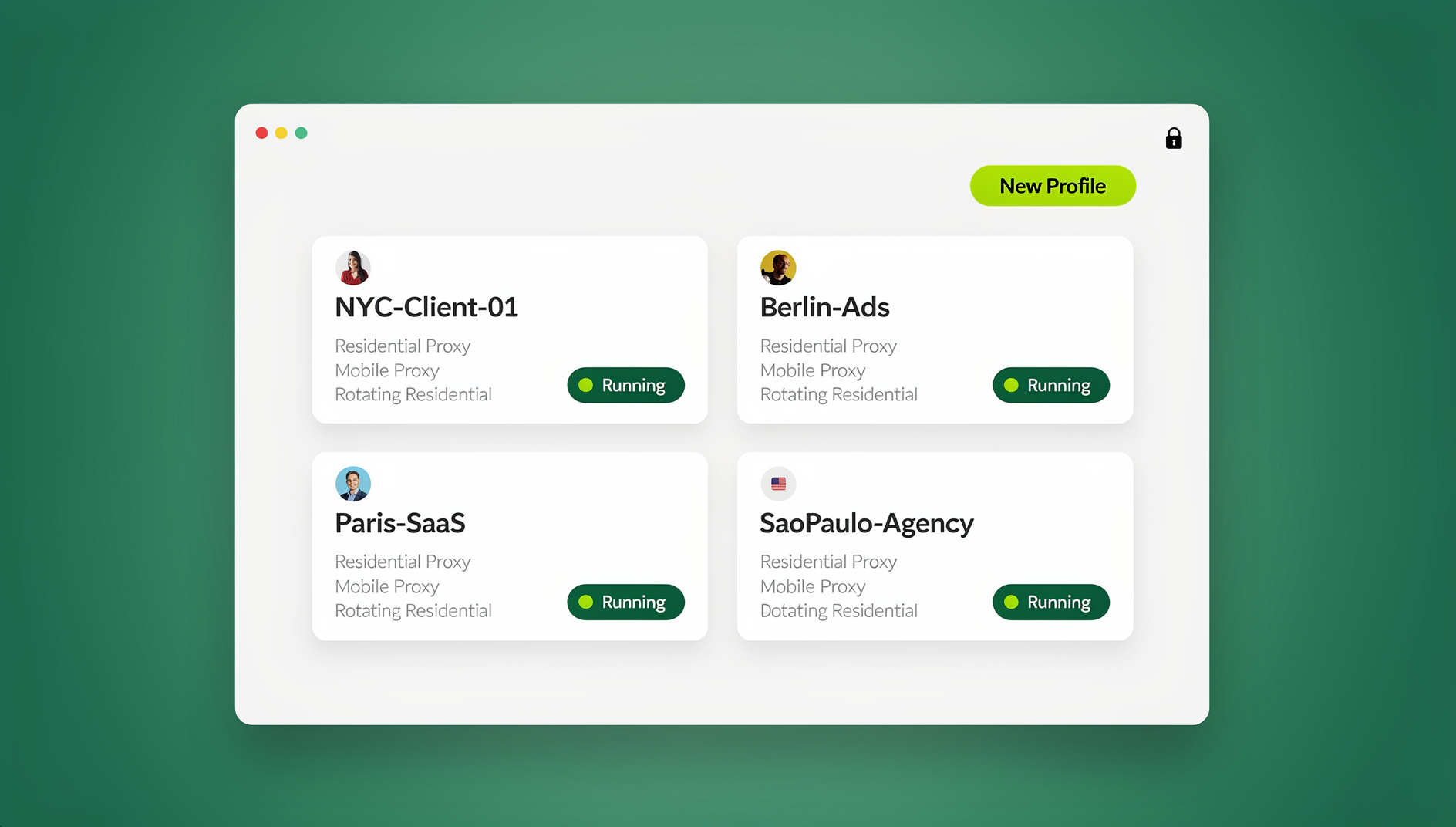
To overcome the limits of native browser profiles, B2B teams use Send.win. Send.win is a professional platform designed to isolate and run multiple browser sessions concurrently. Every profile in Send.win is completely sandboxed, isolating cookies, cache, local storage, and browser fingerprint metadata to prevent any data leaks between customer accounts.
Send.win does not provide any browser add-ons or legacy browser plugins. It operates via two secure models:
- Sendwin Browser: A native desktop app for Windows, macOS, and Linux that runs profiles locally with hardware-accelerated performance.
- Cloud Browser Sessions: Segregated profiles hosted in secure cloud servers, allowing teams to log into customer dashboards from any device without installing any software locally.
By using Send.win, account managers can switch between customer portals with a single click. There is no risk of session leakage, and teams can share pre-authenticated sessions securely without exchanging passwords, maintaining an exact audit trail of who accessed each profile.
Since Send.win operates at the container layer, it optimizes resource allocation. Rather than launching fully independent browser instances that drain RAM, Send.win isolates profiles at the session level, ensuring that technicians can run dozens of parallel accounts smoothly on standard office hardware.
Industry-Specific Use Cases for Multi-Account Operations
Managing multiple customer environments is a common operational task across several digital industries, each with unique challenges.
Digital Advertising Agencies
Ad agencies manage Google Ads, Meta Business Manager, and TikTok Ads accounts for dozens of clients. Ad platforms are highly sensitive to account logins; accessing multiple client portals from a single browser profile can trigger automatic security flags and lead to account suspensions. Agencies use a secure browser for ads management to keep client profiles completely isolated, using dedicated proxies to ensure each account appears to log in from its own static geographic location.
E-Commerce Store Managers
Agencies that run store operations for multiple brands must access Amazon Seller Central, Shopify Admin, and Stripe merchant dashboards. Similar to ad platforms, e-commerce portals monitor logins closely to prevent fraud. Juggling these environments without container separation can lead to merchant accounts being flagged as “linked store operations.” Implementing session isolation is crucial for managing multiple Amazon accounts safely.
Managed IT Service Providers (MSPs)
MSPs support customer IT infrastructure across Microsoft 365, AWS, and Azure. MSP technicians must monitor and log into client portals to reset passwords, configure security policies, or review alert dashboards. Using isolated browser environments allows technicians to keep multiple client portals open on separate screens, improving response times and ensuring that administrative changes are applied only to the intended tenant.
Pricing and Team Features of Send.win
Send.win provides flexible subscriptions designed to match your team’s size and operational needs. Every plan starts with a 30-day free trial that requires no credit card, giving you ample time to evaluate the platform.
- Pro Plan: $19/month ($6.99/month when billed annually). Includes 150 isolated profiles, 5GB of proxy bandwidth, and access to the Automation API.
- Team Plan: $49/month ($20.99/month when billed annually). Designed for collaborative groups, this plan supports 500 profiles, 20GB of proxy bandwidth, 16 team seats, and full Automation API access.
- Add-Ons: Scale your resources at any time. Extra proxy bandwidth is priced at $6.00/GB, and additional profiles cost $0.05/profile.
🏆 Send.win Verdict
Efficient multi-customer account management in B2B systems depends on secure data separation. Send.win provides isolated sandboxed browser sessions and secure team profile sharing, allowing your account managers to switch between client environments instantly and safely without risking session leakage.
Try Send.win free today — start managing multiple client accounts with zero risk.
Frequently Asked Questions
What is B2B systems multiple customer accounts management?
It is the operational process of creating, partitioning, and managing separate digital profiles and database records for different customer companies within a B2B business system.
Why is session isolation important in multi-account management?
Without session isolation, web browsers mix cookies and local data across tabs. This can lead to account logout loops, database save errors, and unauthorized access to customer data.
How do multi-tenant databases keep customer data isolated?
They logical separate data using Tenant IDs. Every database table includes a Tenant ID column, and the backend code automatically filters queries to ensure users only retrieve their own data.
Is a cookie management tool sufficient for B2B account security?
While a cookie manager helps clean data, it does not isolate browser fingerprint parameters or local storage. For enterprise-grade security, teams need a dedicated session-isolated browser like Sendwin Browser.
Does Send.win offer a free trial or demo?
Yes. Send.win offers a 30-day free trial with no credit card required, allowing you to test all features including isolated profiles and the Automation API.
What features are included in Send.win’s Team plan?
The Team plan includes 500 isolated profiles, 20GB of proxy bandwidth, the local Automation API, and up to 16 team seats for collaborative profile management and session sharing.
How do B2B support agents switch between customer sessions without logging out?
Agents use the Sendwin Browser desktop app or cloud browser sessions. Each customer profile runs in its own isolated container, permitting side-by-side access to multiple client dashboards.
Can I run automated testing across customer accounts in Send.win?
Yes. Send.win offers a local Automation API on its Pro and Team plans, which integrates with Selenium, Puppeteer, or Playwright to run automated testing scripts across customer accounts.