Why Managing Multiple Microsoft Teams Accounts Demands Session Isolation
To manage multiple microsoft teams accounts without constant tenant switching or authentication collisions, you must isolate each organization’s session state into dedicated browser containers. Standard Teams apps and browser tabs share authentication tokens, forcing disruptive tenant logouts. Using isolated browser profile containers with session isolation allows IT consultants, MSPs, and multi-tenant professionals to run 10+ active Teams instances simultaneously with independent cookies, persistent logins, and real-time notifications.
📌 TL;DR Executive Summary
- Core Takeaway: Microsoft Entra ID single sign-on (SSO) architecture binds browser cookies globally, making simultaneous multi-tenant collaboration impossible in standard browser tabs or basic desktop clients.
- Key Risk/Challenge: Token overwrites, constant MFA re-prompting, missed client messages during tenant switching, and identity bleed across cross-tenant SharePoint/OneDrive links.
- Recommended Solution: Sandboxed profile containers via Sendwin Browser or Cloud Sessions isolate authentication tokens, cookies, and local caches per client tenant, maintaining persistent multi-tenant access.
The Multi-Tenant Reality for MSPs, Consultants, and Contractors
Modern enterprise workflows rarely fit neatly into a single corporate domain. IT consultants, managed service provider (MSP) engineers, fractional executives, legal advisors, and freelance project managers routinely operate across multiple client organizations every business day. Each client provisions a dedicated Microsoft 365 identity within their own Microsoft Entra ID (formerly Azure AD) tenant to enforce security boundaries, access controls, and compliance monitoring.
When you attempt to manage multiple microsoft teams accounts across these disparate environments, the standard Microsoft collaboration stack breaks down. A typical technical consultant might need to monitor:
- Internal Corporate Tenant: Your primary employer identity for internal standups, company announcements, and payroll.
- Client Production Tenants: Direct member or guest accounts in 3 to 7 client tenants requiring immediate response times for incident triage.
- Admin & Partner Portals: Elevated administrative accounts requiring strict conditional access and separate multi-factor authentication (MFA).
- Vendor & Community Hubs: External partner organizations and Microsoft developer network channels.
Operating across these boundaries in real time is a core professional requirement. Yet traditional desktop software and unified browser windows treat identity as a singular, monolithic state. When you switch contexts, the underlying platform struggles to reconcile contradictory authentication claims, leaving you locked in endless re-authentication loops.
Under the Hood: Entra ID Tokens, Cookies, and Session Conflicts
Understanding why Microsoft Teams resists multi-account management requires examining the Microsoft Entra ID authentication handshake. When you log into Microsoft 365 or Teams on the web, your browser navigates to login.microsoftonline.com and initiates an OAuth 2.0 / OpenID Connect authorization code flow.
Upon successful credential verification and MFA completion, the authorization server issues several critical session artifacts stored directly in your browser storage:
- ESTSauth and ESTSAUTHPERSISTENT Cookies: Core authentication cookies written to the
.login.microsoftonline.comdomain that maintain your active login state across Microsoft 365 web apps. - SignInStateCookie: Tracks user flow, active tenant context, and authentication step progression.
- Primary Refresh Tokens (PRT) & Access Tokens: Cached in browser
localStorage,sessionStorage, and IndexedDB partitions for endpoints liketeams.microsoft.comandgraph.microsoft.com. - bpos_id Cookie: Identifies the user’s specific business portal online identity across regional Microsoft clusters.
In a standard web browser, all tabs share a single, shared cookie jar and local storage partition for any given domain. When you open a second tab to log into Client B’s Microsoft Teams tenant while Client A is active in the first tab, the authentication response from Client B overwrites the ESTSauth cookies for login.microsoftonline.com.
The moment you click or receive a message in Client A’s tab, Teams attempts to refresh its background token using the newly overwritten cookie jar. The Entra ID endpoint detects a mismatched tenant ID and user principal name (UPN), instantly throwing an AADSTS50020 error (“User account from identity provider does not exist in tenant”) or kicking you back to the “Pick an account” selection screen.
Comparing Workaround Strategies: Desktop Client, Chrome Profiles, and Incognito
Professionals have developed several makeshift strategies to handle multiple Microsoft accounts, but each approach introduces serious operational friction, memory bloat, or security vulnerabilities.
1. The Microsoft Teams Desktop App (New Teams Multi-Tenant / MTMA)
Microsoft released the “New Teams” client with Multi-Tenant, Multi-Account (MTMA) support, allowing users to add multiple work or school accounts. While an improvement over the legacy Electron client, major technical limitations persist:
- Limited Concurrency: You can only actively interact with one tenant window at a time. Background accounts show small notification badges but require a context switch to read or respond.
- Delayed Background Notifications: Background tenants frequently experience notification lag or silent disconnections when tokens expire in the background.
- Guest Tenant Friction: Switching to organizations where you are registered as a Guest rather than a full Member still triggers a slow UI reload that unloads your current meeting or active call.
- System Overhead: Running multiple instances within the native client consumes excessive system memory and CPU cycles during active calls.
2. Multiple Chrome or Edge Browser Profiles
Creating separate user profiles inside standard browsers (like Google Chrome or Microsoft Edge) physically separates cookie storage directories on your disk. While functional, scaling this workflow beyond 3 or 4 tenants becomes unmanageable:
- Window Clutter: Each browser profile runs as an entirely separate operating system application instance with its own window stack, filling your taskbar.
- Excessive RAM Consumption: Ten Chrome profiles running Microsoft Teams Web can easily swallow 12GB to 16GB of RAM, crippling your machine.
- Zero Centralized Session Management: If you work across multiple devices (desktop, laptop, mobile), you must manually set up, authenticate, and configure profiles on every individual machine.
- No Proxy Integration: Standard browser profiles route traffic through your default local network connection, failing if specific client tenants require static IP whitelisting or geo-specific egress points.
3. Incognito and InPrivate Windows
Private browsing windows provide a temporary, clean cookie partition. However, Incognito mode is fundamentally flawed for persistent daily work:
- Ephemeral Storage: All session data, cached files, and authentication tokens vanish the moment you close the window.
- MFA Fatigue: You must complete full username, password, and multi-factor authentication verifications every single morning or whenever a window accidentally closes.
- Zero Desktop Notification Integration: Private windows frequently block persistent service workers and push notification registrations.
| Method | Simultaneous Real-Time Access | Persistent Logins (No Daily MFA) | RAM Efficiency | Dedicated Proxy / IP Support | Cross-Device Cloud Sync |
|---|---|---|---|---|---|
| Teams Desktop (MTMA) | ❌ Single active focus | ✅ Yes | ⚠️ Moderate | ❌ No | ❌ No |
| Chrome/Edge Profiles | ✅ Yes (Separate windows) | ✅ Yes | ❌ Poor (High RAM) | ❌ No (Global OS network) | ❌ No |
| Incognito Windows | ⚠️ Limited (1 extra session) | ❌ No (Wiped on close) | ✅ High | ❌ No | ❌ No |
| Send.win Profile Containers | ✅ Yes (Side-by-side tabs) | ✅ Yes (Encrypted local/cloud) | ✅ High (Shared engine) | ✅ Yes (Per-profile proxy) | ✅ Yes (Cloud sync) |
The Clean Solution: Containerized Profile Isolation for Microsoft Teams
The definitive engineering solution to manage multiple microsoft teams accounts is containerized browser session isolation. Rather than launching separate heavyweight browser instances or fighting desktop client constraints, session containers create virtualized sandboxes within a single unified browsing window.
When applying managing multiple accounts architecture to Microsoft Teams, every profile container encapsulates:
- Independent Cookie Stores: Tab A holds Client Alpha’s
ESTSauthtokens, while Tab B holds Client Bravo’s tokens in complete mathematical isolation. Neither tab can read, modify, or overwrite the other’s authentication state. - Isolated Storage Partitions: IndexedDB instances, Web SQL databases, and
localStoragecaches used by the Teams Web client are partitioned per container. - Persistent Device Fingerprint & State: Browser attributes remain stable across reboots, preventing Microsoft Entra ID from triggering repeated “Unrecognized Device” risk-based Conditional Access prompts.
- Dedicated Network Routes: Each profile container can bind to specific proxy browsers configurations, ensuring traffic to Client A originates from an authorized static corporate IP while Client B routes via standard residential connections.
https://teams.microsoft.com/_#/conversations/?tenantId=YOUR_TENANT_ID) to bypass the tenant-picker redirect entirely.
Step-by-Step Setup: Running 10+ Microsoft Teams Sessions Simultaneously
Configuring a frictionless multi-tenant Microsoft Teams workstation using Send.win takes only a few minutes. Whether you are using the native Sendwin Browser desktop client (available for Windows, macOS, and Linux) or running Cloud browser sessions from any remote machine, follow these structured steps:
Step 1: Create Client-Specific Profile Containers
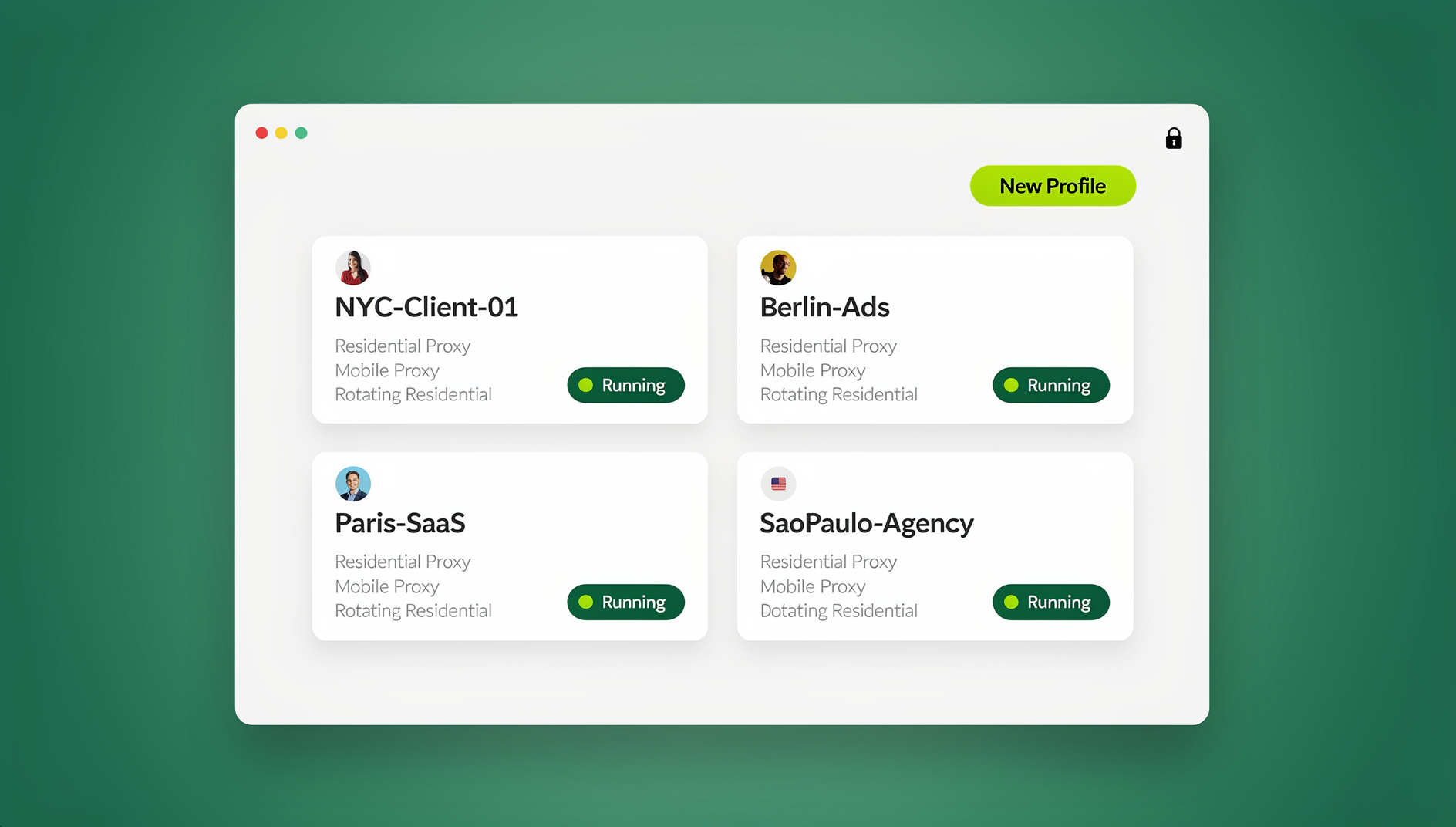
Launch the Sendwin Browser application. Click New Profile to create dedicated containers for each client organization. Assign recognizable identifiers and visual cues:
- Profile 1: “Internal – HQ (US East)” (Emerald Green)
- Profile 2: “Client FinTech – Entra ID” (Navy Blue)
- Profile 3: “Client Healthcare – Compliance Tenant” (Crimson Red)
- Profile 4: “MSP Admin – Tier 3 Support” (Amber Orange)
Step 2: Attach Network Proxies (If Required by Client Security)
If any client tenant enforces IP-based Conditional Access policies (restricting access to specific office networks or approved VPN egress gateways), open the profile’s network settings. Input the dedicated HTTP/HTTPS/SOCKS5 proxy host, port, and authentication credentials. Sendwin routes all traffic for that specific profile through the designated gateway while keeping other client profiles on your direct internet connection.
Step 3: Authenticate and Establish Persistent Sessions
Open each profile in a dedicated tab. Navigate to https://teams.microsoft.com. Complete the login flow for the corresponding client credentials, including Microsoft Authenticator push notifications, FIDO2 security keys, or SMS codes. Because Sendwin preserves session state across restarts, your Entra ID tokens remain securely cached—eliminating repetitive daily logins.
Step 4: Enable Desktop Notifications and Audio/Video Permissions
Grant browser notification, microphone, and camera permissions within each profile tab. Microsoft Teams Web delivers rich HTML5 desktop notifications. Because each profile runs concurrently, you will receive real-time banner alerts and sound pings the instant a client messages you in any tenant, regardless of which tab you are currently viewing.
Step 5: Organize Tab Groups for One-Click Workflow Access
Organize your active Teams sessions into synchronized tab groups. With Send.win’s workspace management, you can group all communication tools (Teams, Slack, Outlook Web, Jira) by client project, opening and closing entire client workspaces with a single click without ever logging out.
Navigating Conditional Access, MFA, and Security Compliance
Enterprise IT administrators enforce strict security governance over Microsoft 365 environments. Understanding how profile isolation interacts with these security mechanisms ensures you maintain compliance while eliminating operational friction.
Conditional Access Policies (CAP)
Microsoft Entra ID Conditional Access evaluates signals—such as user identity, IP location, device platform, and client application—before granting access to Teams data. Profile isolation ensures each client profile transmits consistent session parameters. If Client A requires connections from a specific geographic region, assigning a static geo-targeted proxy to that container satisfies the CAP boundary without altering the routing of your other client sessions.
Device Compliance and Modern Authentication
When connecting to high-security client tenants, administrators may require device registration. Using Sendwin’s persistent local storage engine guarantees that the cryptographic keys and hardware tokens generated during the initial WebAccountManager / browser handshake remain intact, avoiding unexpected token revocations.
Zero-Trust Isolation and Safe Browsing Hygiene
In multi-client consulting, security is a two-way street. You must protect your internal systems from potential malware in client file shares while ensuring client data never leaks across boundaries. Isolated containers enforce strict safe browsing protocols: downloaded files, cached scripts, and session cookies from Client A are completely segregated from Client B’s environment, preventing cross-tenant data leaks and accidental cross-posting.
Optimizing Memory and Performance Across Dozens of Concurrent Sessions
Running 10 or more active Microsoft Teams sessions simultaneously can place significant demands on system memory if not managed intelligently. Microsoft Teams Web is a full-featured single-page application (SPA) that loads substantial JavaScript bundles and real-time WebSocket listeners.
To ensure smooth performance on laptops and workstations, implement these optimization practices:
- Leverage the Native Desktop Client Engine: The Sendwin Browser desktop client utilizes a shared rendering core across all profiles. Unlike opening 10 separate Chrome profile windows (which launch 10 independent browser process trees), Sendwin manages memory dynamically, reducing RAM overhead by up to 60%.
- Utilize Cloud Browser Sessions for Low-Spec Devices: If you are working from a lightweight ultrabook or Chromebook, offload heavy Teams processing entirely to Send.win Cloud Browser sessions. The sessions execute on high-performance cloud infrastructure, streaming the responsive interface directly to your screen with zero local memory consumption.
- Disable Unnecessary Background Video Feeds: When participating in simultaneous client meetings, utilize audio-first mode or gallery view optimizations in background tabs to conserve GPU decoding capacity.
- Automate Routine Maintenance via Automation API: For MSP teams monitoring alert channels across dozens of tenants, Send.win includes an Automation API (compatible with Selenium, Puppeteer, and Playwright on both Pro and Team plans) to automate health checks and message scraping without keeping 50 tabs actively rendering.
🏆 Send.win Verdict
Attempting to manage multiple Microsoft Teams accounts through desktop client tenant-switching or cluttered browser profiles results in missed messages, token collision errors, and severe memory exhaustion. Send.win provides true cryptographic session isolation, allowing consultants, MSPs, and agencies to run unlimited concurrent Microsoft Teams tenants with persistent logins, dedicated proxy routing, and seamless cloud synchronization. With Pro starting at $19/mo ($6.99/mo annual for 150 profiles, 5GB storage, and Automation API) and Team at $49/mo ($20.99/mo annual with 500 profiles, 20GB storage, Automation API, and 16 seats), Send.win empowers teams with frictionless multi-tenant collaboration.
Try Send.win free today — start your 30-day free trial with no credit card required and experience frictionless multi-tenant collaboration.
Frequently Asked Questions About Managing Multiple Teams Accounts
Can you be logged into multiple Microsoft Teams accounts at once?
Yes. While the standard Microsoft Teams desktop app limits active engagement to one primary account at a time, using an isolated multi-login browser like Sendwin Browser allows you to run dozens of distinct Microsoft Teams accounts simultaneously in separate container tabs with independent logins and real-time notifications.
Why does Microsoft Teams keep logging me out when I switch between client accounts?
Microsoft Entra ID uses global session cookies (such as ESTSauth) stored at the domain level. When you open a standard browser tab to log into another tenant, it overwrites the existing authentication cookies. The original tab detects this mismatch during background token refresh, invalidating your session and forcing a re-login.
What is the difference between guest access and full multi-tenant accounts in Teams?
Guest access allows an external user (using their home organization credentials) to participate in limited channels within another company’s tenant. Full multi-tenant accounts occur when each client provisions a distinct, dedicated email address (e.g., [email protected] and [email protected]) inside their own directory. Full multi-tenant accounts require complete session isolation to operate concurrently.
Does the “New Microsoft Teams” desktop app fix the multi-account problem completely?
No. Although the “New Teams” client introduced Multi-Tenant, Multi-Account (MTMA) support, it only displays one active tenant interface at a time. Switching tenants still causes brief disconnections, background tenant notifications are frequently delayed, and managing more than 3 or 4 client organizations remains cumbersome.
How does session isolation prevent Microsoft Entra ID cookie contamination?
Session isolation partitions the browser’s cookie jar, localStorage, sessionStorage, and IndexedDB cache at the container level. Each container operates in a sandboxed environment where Microsoft Entra ID authentication tokens are strictly contained, preventing them from overwriting credentials in adjacent tabs.
Can I assign different proxy IPs to specific Microsoft Teams tenant profiles?
Yes. Send.win allows you to assign unique HTTP, HTTPS, or SOCKS5 residential or datacenter proxies to individual profile containers. This is essential for consultants who must access client tenants protected by IP-whitelisting or geo-restricted Conditional Access policies.
Will running multiple Teams accounts in Send.win trigger security alerts on client tenants?
No. Because Send.win maintains persistent, authentic browser device fingerprints and preserves valid Entra ID OAuth refresh tokens, your connection appears to Microsoft security systems as a legitimate, continuous browser session from a single authorized device.
How does Send.win compare to using separate Google Chrome profiles for Teams?
While Chrome profiles offer basic cookie separation, each profile launches as a separate window process, consuming massive amounts of RAM and cluttering your OS taskbar. Send.win runs all isolated sessions inside unified, color-coded tabs within a single window, supports per-profile proxy assignment, and offers cloud synchronization across devices.
How Send.win Helps With Manage Multiple Microsoft Teams Accounts
Send.win is an antidetect browser built for exactly this kind of work — every profile is a clean, isolated identity:
- Isolated profiles – unique fingerprint, separate cookies and storage per profile
- Stealth engine – canvas, WebGL, fonts, and audio spoofed at the engine level
- Desktop app + cloud sessions – native app for Windows, macOS, and Linux, or run profiles in the cloud with no install
- Built-in residential proxies – with automatic timezone, locale, and WebRTC matching
- Team features – share logged-in profiles with teammates without sharing passwords
Try the instant cloud browser demo — no install, no signup — or download the desktop app. The 30-day free trial needs no credit card, and paid plans start at $6.99/month billed annually (see pricing).