What “Assigning a Proxy to a Session” Actually Means in Send.win
Every browser session in Send.win is an isolated profile — its own cookies, local storage, cache, and browser fingerprint, completely walled off from every other session you run. When you assign a proxy to a session, you’re pairing that isolated profile with its own outbound IP address, so the site you’re logging into sees a unique, consistent location for that account every single time you open it. No shared IP, no VPN toggling between tabs, no accidentally logging into three different accounts from the same address in the same afternoon.
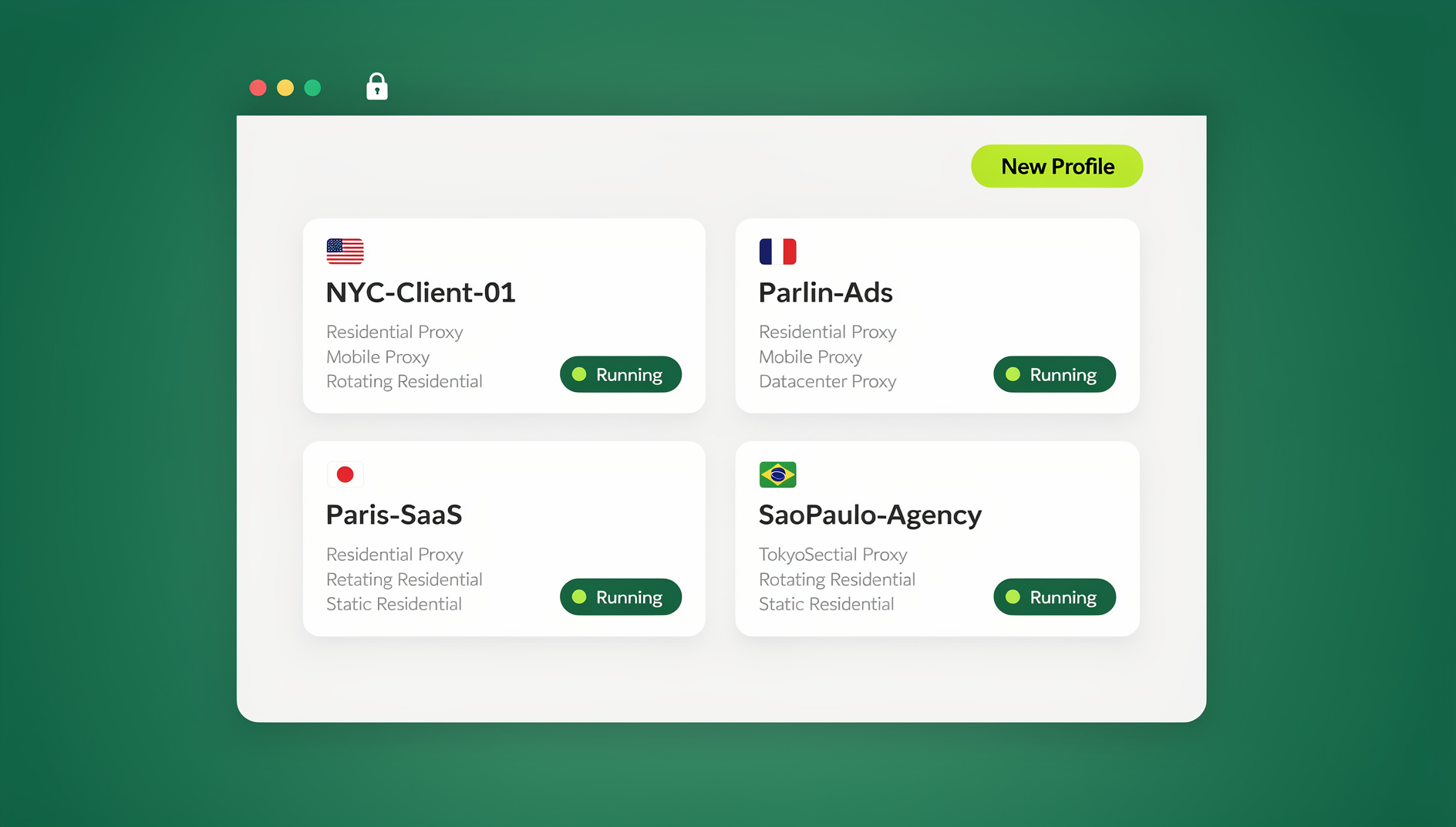
This matters more in 2026 than it did when this guide was first written. Platforms like Amazon, Meta, TikTok Shop, and most ad networks now fingerprint far more than your IP — but IP consistency is still one of the first and cheapest signals they check. If Session A (your main Instagram account) and Session B (a client’s Instagram account) both connect from your home Wi-Fi, that’s a shared-IP correlation the platform can see instantly. Give each session its own proxy, and each one looks like a completely separate person browsing from a completely separate place.
Why You Should Assign a Unique Proxy to Every Session
Avoiding Multi-Account Flags and Bans
Most platform bans on multi-accounting aren’t triggered by the account itself — they’re triggered by the network fingerprint linking two “different” accounts back to the same IP. Assigning each Send.win session its own proxy breaks that link at the network layer, on top of the browser-fingerprint isolation Send.win already gives every profile.
Matching Geography, Timezone, and Language
A session that claims to be a UK-based account but connects through a US datacenter IP is an instant red flag. When you assign a proxy located in the correct region, Send.win can align the session’s timezone, locale, and language settings to match — so the account looks coherent from every angle, not just the IP.
Isolating Client or Team Workflows
Agencies running dozens of client ad accounts, or teams managing multiple marketplace stores, need each client’s session to stay on its own network path — both for account safety and so nothing from Client A’s proxy config ever bleeds into Client B’s session. Per-session proxy assignment is what makes that separation clean and auditable.
Before You Start: What You’ll Need
Setting a proxy on a session takes under a minute once you have the right details on hand. You’ll need either:
- A proxy from your own provider (host/IP, port, username, and password), or
- One of Send.win’s built-in proxies, available directly inside the session settings on Pro and Team plans
Proxy Types Supported
Send.win works with the standard proxy protocols used across the browser profile management industry:
| Proxy Type | Best For | Trade-off |
|---|---|---|
| Residential | Social media, marketplaces, ad platforms — anywhere fingerprint trust matters most | Higher cost per GB, but far lower flag risk |
| Mobile (4G/5G) | Highest-trust platforms (Instagram, TikTok) where carrier IPs read as “real users” | Most expensive, sometimes slower |
| Datacenter | Bulk automation, testing, scraping, non-sensitive workflows | Cheapest, but easiest for platforms to detect and block |
| ISP (static residential) | Long-lived accounts that need a stable, unchanging IP over months | Good balance of trust and stability, moderate cost |
Send.win’s Built-In Proxies vs Bringing Your Own
If you don’t already have a proxy provider, Send.win’s Pro and Team plans include built-in proxy bandwidth (5GB on Pro, 20GB on Team, with $6/GB add-ons if you need more) — so you can assign a proxy to a session directly from the same panel without juggling a third-party proxy dashboard. If you already run proxies through Bright Data, Oxylabs, Smartproxy, or a similar provider, Send.win accepts those credentials too — there’s no lock-in either way.
Step-by-Step: How to Assign a Proxy to Each Session (Cloud Browser Sessions)
Here’s the exact workflow for setting a proxy on a session using Send.win’s cloud browser sessions, right from the web dashboard — no local install needed:
- Open Send.win and go to your sessions list, or create a new session if you’re starting fresh.
- Find the session you want to assign a proxy to and click the three-dot menu beside its name.
- Select “Settings” from the dropdown menu.
- Open the “Proxy” (or “Others”) tab inside the session settings panel.
- Choose a proxy source — pick one of Send.win’s built-in proxies, or select “Add New” to enter your own provider’s host, port, username, and password.
- Set the proxy type (HTTP, HTTPS, or SOCKS5) to match what your provider issued.
- Save the settings and refresh the session.
- Verify the connection by opening the session and checking the IP address shown in the profile toolbar or an IP-checking site.
That’s the whole process — once it’s saved, the proxy sticks to that specific session permanently. You can repeat the same steps for every other session, mixing and matching proxy locations as needed, and each one will keep its own independent IP every time you launch it.
Assigning a Proxy from the Send.win Desktop App
Send.win’s native Sendwin Browser desktop app for Windows, macOS, and Linux is the local-first way to run sessions, with encrypted cloud sync — and proxy assignment works the same way there, with a couple of practical advantages for anyone managing a large number of sessions:
- Bulk proxy import: paste a list of proxies (one per line) and assign them across many sessions in one action, instead of clicking into each session’s settings individually.
- Persistent local sessions: desktop sessions run outside a browser tab, so proxy connections and session state survive browser crashes or restarts.
- Better resource handling: if you’re running 20+ proxy-backed sessions at once for a team or agency workflow, the desktop client generally handles that load more smoothly than juggling the same number of cloud browser sessions in open tabs.
To assign a proxy in the desktop app: open the session card, click “Edit Session,” go to the Proxy tab, enter or select your proxy, and save — functionally identical to the cloud browser session flow, just in a native window.
Assigning Proxies to Sessions in Send.win
If you’re managing proxies across many sessions — for QA testing, research, or organising multiple accounts — manually clicking through settings for each one doesn’t scale. Send.win has no automation interface: there is no API, SDK, headless mode or Selenium/Puppeteer/Playwright support on any plan, so proxy assignment is done manually in the app for each profile.
- Create (or select) a session and pass in the proxy host, port, and credentials as part of the session config.
- Run your automated flow — the script now inherits both the session’s fingerprint and its assigned proxy automatically.
This is especially useful for QA teams testing geo-specific site behavior, agencies rotating proxies across dozens of ad accounts on a schedule, and anyone who needs proxy-per-session consistency enforced by code rather than by memory.
Verifying Your Proxy Is Actually Working
A proxy that’s “assigned” but not actually routing traffic is worse than no proxy at all — it gives you false confidence. Always confirm the connection before trusting a session with real account activity:
- Check the displayed IP in the session toolbar or by visiting an IP-lookup page inside the session and comparing it against your proxy provider’s expected IP range.
- Run a WebRTC leak test. WebRTC can leak your real local IP even when an HTTP/SOCKS5 proxy is active on the rest of the connection — worth understanding in more depth in our WebRTC leak protection guide.
- Confirm timezone and locale match the proxy’s geographic location — a mismatch here is one of the most common causes of account flags even when the IP itself looks clean.
- Test latency. If pages are timing out or loading unusually slowly, the proxy may be overloaded or the provider’s endpoint may be down — swap it before running any real account activity.
Common Proxy Assignment Mistakes (and How to Fix Them)
| Mistake | Why It’s a Problem | Fix |
|---|---|---|
| Reusing one proxy across multiple sessions | Defeats the entire point — platforms see the shared IP and link the accounts anyway | Assign one dedicated proxy per session, no exceptions for related accounts |
| Mismatched proxy location vs. account details | An account with a US billing address browsing through a Vietnam-based IP looks suspicious | Match proxy geography to the account’s stated location and set timezone/locale accordingly |
| Using free/public proxies | Often already blacklisted, extremely slow, or logging your traffic | Use a reputable residential, mobile, or ISP proxy provider — or Send.win’s built-in proxy bandwidth |
| Never rotating stale datacenter proxies | Platforms build reputation blocklists over time against known datacenter IP ranges | Rotate datacenter proxies periodically; use residential/mobile for sensitive, long-lived accounts |
| Skipping the verification step | A misconfigured proxy can silently fail back to your real IP without any warning | Always check the visible IP and run a leak test after saving a new proxy |
Proxy Rotation Strategies for Teams Running Many Sessions
Once you’re past a handful of sessions, proxy management becomes a workflow problem, not just a settings toggle. A few patterns that scale well:
- Sticky proxies per account, not per task. The proxy should stay bound to the session/account long-term, not rotate every login — consistency is what builds trust with a platform over weeks and months.
- Separate proxy pools by risk tier. Use mobile or ISP proxies for your highest-value, longest-lived accounts, and reserve cheaper datacenter proxies for disposable or testing sessions.
- Document proxy-to-session mapping. When you’re creating sessions in Send.win at scale, keep a simple spreadsheet or naming convention linking each session to its proxy provider and location — it saves hours when troubleshooting a flagged account later.
- Hand off proxy-configured sessions safely. If a client or teammate needs access to an account without seeing the raw proxy credentials, share the session with your team through Send.win rather than exporting credentials manually.
Choosing Between IPv4 and IPv6 Proxies for Your Sessions
Most providers still default to IPv4, but IPv6 proxy pools are increasingly common and considerably cheaper per IP in bulk. The trade-off is that some platforms treat IPv6 ranges differently in their fraud scoring, so it’s worth understanding the practical differences — including cost, compatibility, and detection risk — before switching a batch of sessions over. Our IPv6 vs IPv4 proxy comparison breaks down which protocol fits which use case.
It’s also worth being clear on what a proxy is (and isn’t) doing for you compared to a VPN, since the two get conflated constantly in multi-account discussions. A proxy applies per-session or per-app, which is exactly why Send.win pairs it with individual profiles rather than routing your entire device through one tunnel; a VPN applies system-wide instead. If you’re deciding between the two for a broader privacy setup, our proxy vs VPN breakdown covers the distinction in more depth.
🏆 Send.win Verdict
Assigning a proxy to each session is one of the highest-leverage things you can do inside Send.win — it takes the fingerprint isolation you already get from separate profiles and pairs it with genuine network-level separation, so each profile keeps its own cookies, storage and fingerprint alongside its own proxy. Whether you’re setting proxies one by one in a cloud browser session from the web dashboard or bulk-importing them in the Sendwin Browser desktop app, the workflow scales from a single side hustle to a full agency stack without changing tools.
Try the free Send.win cloud demo — a 3-minute preview without signup (10 minutes a day with a free account), and assign your first proxy-backed session in under two minutes.
Frequently Asked Questions
Do I need my own proxy, or does Send.win provide one?
Both options work. Pro and Team plans include built-in proxy bandwidth (5GB and 20GB respectively) that you can assign directly from session settings, or you can bring proxy credentials from your own provider — Send.win supports HTTP, HTTPS, and SOCKS5 proxies from any source.
Can I use the same proxy for more than one session?
Technically yes, but it defeats the purpose. If two “separate” accounts share the same proxy IP, most platforms can still link them together. Assign one dedicated proxy per session whenever the sessions need to look independent.
How do I know if my proxy is actually working?
Open the session and check the IP shown in the toolbar or an IP-lookup site — it should match your proxy provider’s location, not your real network. Also run a WebRTC leak test, since WebRTC can occasionally leak your real IP even with a proxy active.
What’s the difference between a proxy and Send.win’s session isolation?
Session isolation keeps each profile’s cookies, cache, storage, and browser fingerprint separate. A proxy adds a separate network-level IP on top of that isolation. You want both — fingerprint isolation without IP separation (or vice versa) leaves an obvious correlation signal.
Which proxy type should I use for social media accounts?
Residential or mobile proxies are strongly preferred for platforms like Instagram, TikTok, and Facebook, since they read as real consumer connections rather than flagged datacenter ranges. Datacenter proxies are fine for lower-risk, non-sensitive automation.
Can I assign proxies automatically through a script instead of the UI?
No — Send.win has no automation interface on any plan: there is no API, SDK, headless mode or Selenium/Puppeteer/Playwright support, so sessions and proxy configuration cannot be set up programmatically. Proxies are assigned manually per profile in the app.
Does assigning a proxy slow down my browsing session?
Some latency is normal since traffic routes through an extra hop, but a quality residential or ISP proxy adds minimal noticeable delay. If a session feels sluggish or times out repeatedly, it’s usually a sign the specific proxy endpoint is overloaded — swap it rather than troubleshooting the session itself.
Is the Send.win Desktop app required to assign proxies, or does the cloud browser work too?
Both work identically for proxy assignment. Cloud browser sessions — run right from the web dashboard with no install — are fine for a handful of sessions; the native Sendwin Browser desktop app (Windows/macOS/Linux) is worth switching to once you’re managing dozens of proxy-backed sessions, since it supports bulk proxy import and handles heavier session loads more reliably than juggling many cloud sessions in browser tabs.