Can You Safely Manage Multiple AWS Accounts in the Same Browser?
To safely manage multiple AWS accounts in a single browser without cookie conflicts or session overlaps, you should use separate browser profiles or an isolated multi-login browser. The AWS Management Console relies on authentication cookies that overwrite each other in a standard browser tab, which can lead to performing actions in the wrong account; utilizing isolated browser profiles or cloud browser sessions keeps each account’s session data completely sandboxed.
Running a single AWS account is straightforward, but as your infrastructure matures, managing a multi-account architecture becomes essential. Amazon Web Services (AWS) itself recommends separating resources into distinct accounts based on environment, business unit, and security requirements. For DevOps engineers, Managed Service Providers (MSPs), security teams, and cloud administrators, this means accessing production, staging, development, and security accounts every single day.
Juggling multiple environments in standard browsers introduces massive operational risks. A simple copy-paste error or an active session overlap can result in running destructive commands in a production console instead of a development sandbox. In this playbook, we will analyze the security risks of multi-account console access, explore native identity configurations, and demonstrate how session isolation tools solve authentication conflicts to keep your infrastructure safe.
The Critical Risks of Juggling AWS Consoles in Standard Tabs
Using a single browser window to access different AWS accounts creates serious security vulnerabilities and performance bottlenecks for IT teams.
The Console Session Collision Hazard
The AWS Management Console uses cookies to track user identity and permission levels. When you log into an AWS account, the browser saves these cookies. If you open a new tab and try to log into a different AWS account, the new session will overwrite the active cookies. This can lead to a dangerous situation where clicking “refresh” in your production tab automatically switches its identity to your development account, or vice versa, leading to accidental deletions of critical resources.
Single Sign-On (SSO) and Okta Authentication Loops
Most enterprise AWS environments enforce single sign-on (SSO) using Okta, Ping Identity, or Microsoft Entra ID. When you log into AWS through your corporate portal, the identity provider sets authentication cookies. Juggling multiple corporate portals inside a single browser profile causes these identity cookies to collide, forcing constant log-outs, password prompts, and security alerts that break your engineering workflow.
Compliance and Audit Trail Pollution
Security frameworks like SOC 2 and ISO 27001 require precise logging of all administrative actions. If multiple engineers share credentials or access consoles using non-isolated browser environments, tracing who performed a specific action in AWS CloudTrail becomes difficult. Ensuring that each administrative login is completely isolated is a key requirement for modern compliance standards.
To prevent these risks and maintain a clean audit trail, implementing modern session isolation is a core operational requirement.
Architecting a Sound AWS Multi-Account Strategy
AWS recommends separating your workloads into multiple accounts to limit the blast radius of security incidents and allocate costs accurately.
AWS Organizations and Consolidated Billing
AWS Organizations is the foundation of a multi-account setup. It allows you to create new AWS accounts programmatically, group them into hierarchical structures, and consolidate billing. With consolidated billing, you receive a single invoice for all member accounts, allowing you to qualify for volume discounts across your entire organization.
Recommended Organizational Unit (OU) Structures
To manage multiple accounts efficiently, organize them into Organizational Units (OUs) with specific Service Control Policies (SCPs) applied. A standard architecture includes:
- Security OU: Dedicated accounts for centralized logging (storing CloudTrail and VPC Flow Logs) and security tooling (such as GuardDuty and Security Hub).
- Infrastructure OU: Accounts for shared networking, DNS directories, and transit gateways.
- Workloads OU: Separate accounts for Production, Staging, and Development environments, ensuring complete isolation of active code.
- Sandbox OU: Free-use accounts for developers to experiment with new AWS services, secured by strict spending limits.
Authentication Gateway: IAM Identity Center (AWS SSO) and Roles
Managing access to multiple accounts requires centralized identity governance rather than creating local IAM users in every account.
Centralized Access with IAM Identity Center
AWS IAM Identity Center (formerly AWS Single Sign-On) allows you to manage user portal logins centrally. You connect your identity provider (like Okta or Azure AD) to the Identity Center, define permission sets, and assign users to specific accounts. When engineers log in, they see a portal listing all accounts and roles they are authorized to access.
Cross-Account IAM Roles
For cross-account access (such as a deployment script in a CI/CD account deploying resources to a production account), you configure cross-account IAM roles. The target account creates a role with a trust policy that allows the source account to assume it. The source account then uses the AWS Security Token Service (STS) to obtain temporary, short-lived credentials, avoiding the risk of hardcoded API keys.
Method 1: Native Role Switching inside the AWS Console
AWS provides a native “Switch Role” feature within the Management Console to allow users to navigate between accounts.
How to Use Native Role Switching
- Log into your primary AWS account using your standard credentials.
- Click your username in the top-right corner of the console header.
- Select Switch Role from the dropdown menu.
- Enter the Target Account ID, the Role Name, and an optional display name and color.
- Click Switch Role. The console will reload under the assumed role.
Limitations of the Native Switcher
While native role switching is useful for quick checks, it has severe limitations for day-to-day work. The console only remembers up to 5 roles in its history, which is insufficient for engineers managing dozens of client environments. Furthermore, assuming a role logs you out of your base account in that browser tab, preventing you from monitoring both environments side-by-side. The session duration is also limited, forcing you to re-authenticate frequently and interrupting long-running administrative tasks.
Method 2: Local Browser Profiles (Chrome/Edge)
To monitor production and development environments side-by-side, many teams set up dedicated browser profiles.
Setting Up Local Profiles
- Open Google Chrome or Microsoft Edge and click your user profile icon.
- Select Add or Add Profile.
- Assign the profile a specific color and a clear name (e.g., “AWS Production”).
- Open the new window, navigate to the AWS console, and sign in.
- Repeat this for your development and security accounts, arranging the windows on your screen.
Disadvantages of Local Profiles
Standard browser profiles resolve cookie conflicts, but they are not built for team collaboration. These profiles are saved locally on your physical machine. If you switch computers or travel, you must recreate the profiles and pass MFA checks again. Additionally, running multiple profiles locally consumes large amounts of memory, slowing down your machine.
All local profiles also share the same hardware device fingerprint and public IP address. If your client enforces strict security policies, accessing multiple consoles from the same IP can trigger automated security alerts. Using a dedicated multi-login browser provides a more secure approach.
Method 3: Professional Account Isolation with Sendwin
Sendwin is a browser profile manager designed to help DevOps teams and IT consultants manage multiple cloud environments securely. It isolates browser sessions at both the cookie and fingerprint level, eliminating session conflicts.
Sendwin offers two core modes of operation:
- Sendwin Browser Desktop Client: A desktop application that runs isolated browser profiles locally on your computer, providing high-speed performance for console navigation.
- Cloud Browser Sessions: A zero-install solution that runs browser profiles on secure, remote cloud servers. This allows engineers to access AWS consoles from any device without local hardware overhead.
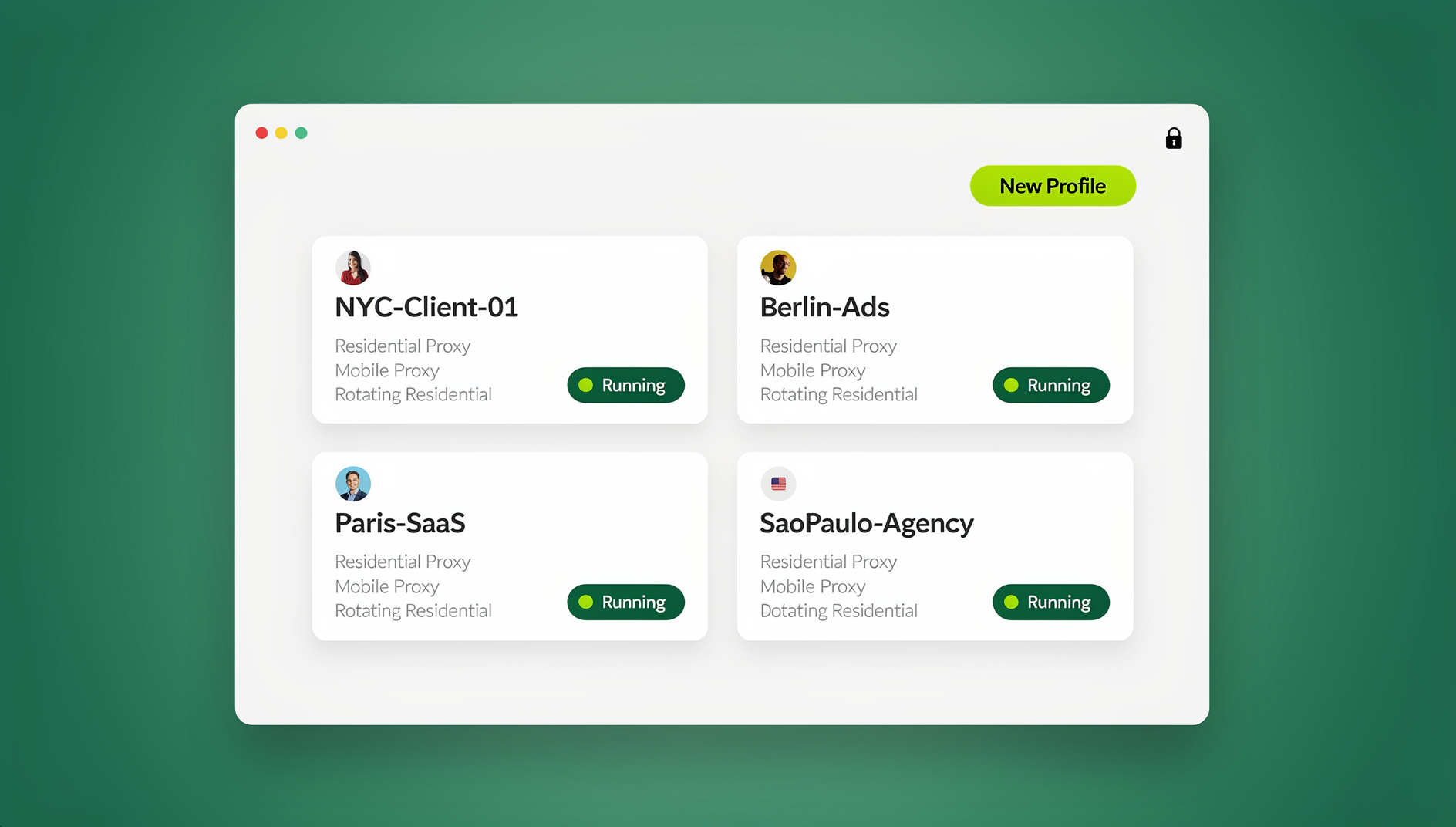
With Sendwin, you can keep separate, persistent AWS console sessions open side-by-side. Each session gets a unique, consistent hardware fingerprint and can be paired with a dedicated proxy. This ensures that your production session always originates from a dedicated IP address, satisfying strict corporate security requirements.
For on-call teams, Sendwin supports secure session sharing. You can share access to an active AWS console session with a colleague during an incident, allowing them to troubleshoot immediately without sharing passwords or passing manual MFA challenges. This platform is designed to help tech teams manage multiple accounts easily. These features act as valuable productivity hacks for cloud engineers.
AWS Console Management Comparison Table
The table below compares the three main methods of managing multiple AWS Console environments.
| Feature | Native Role Switcher | Standard Browser Profiles | Sendwin Sessions |
|---|---|---|---|
| Side-by-Side Viewing | No (replaces current tab) | Yes (limited by memory) | Yes (unlimited profiles) |
| Session History Limit | Max 5 roles | No limit | No limit |
| Proxy Support | No | No | Yes (per-session proxies) |
| Team Sharing | No | No | Yes (secure session sharing) |
| Fingerprint Separation | No | No | Yes (separate fingerprint per profile) |
| Resource Overhead | Low | High (multiple processes) | Low (cloud session option) |
Cost Management and Tagging Governance Across Accounts
As the number of AWS accounts in your organization grows, tracking spending and enforcing governance policies becomes a major administrative challenge.
Consolidated Billing Optimization
Use consolidated billing in AWS Organizations to track spending across all accounts from a single dashboard. Enforce a strict tagging strategy across your organization using keys like Environment (production, staging, development), Team (engineering, marketing), and CostCenter. This allows you to filter costs in AWS Cost Explorer and identify unusual spending quickly.
Enforcing Tagging Policies via SCPs
To ensure developers comply with tagging rules, configure Service Control Policies (SCPs) that block the creation of resources (like EC2 instances or S3 buckets) if they lack the required tags. This ensures compliance without requiring constant manual audits.
Automation and Infrastructure as Code (IaC) in Multi-Account Setups
Managing resources across multiple accounts manually is prone to errors. Using Infrastructure as Code (IaC) is essential to maintain consistency.
Cross-Account Provider Settings in Terraform
In Terraform, you can manage resources across multiple accounts by defining provider aliases with different assume-role configurations.
# Provider for Development Account
provider "aws" {
  alias  = "dev"
  region = "us-east-1"
  assume_role {
    role_arn = "arn:aws:iam::111111111111:role/TerraformDeploymentRole"
  }
}

# Provider for Production Account
provider "aws" {
  alias  = "prod"
  region = "us-east-1"
  assume_role {
    role_arn = "arn:aws:iam::222222222222:role/TerraformDeploymentRole"
  }
}
Multi-Account Deployment via AWS CDK Pipelines
For development teams using the AWS Cloud Development Kit (CDK), you can build deployment pipelines that automatically deploy resources across accounts. The pipeline compiles your code, deploys to a staging account for testing, and waits for manual approval before deploying to production, ensuring a safe release process.
Security Auditing and Compliance Best Practices
Security is the primary reason to implement a multi-account strategy. Follow these best practices to secure your environments:
- Never Use the Root Account: Lock away the root credentials for all member accounts. Enable MFA on the root user and use IAM Identity Center for all daily administrative access.
- Centralize Security Logging: Configure all accounts to send their CloudTrail logs, VPC Flow Logs, and GuardDuty findings to a dedicated, read-only security account.
- Enable AWS Config: Use AWS Config to monitor resource configurations across all accounts and alert security teams to any compliance violations (such as public S3 buckets).
- Implement Least Privilege: Grant users only the permissions necessary for their role. Regularly review permissions and revoke stale access to minimize security risks.
🏆 Send.win Verdict
Managing multiple AWS accounts doesn’t have to result in session timeout loops, credential conflicts, or the constant threat of executing commands in the wrong production console. While AWS SSO simplifies the login gateway, only Sendwin provides the absolute isolation needed to keep multiple consoles active side-by-side. By using isolated profiles in the Sendwin Browser desktop client or cloud browser sessions, you can coordinate development, staging, and production accounts securely without cross-contamination, starting at just $6.99/month on our annual Pro plan.
Try the free Send.win cloud demo — preview it for 3 minutes without signup, or 10 minutes a day with a free account, to secure your cloud environments and streamline administrative workflows.
Frequently Asked Questions
Can I log into two different AWS accounts in the same browser at the same time?
You cannot do this in standard browser tabs because AWS console cookies will overwrite each other, causing session conflicts. To run two accounts side-by-side, you must use separate browser profiles, private windows, or Sendwin’s isolated sessions.
What is the difference between IAM Identity Center and IAM Roles for multi-account access?
IAM Identity Center is a centralized single sign-on service that allows users to access different AWS accounts through a single login portal. IAM Roles are identities with permission policies that users or services can assume temporarily to perform tasks in other accounts.
How does consolidated billing work in AWS Organizations?
Consolidated billing combines the costs of all AWS accounts within an organization into a single monthly bill. This allows you to track spending from a central account and benefit from volume discounts by combining usage across all accounts.
How can I prevent deploying cloud resources to the wrong AWS account?
To avoid deployment mistakes, assign distinct color themes to your browser profiles or Sendwin sessions. Additionally, use Infrastructure as Code tools like Terraform with explicit provider configurations to ensure resources are deployed to the correct account.
What is the best way to share AWS console sessions securely with team members?
The most secure method is using Sendwin’s session sharing feature. This allows you to share an active, authenticated browser session with a colleague, letting them access the console during incidents without sharing password credentials or passing MFA challenges.
What are Sendwin’s subscription costs?
Sendwin has no free trial. The Pro plan costs $19/month or $83.88/year and includes 150 profiles, 5GB of proxy bandwidth. The Team plan costs $49/month or $251.88/year, adding 500 profiles, 20GB of proxy bandwidth, and 16 team seats. The first card purchase is covered by a 7-day money-back guarantee, and the only free option is the cloud demo.