Implementing **browser isolation** is the most effective way to eliminate web-based security threats by executing all active web code in a secure, containerized cloud environment rather than on your local device. By isolating all cookies, scripts, and media files, it shields endpoints from malware, zero-day exploits, and malicious downloads, ensuring that only a safe, rendered stream of pages reaches the user.
Understanding the Basics of Web-Based Threats
Modern internet browsing is filled with hidden dangers. Every time you open a web page, your browser downloads and runs complex scripts, styles, and media. While this creates a rich, interactive user experience, it also opens a backdoor for cybercriminals. Malicious websites can exploit vulnerabilities in your browser to execute unauthorized code on your computer, steal your cookies, or compromise your files.
Traditional cybersecurity tools like antivirus programs and firewalls try to scan files and detect known threats. However, these tools are reactive. They can only protect you from threats they already know about. When faced with a new, undiscovered vulnerability (a zero-day exploit) or highly customized malware, traditional tools often fail. To achieve real security, you need a proactive approach that stops threats before they ever touch your device.
This is where the concept of sandboxed web access becomes essential. Instead of trying to detect if a website is friendly or dangerous, a secure browsing strategy treats every page as hostile. By executing all code in a separate, temporary environment, you can surf the web freely without worrying about security alerts or data leaks. This shifting of the execution boundary is the core principle of modern enterprise defense.
What Is Browser Isolation and How Does It Work?
At its core, **browser isolation** is a technology that separates the act of browsing the web from the physical device you are using. Instead of running web code on your local computer, the code runs inside a virtual machine or a container. This container can be located on a remote cloud server or in a secure sandbox on your local operating system.
To understand this, think of a researcher handling a dangerous virus. They do not touch the virus directly. Instead, they put their hands inside a sealed glove box and work with the virus through a glass partition. You can see the virus and manipulate it, but it cannot touch you or escape into the room. Sandboxed browsing works the same way: the website runs inside a sealed virtual box, and you only see the visual output.
When you navigate to a website using this technology, the following steps occur behind the scenes:
- Your browser sends a request to open a specific web address.
- The isolation platform intercepts this request and spins up a clean, disposable container in the cloud.
- The container downloads the website’s HTML, CSS, JavaScript, and other files, executing them completely within its isolated environment.
- The platform renders the visual output of the website and streams it to your local screen in real-time.
- You can click, type, scroll, and interact with the page normally, but no code from the website ever runs on your local CPU.
- When you close the tab or end your session, the container is destroyed, along with any malware or cookies accumulated during the session.
5 Crucial Benefits of Browser Isolation
Moving your web activities to a containerized environment provides five major benefits that transform your digital security and daily workflows. Below, we explore each of these advantages in detail.
1. Absolute Protection Against Malware and Zero-Day Exploits
The primary benefit of sandboxed browsing is its ability to block 100% of web-based malware. Because no code executes on your device, malicious scripts cannot install ransomware, trojans, or spyware on your operating system. If you visit a compromised website that attempts a drive-by download, the attack occurs inside the remote container and cannot escape to your host computer.
This protection extends to zero-day exploits. Zero-day threats are vulnerabilities that developers do not know about yet, meaning no patches or antivirus signatures exist to stop them. When a zero-day exploit is executed in an isolated container, it might compromise the container itself, but because the container is destroyed when you close the tab, the threat is instantly neutralized without affecting your physical machine.
2. Eliminating Phishing and Malicious Links
Phishing is one of the most common ways organizations get breached. Attackers send emails with links to fake login pages or malicious sites. While training employees helps, human error is inevitable. Someone will eventually click a bad link.
With remote containerized browsing, clicking a phishing link is no longer catastrophic. The destination page loads in the cloud, isolated from your corporate network. Many advanced isolation platforms also render phishing sites in a read-only mode, preventing users from typing their passwords or credentials into unauthorized fields. This dual layer of visual security and input restriction shuts down phishing attacks before they can cause harm.
3. Secure Multi-Account Management and Fingerprint Separation
For modern businesses and marketers, managing multiple accounts on social media, e-commerce, or advertising platforms is a daily necessity. However, platforms track your browser fingerprint (your device configuration, canvas signatures, and IP address) to link and ban related accounts. If you log into multiple profiles from the same machine, you risk losing all of them.
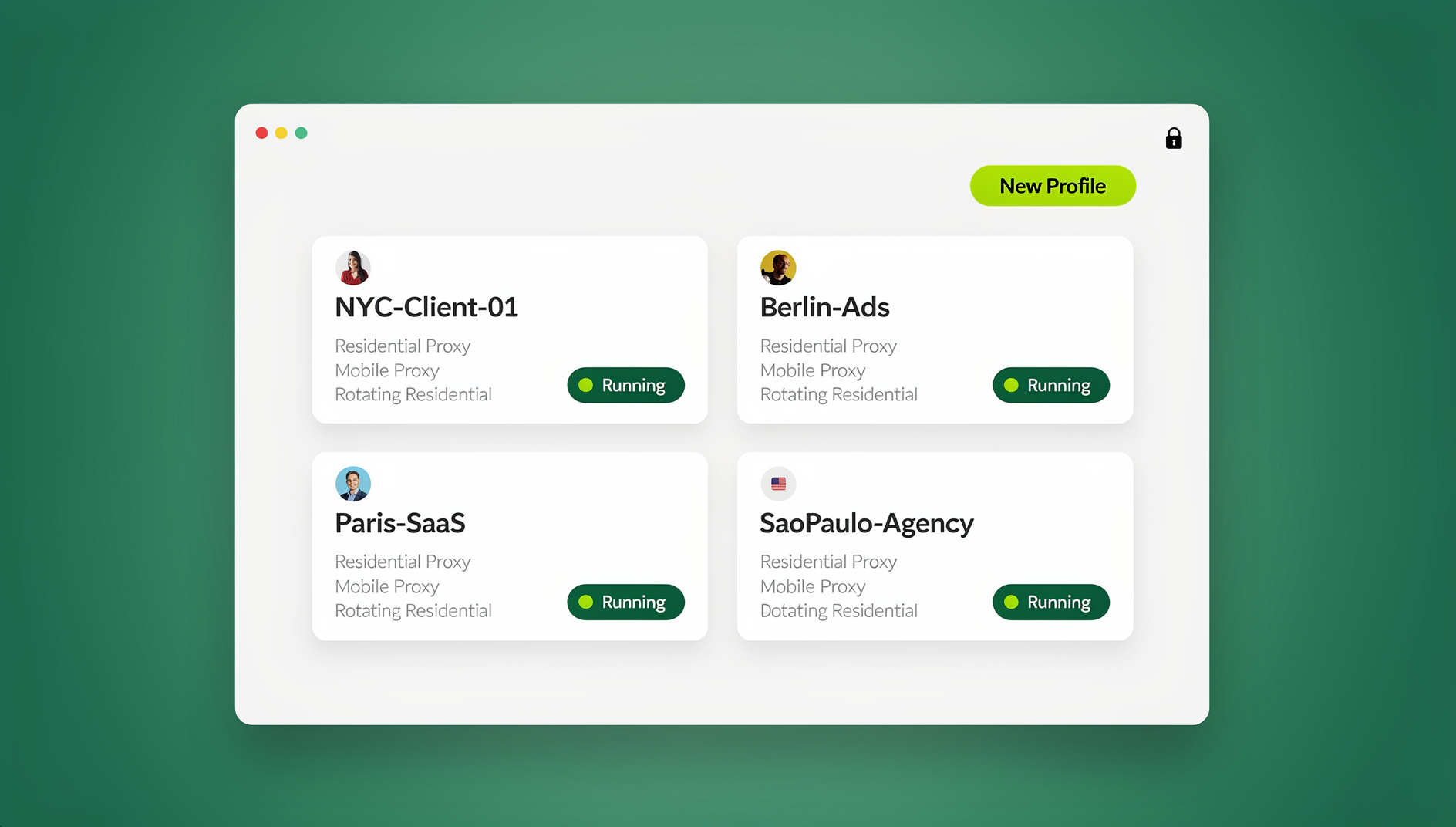
When setting up secure work profiles, combining browser isolation with a professional proxy browser setup allows you to assign unique IP addresses to each profile. This prevents websites from linking your activities based on network identity. Each container acts as a completely different computer, with its own cookie jar, local storage, and custom browser fingerprint. This enables you to run dozens of client accounts simultaneously without any fear of cross-contamination or automated bans.
4. Safe Access to Untrusted Content for Remote Teams
Remote work has expanded the attack surface for businesses. Employees access corporate resources from personal devices, home Wi-Fi networks, and public hotspots. Securing these endpoints is a massive challenge for IT administrators.
Implementing containerized browsing allows remote employees to access the web safely from any machine. To protect sensitive data from exposure, organizations are increasingly adopting advanced browser isolation technology. This methodology treats all web content as potentially untrusted and executes it inside a containerized remote environment. This ensures that even if an employee uses an unmanaged personal device, corporate systems and data remain protected from web-borne infections.
5. Bypassing Regional Restrictions and Network Censorship
Many businesses operate globally and need to verify ad campaigns, monitor local competitor pricing, or scrape public data across different countries. However, websites often block traffic coming from specific regions or data centers.
Because isolated browsing sessions run on cloud servers, you can select which cloud data center routes your traffic. By pairing your session with localized proxies, you can view the web exactly as a user in London, Tokyo, or New York would. This bypasses geographic blocks and network restrictions while maintaining complete anonymity, as websites only see the IP address of the remote container, not your true physical location.
Architectural Comparison: How Isolation Systems Differ
Not all isolation systems are built the same way. Understanding the different architectures is key to choosing the right tool for your specific needs. The three main types are Remote Browser Isolation (RBI), Local VM Isolation, and Client-Side Content Filtering.
Remote Browser Isolation (RBI)
Remote Browser Isolation is the gold standard for security. All code runs on a cloud server. There are two main ways to send the visual output to the user: pixel streaming and DOM mirroring. Pixel streaming sends a continuous video feed of the remote browser, which is highly secure but can consume significant network bandwidth. DOM mirroring sends a sanitized version of the page’s code, which is faster and uses less bandwidth but has a slightly larger attack surface. Both approaches keep the execution completely off your device.
For developer-centric workflows, running a sandboxed docker browser can isolate web scraping scripts from the local OS, preventing resource hogging and ensuring clean session states. By wrapping the container inside Docker, developers can automate session spin-up and teardown via simple API commands.
Local Virtual Machine Isolation
Local VM isolation runs a sandbox on your own computer. It uses virtualization software to create a mini-operating system that runs alongside your main OS. If you download a file, it stays inside the virtual machine. While this eliminates cloud server costs, it requires a very powerful local computer with plenty of RAM and CPU resources. It can also be slow to start, and if a hacker finds a virtual machine escape vulnerability, they can still compromise your main system.
In enterprise environments, implementing dedicated application isolation prevents compromised web sessions from escalating into full network intrusions. It compartmentalizes specific high-risk applications, like PDF readers or legacy browsers, inside local hardware-virtualized environments.
Client-Side Content Filtering
This is the weakest form of isolation. Rather than running the website in a separate container, a program intercepts the code before it loads in your browser. It removes known dangerous elements, like specific JavaScript scripts or active elements, and passes the remaining code to your browser. This is very fast and cheap, but it often breaks websites, and it cannot protect against new, unknown exploit techniques that use standard web elements.
Comparison of Isolation Architectures
| Feature | Remote Browser Isolation (RBI) | Local VM Isolation | Client-Side Filtering | Send.win Cloud Sessions |
|---|---|---|---|---|
| Security Level | Highest (Zero code on local device) | High (Requires VM container) | Low (Runs code on local device) | Highest (Fully remote sandbox) |
| Device Resource Usage | Near Zero (Uses server RAM/CPU) | Very High (Consumes local RAM/CPU) | Low (Standard browser load) | Near Zero (Streamed to device) |
| Website Compatibility | High (Matches modern Chromium) | Medium (VM limits GPU scaling) | Low (Breaks dynamic scripts) | High (Optimized Chromium core) |
| Proxy Routing Support | Excellent (Server-side mapping) | Poor (Requires local routing setup) | None (Uses default connection) | Excellent (Built-in proxy engine) |
| Setup Complexity | Low (Web-based dashboard) | High (Requires VM configuration) | Low (Simple browser setting) | Zero (No local install needed) |
Why Send.win Is the Ideal Browser Isolation Partner
While enterprise isolation systems are complex and expensive, Send.win makes secure browsing and profile isolation accessible to everyone. Whether you are an individual wanting to protect your personal computer, a marketer running multiple client campaigns, or a remote team sharing access to corporate tools, Send.win offers a powerful, cost-effective solution.
Send.win operates in two distinct, user-friendly modes:
- Sendwin Browser: A native desktop client designed for Windows, macOS, and Linux. It allows you to run multiple isolated browser profiles locally on your computer, utilizing your local hardware while keeping all cookies, storage, and fingerprints completely separated. This is perfect for high-speed, multi-session operations.
- Cloud Browser Sessions: Secure sessions that run entirely on Send.win’s remote servers and stream the visual output to your screen. This requires no installation at all. You can log in from a mobile phone, tablet, or public library computer and immediately access your secure browsing environments.
Pricing is transparent and affordable. Send.win offers paid plans with a 7-day money-back guarantee on your first card purchase, so you can test the full capability of the system. The Pro plan is priced at $19/mo (or $83.88/yr) and includes isolated profiles and proxy bandwidth. The Team plan is $49/mo (or $251.88/yr) and scales to more profiles, additional proxy bandwidth, and includes seats for password-free profile sharing and team collaboration.
Unlike traditional tools that require you to buy expensive external proxy services, Send.win has proxy management built directly into its core interface. You can easily assign specific residential or datacenter proxies to individual profiles, ensuring that each session has a distinct geographic IP address and local timezone matching. This built-in integration makes setting up an isolated multi-account workspace simple and quick.
Furthermore, Send.win does not offer an automation interface: there is no API, SDK, headless mode or Selenium/Puppeteer/Playwright support on any plan. Each profile keeps its own consistent browser fingerprint, along with separate cookies and storage, so your browsing sessions stay contained and organised.
🏆 Send.win Verdict
Traditional security tools cannot keep pace with modern web exploits, phishing, and fingerprint tracking. Send.win delivers robust browser isolation through a fast desktop client and flexible cloud browser sessions, ensuring web code never executes directly on your physical hardware. With built-in proxy support and affordable plans starting at just $6.99/mo, it is the ultimate tool for both individual security and high-volume multi-account administration.
Try Send.win today — Plans start at $19/mo, and your first card purchase is covered by a 7-day money-back guarantee. You can also preview it free in the cloud demo.
Frequently Asked Questions
What is browser isolation?
It is a security method that runs all web page code in a contained virtual environment, either on a remote cloud server or in a local sandbox, streaming only a safe visual representation to the user’s screen.
Does browser isolation slow down my internet speed?
Modern remote container platforms add only a tiny amount of latency, usually between 10 to 50 milliseconds, which is not noticeable for normal activities like reading articles, checking social media, or running automated tasks.
What is the difference between the Sendwin Browser and cloud sessions?
The Sendwin Browser is a native desktop client that runs isolated profiles on your local machine, while cloud browser sessions run entirely on remote servers in the cloud, needing no software installation at all.
How much does Send.win cost?
Send.win offers no free trial; paid plans start with a 7-day money-back guarantee on your first card purchase. The Pro plan costs $19/mo (or $83.88/yr), and the Team plan costs $49/mo (or $251.88/yr), providing profile sharing and team collaboration.
Do I need to buy separate proxies for multi-account management?
While you can connect your own external proxies, Send.win includes built-in proxy support and provides allocated monthly proxy bandwidth on paid plans to help you route profiles through clean IP addresses easily.
Does Send.win offer an Automation API?
No. Send.win has no automation interface: there is no API, SDK, headless mode or Selenium/Puppeteer/Playwright support on any plan, including the Pro plan ($19/mo) and the Team plan ($49/mo).
How is browser isolation different from a VPN?
A VPN only encrypts your network connection and masks your IP address, but it does not stop web code from executing on your computer. Isolation actually runs the web code in a separate sandbox, protecting you from malware and zero-day exploits.
Adopting a robust security model is no longer optional in today’s threat landscape. By moving your daily web activities into isolated containers, you shield your systems from malicious software, prevent tracking scripts from cataloging your device, and build a secure platform for managing your business profiles. Incorporating Send.win into your operational framework ensures that your endpoints remain secure, your teams collaborate efficiently, and your online resources are fully protected.